
Lecture
To benefit from using implemented standards and processes, you must constantly monitor that everything is being done according to the established agreement, and that you are getting exactly the result you planned. Anything that is not used regularly sooner or later ceases to exist. This is a law of human behavior.
The Capability Maturity Model Integration (CMMI - Capability Maturity Model Integration) achieves this by means of audits (CMMI defines an audit as a Quality Assurance activity, because this model tests the processes, not the product). When using agile methodologies, for example Extreme Programming or SCRUM, a coach is hired for this purpose. It does not matter how the check itself is carried out or what you call it – all of it brings quality benefits.
If you encounter a situation where an adopted standard or process is being ignored, you need to find out why this is happening, because the reasons can be completely different. For example:
Every violation of a standard or process is an opportunity to study it and improve it so that it meets the needs of the team.
Capability Maturity Model Integration (CMMI) — is a set of models (methodologies) for improving processes in organizations of different sizes and types of activity. CMMI contains a set of recommendations in the form of practices, the implementation of which, in the opinion of the model's developers, makes it possible to achieve the goals necessary for the full implementation of certain areas of activity.
The set of CMMI models includes three models: CMMI for Development (CMMI-DEV), CMMI for Services (CMMI-SVC) and CMMI for Acquisition (CMMI-ACQ). The best known is the CMMI for Development model, aimed at organizations engaged in the development of software, hardware, and complex systems. At the moment, two versions of the models are in effect: three separate models of version 1.3 (released in November 2010) and a partially published unified version 2.0 (released at the end of March 2018).
CMMI is a development of the CMM methodology, which was developed from the second half of the 1980s by the Software Engineering Institute (SEI) at Carnegie Mellon University. Since January 2013, all activity related to the CMMI models has been transferred from SEI to the CMMI Institute, specially created for this purpose at Carnegie Mellon University. Later (from 2016) the CMMI Institute became a division of the commercial association ISACA.
In 2007, the first authorized (later — certified) CMMI instructor appeared in Russia, and in 2008 the first Russian-speaking Lead Appraiser. As of July 2018, one lead appraiser and one certified instructor (in the person of one specialist) are certified by the CMMI Institute in Russia. There are also several specialists in Russia who hold CMMI Associate certification (a certification confirming a high level of knowledge of the model, but not granting the right to conduct official training and/or appraisals).
CMMI defines 22 process areas. For each of the process areas there is a set of goals that must be achieved when implementing CMMI in that process area. Some goals are unique — they are called specific. Generic goals apply to all process areas. Goals are achieved by implementing practices (the model's recommendations), or adequate alternatives to them. Depending on their relation to a particular goal, practices are divided into specific and generic.
There are two representations of CMMI: continuous and staged. When implementing CMMI practices using the continuous representation, the choice of process areas is not fixed (although the model contains recommendations on the order for implementing the areas). To assess the level of institutionalization of a process area, a capability level scale from 0 to 5 (six levels) is used. The staged representation defines five (1-5) maturity levels of an organization. To reach each maturity level (except the first), it is necessary to meet the requirements for achieving the goals of a specific set of process areas in order to achieve the corresponding goals. The first maturity level is not defined in the model.
Any process improvement implies a smooth/gradual process. In CMMI these stages are formalized — there are 5 maturity levels, each of which indicates the maturity of the organization's processes.
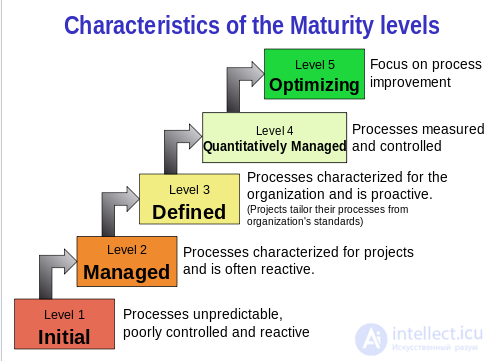
| 5. Focus on process improvement | Optimizing |
| 4. Processes are measured and controlled | Quantitatively managed |
| 3. Processes are defined at the level of the entire organization. Processes are performed proactively | Defined |
| 2. Processes are defined at the project level. Processes often appear in response to certain events | Managed |
| 1. Processes are unpredictable, poorly controlled. Processes appear in response to certain events | Initial |

Comments