
Lecture
In programming a bug (English bug — original meanings: a bedbug, any insect, a virus) — is a slang word, usually denoting an error in a program or system, because of which the program produces unexpected behavior and, as a result, an unexpected outcome. Most bugs arise from mistakes made by the program's developers in its source code, or in its design. Some bugs also arise from incorrect operation of the compiler, which produces incorrect code. A program that contains a large number of bugs and/or bugs that seriously limit its operability is called unstable or, in slang, «glitchy», «buggy», «bugged», «flaky», «bug(g)ed»).
The term «bug» is usually used in relation to errors that manifest themselves at the program's runtime stage, as opposed to, for example, design errors or syntax errors. A report containing information about a bug is also called an error report or a problem report (English bug report). A report about a critical problem (English crash) that causes the program to terminate abnormally is called a crash report (English crash report).
«Bugs» are localized and eliminated during the process of testing and debugging a program.
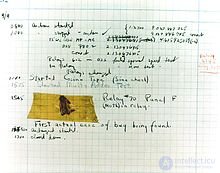
An entry in a technical log
In the sense of an elusive technical fault, the word bug (English bug) was used long before the appearance of computers by staff of telegraph and telephone companies in relation to malfunctions of electrical equipment and radio engineering. In 1878 Thomas Edison wrote:
«It has been just so in all of my inventions. The first step is an intuition, and comes with a burst, then difficulties arise — this thing gives out and then that — «bugs» — as such little faults and difficulties are called — show themselves and months of intense watching, study and labor are requisite before commercial success or failure is certainly reached».
During the Second World War the word «bugs» was used for problems with radar electronics.
According to one version, in relation to a software error this term was first applied in 1946 by Grace Hopper, who was programming the Harvard Mark II computer at Harvard University (English) Russian.. Having traced an error in the program's operation down to an electromechanical relay of the machine, she found a moth stuck between the contacts. The extracted insect was taped into the technical logbook with an accompanying note: «First actual case of bug being found» (English First actual case of bug being found) .
Depending on the stage of software development at which an error is detected, the following are distinguished:
By size:
By time of appearance:
By place and direction:
Depending on the nature of the error, the program and the runtime environment, an error may manifest itself immediately, or, on the contrary, remain unnoticed for a long time (for example, the Year 2038 problem).
Also an error may manifest itself as a vulnerability, making unauthorized access to the system or a DoS attack possible.
To debug a program (English debugging), software developers use special debugger programs (English debugger). For example, in the Windows operating system you can use the WinDbg program from the Microsoft Debugging Tools for Windows package. For GNU/Linux and a number of other UNIX-like operating systems there is the GDB (GNU Debugger) debugger.
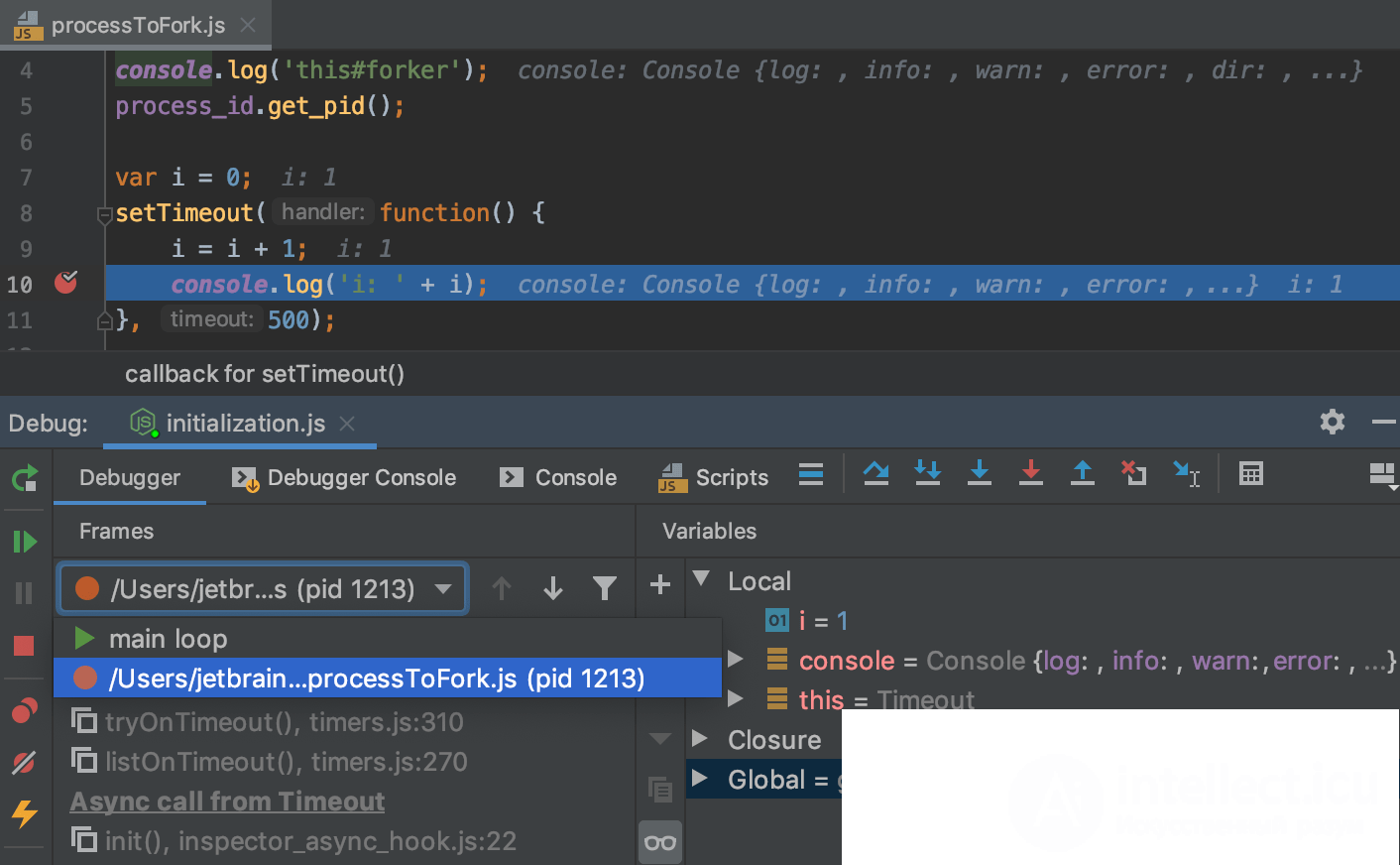
Fig. an example of debugging an application (debugging)
The bulk of bugs are usually debugged at the stage of compiling and testing the program. However, some errors still make it into the release and manifest themselves on end users' computers during the operation of the software. To improve the quality of software, special programs are used whose purpose is to catch an error in the target application, collect the necessary information about its symptoms and send a report over the internet to the developers of that software.
For example, the Windows operating system has the Dr. Watson utility built in, which by default catches errors in the user's applications and sends a report to a special Microsoft server. Similar libraries such as Breakpad and CrashRpt can also be cited as examples.
An error tracking system (English bug tracking system) — an application program designed to help software developers (programmers, testers, and others) keep track of and control errors and malfunctions found in programs, user wishes, and also to monitor the process of fixing these errors and the fulfillment or non-fulfillment of the wishes.
The main component of such a system is a database containing information about detected defects. This information may include:
In addition, advanced systems provide the ability to attach files that help describe the problem (for example, a memory dump or a screenshot).
A bug or defect report - this is a document describing a situation or a sequence of actions that led to incorrect behavior of the object under test, indicating the causes and the expected result.
To obtain more detailed information about bug reports, we recommend the following information to your attention; having reviewed it you will get a comprehensive picture of the structure, the features of writing, and some other nuances needed to write good bug reports:
Different defect management systems offer us different fields to fill in and different structures for describing defects. The table below is an attempt to show what, based on the experience we have gained, we recommend that you use as a bug report template.
| Header | |
|
Short description (Summary) |
A short description of the problem, clearly indicating the cause and type of the error situation. |
| Project (Project) | The name of the project being tested |
| Application component (Component) | The name of the part or function of the product being tested |
| Version number (Version) | The version in which the error was found |
| Severity (Severity) |
The most common is a five-level system for grading the severity of a defect:
|
| Priority (Priority) |
Defect priority:
|
| Status (Status) | The status of the bug. Depends on the procedure used and the bug workflow and life cycle |
| Author (Author) | The creator of the bug report |
| Assigned To (Assigned To) | The name of the employee assigned to resolve the problem |
| Environment | |
| OS / Service Pack, etc. / Browser + version / ... | Information about the environment in which the bug was found: the operating system, service pack, for WEB testing - the name and version of the browser, etc. |
| ... | |
| Description | |
| Steps to Reproduce (Steps to Reproduce) | The steps by which the situation that led to the error can easily be reproduced. |
| Actual Result (Result) | The result obtained after going through the reproduction steps |
| Expected Result (Expected Result) | The expected correct result |
| Additions | |
| Attachment (Attachment) |
A file with logs, a screenshot, or any other document that can help clarify the cause of the error or indicate a way to solve the problem
|
Different bug-tracking systems offer us different ways of describing the severity and priority of a bug report, but the meaning put into these fields stays unchanged. Everyone knows a bug tracker like Atlassian JIRA. In it, starting from some version, instead of using the Severity and Priority fields at the same time, only Priority was kept, which combined the properties of both fields: Originally, JIRA did have both a Priority and a Severity field. The Severity field was removed for a number of reasons...So those who are used to working with JIRA do not always understand the difference between these concepts, since they have had no experience using them together. Based on personal experience, I insist on separating these concepts, or more precisely on using both the Severity and Priority fields, since the meaning put into them is different:
Severity (Severity) - this is an attribute characterizing the impact of a defect on the operability of the application.
Priority (Priority) - this is an attribute indicating the order in which a task should be performed or a defect should be fixed. It can be said that this is a tool for a manager planning work. The higher the priority, the faster the defect needs to be fixed.
S1 Blocker (Blocker)
A blocking error that puts the application into a non-working state, as a result of which further work with the system under test or its key functions becomes impossible. Solving the problem is necessary for the further functioning of the system.
S2 Critical (Critical)
A critical error, incorrectly working key business logic, a hole in the security system, a problem that led to a temporary server crash or that puts some part of the system into a non-working state, with no possibility of solving the problem using other entry points. Solving the problem is necessary for further work with the key functions of the system under test.
S3 Major (Major)
A major error, part of the main business logic works incorrectly. The error is not critical, or there is a way to work with the function under test using other entry points.
S4 Minor (Minor)
A minor error that does not violate the business logic of the part of the application under test, an obvious user interface problem.
S5 Trivial (Trivial)
A trivial error that does not concern the application's business logic, a poorly reproducible problem, barely noticeable through the user interface, a problem with third-party libraries or services, a problem that has no effect at all on the overall quality of the product.
P1 High (High)
The error must be fixed as quickly as possible, since its presence is critical for the project.
P2 Medium (Medium)
The error must be fixed; its presence is not critical, but it requires a mandatory fix.
P3 Low (Low)
The error must be fixed; its presence is not critical, and it does not require an urgent fix.
The order of fixing errors by their priority:
High -> Medium -> Low
We want to offer you the following approach to defining requirements for the number of open bugs:
All requirements for open errors are agreed upon and documented at the stage of deciding on the quality of the product being developed. As an example of documenting such requirements, there is the item Test completion criteria in the test plan
A bug report - is a technical document, and in this regard we want to note that the language used to describe the problem should be technical. Correct terminology should be used when naming user interface elements (editbox, listbox, combobox, link, text area, button, menu, popup menu, title bar, system tray, etc.), user actions (click link, press the button, select menu item, etc.) and the results obtained (window is opened, error message is displayed, system crashed, etc.).
Note that the mandatory fields of a bug report are: short description (Bug Summary),severity (Severity), steps to reproduce (Steps to reproduce), result (Actual Result),expected result (Expected Result). Below are the requirements and examples for filling in these fields.
The name speaks for itself. In one sentence you need to fit the meaning of the whole bug report, namely: briefly and clearly, using correct terminology, say what does not work and where. For example:
In addition, we suggest that you study the "Where? What? When?" principle, described on the pages of the"QA Nest" blog:
"What does this principle consist of?
Compose a sentence in which the facts of the defect are laid out in the following order:
- Where?: In what place of the user interface or of the software product's architecture the problem is located. Moreover, start the sentence with a noun, not a preposition.
- What?: What happens or does not happen according to the specification or your understanding of the normal operation of the software product. Here, indicate the presence or absence of the object of the problem, not its content (that is given in the description). If the content of the problem varies, all known variants are given in the description.
- When?: At what moment in the operation of the software product, upon the occurrence of what event, or under what conditions, the problem manifests itself.
Why must the order be exactly this?
In this form, unfamiliar defects are more convenient to sort by summary, as practice shows (since it is most likely among the defects of other engineers that a search for duplicates will be carried out). If you think differently - come up with your own order, but it must become uniform for all project members without exception, otherwise you will not achieve the necessary result."
In a nutshell, it can be noted that if a problem is found in the application's key functionality and after it occurs the application becomes completely unavailable, and further work with it is impossible, then it is blocking. Usually all blocking problems are found during the initial verification of a new version of the product (Build Verification Test, Smoke Test), since their presence does not allow testing to be carried out fully. If testing can be continued, then the severity of this defect will be critical. As for major, minor and trivial errors, the matter is fairly transparent and, in our opinion, does not require additional explanation.
It is very important to clearly describe all the steps, mentioning all the input data (username, data for filling in the form) and intermediate results.
For example:
Steps to Reproduce
1. Log into the system: User Tester1, password xxxXXX
--> Login to the system performed
2. Click the Profile link
--> The Profile page opened
3. Enter New username: Tester2
4. Click the Save button
Result
An error appeared on the screen. The new username was not saved
Expected Result
The profile page reloaded. The new username value is saved.
Insufficient data provided
The same problem does not always manifest itself with all input values and under any user logged into the system, so it is strongly recommended to include all necessary data in the bug report
Determining severity
Very often there is either an overestimation or an underestimation of a defect's severity, which can lead to an incorrect order when solving the problem.
Description language
When describing a problem, incorrect terminology or complex turns of phrase are often used, which can mislead the person responsible for solving the problem.
Absence of an expected result
In cases where you have not indicated what the required behavior of the system should be, you waste the developer's time searching for this information, thereby slowing down the fix of the defect. You must indicate a clause in the requirements, a written test case, or your personal opinion, if this situation was not documented.
The table described below shows the main fields of a bug report and the role of the employee responsible for filling in that field. Fields required to be filled in are highlighted in red:
| Field | Responsible for filling in the field |
|---|---|
| Short description (Summary) | The author of the bug report (usually the Tester) |
| Project (Project) | The author of the bug report (usually the Tester) |
| Application component (Component) | The author of the bug report (usually the Tester) |
| Version number (Version) | The author of the bug report (usually the Tester) |
| Severity (Severity) | The author of the bug report (usually the Tester), however this attribute can be changed by a manager above |
| Priority (Priority) | The project manager or the manager responsible for developing the component the bug report is written against |
| Status (Status) | The author of the bug report (usually the Tester), but many bug-tracking systems set the status by default |
| Author (Author) | Set by default; if not, the name of the bug report's author is indicated |
| Assigned To (Assigned To) | The project manager or the manager responsible for developing the component the bug report is written against |
| OS / Service Pack, etc. / Browser + version / ... | The author of the bug report (usually the Tester) |
| Steps to Reproduce (Steps to Reproduce) | The author of the bug report (usually the Tester) |
| Actual Result (Result) | The author of the bug report (usually the Tester) |
| Expected Result (Expected Result) | The author of the bug report (usually the Tester) |
| Attachment (Attachment) |
The author of the bug report (usually the Tester), as well as any team member who believes the attached data will help fix the bug
|
As a rule, an error tracking system uses one variant or another of the «lifecycle» of an error, whose stage is determined by the current state, or status, in which the error is located.
A typical defect lifecycle:
The system may give the administrator the ability to configure which users can view and edit errors depending on their state, move them to another state, or delete them.
In a corporate environment, an error tracking system can be used to obtain reports showing the productivity of programmers in fixing errors. However, this approach often does not give sufficiently accurate results, because different errors have varying degrees of severity and complexity. At the same time, the severity of a problem has no direct relationship to the complexity of fixing the error.
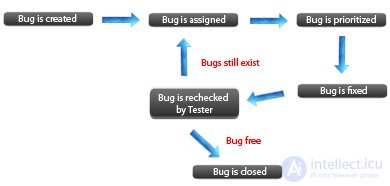
Fig. The lifecycle of a bug
Before starting the description of the elementary lifecycle of a bug, we suggest looking at the following flowchart, showing the main statuses and possible transitions from status to status over the course of its existence:
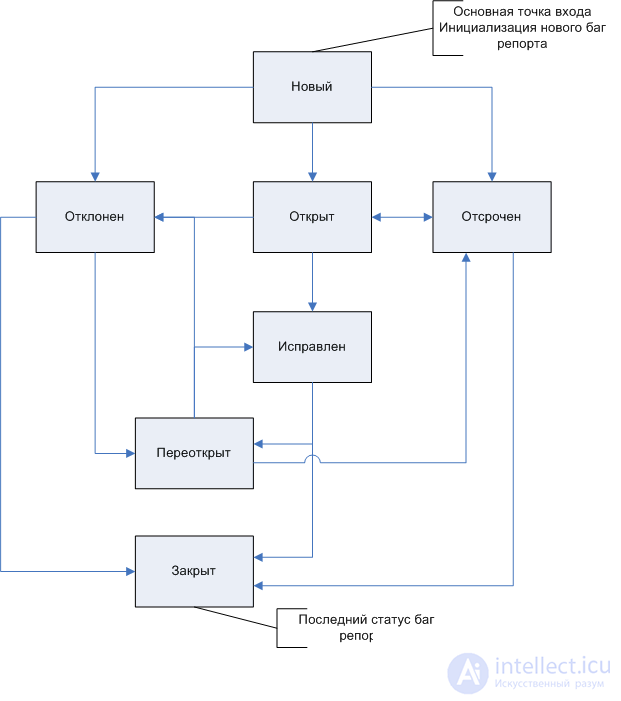
Now let's move on to describing this diagram.
Suppose you found a bug and registered it in the bug-tracking system. According to our flowchart it will get the status “New”. The tester responsible for validating new bug reports, or the project coordinator (depending on the distribution of roles in your team), can move it into one of the following statuses:
Let's now go through each of the options in order.
* * *
We want to note that this scheme is greatly simplified. For greater clarity, and possibly for the convenience of working on the project, you can add additional statuses and transitions, especially since modern bug-tracking systems allow this to be done. However, keep in mind that overly convoluted transition schemes and unnecessary statuses can significantly complicate life.
Note 1: in some bug-tracking systems a newly created bug report immediately gets the “Open” status without additional validation
Note 2: many bug-tracking systems allow reopening closed bugs, however I personally am against this practice, so I did not describe such a transition in the lifecycle presented above
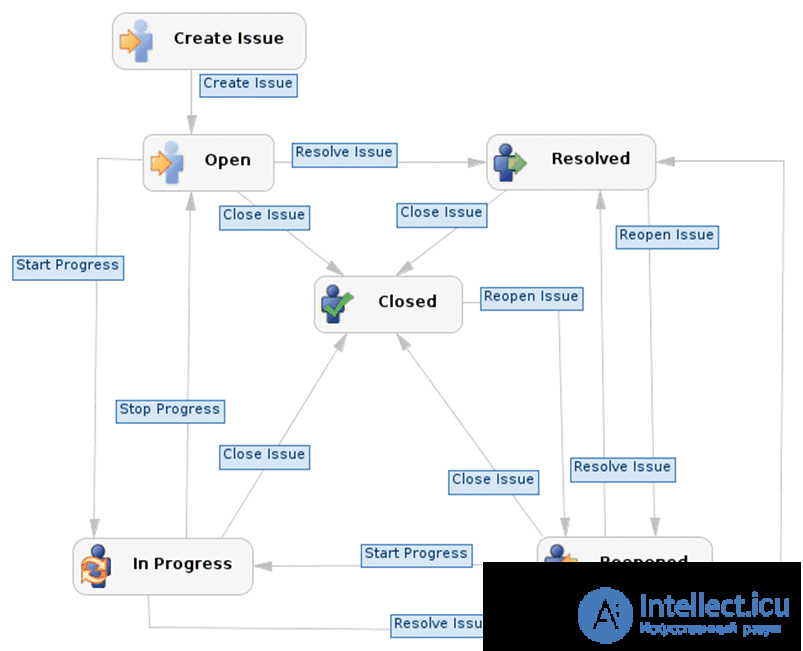
Note 3: The lifecycle discussed above is based on the assumption that there is someone on the team responsible for assigning bug reports. If there is no such role on the project, then bugs are assigned by the developers themselves, and then, to avoid confusion, it makes sense to introduce one more intermediate status “In progress” (In progress), showing that this bug report has already been assigned and is at the fixing stage. An example implementation of such a lifecycle based on JIRA can be seen in the following figure:
Freely distributed
Proprietary
Other

Comments