
Lecture
Climatology (from Ancient Greek κλίμα (gen. κλίματος) — inclination, and Ancient Greek λόγος — study, science) is a science, a branch of meteorology, that studies climate — the totality of weather characteristics over a long-term period, characteristic of a particular place or of the Earth as a whole. Climatology examines the patterns of climate formation, their distribution over the Earth's territory, their preceding history, and forthcoming changes.
Climatology – the science studying the conditions of climate formation and the climatic regime of various countries and regions. Climatology examines the relationships between individual climate-forming factors and their interaction with the underlying surface.
Applied branches of climatology:
1. Agroclimatology - the study of climate as a factor of fertility.
2. Bioclimatology - the study of the influence of climate on living organisms.
3. Medical climatology - the influence of climate on the course of diseases.
Tasks of climatology:
Meteorology - the science of the Earth's atmosphere and the processes occurring in it.
The main branch of meteorology is atmospheric physics. It studies the composition and structure of the atmosphere, heat exchange, the thermal regime of the atmosphere, moisture circulation, phase transformations of water in the atmosphere, the movement of air masses, as well as acoustic, optical, and electrical phenomena in the atmosphere.
Within meteorology the following are distinguished:
1. Actinometry - this branch studies the transfer and transformation of solar energy in the atmosphere.
2. Aerology studies the physical processes in the atmosphere above the friction layer.
3. Synoptic meteorology - studies the influence of large-scale atmospheric processes and deals with weather forecasting.
4. Dynamic meteorology - engaged in the theoretical study of various atmospheric processes.
Tasks of meteorology:
Climatology and meteorology are closely related to one another, so they are often studied within a single course.
Understanding the patterns of climate is possible on the basis of the general laws to which atmospheric processes are subject.
The quantities that characterize the physical state of the atmosphere and atmospheric processes are called meteorological elements. The meteorological elements are: temperature, humidity, wind speed, cloudiness, pressure.
Atmospheric processes characterized by a certain combination of meteorological elements are called atmospheric phenomena (thunderstorm, blizzard, fog, whirlwind, tornado, etc.).
The state of the atmosphere continuously changes in space and time. The state of the atmosphere at a specific moment in time, or over a certain period of time, characterized by a specific set of meteorological elements and phenomena, is called weather.
The concept of climate is related to the concept of weather. Climate (from the Greek for the inclination of the sun's rays) is a statistical concept, the long-term regime of weather, one of the main characteristics of the geography of a locality. Climate is characterized not only by the long-term regime of weather, but also by the weather conditions possible in a given locality.
Factual information about weather and climate is obtained through observation. Meteorological observatories, aviation, satellite, and other observations are used for this purpose.
Unlike meteorology, which focuses on short-term weather systems lasting no more than a few weeks, climatology studies the frequency and trends of these systems. It studies the periodicity of weather phenomena over many years and millennia, as well as changes in long-term average weather conditions depending on atmospheric conditions. Climatologists study both the nature of climate — local, regional, or global — and the natural or anthropogenic factors causing its change. Climatology examines the past and can help predict future climate changes.
Phenomena of climatological interest include the atmospheric boundary layer, circulation patterns, heat transfer (radiative, convective, and latent), the interaction of the atmosphere with oceans and the land surface (in particular, vegetation, land use, and topography), as well as the chemical and physical composition of the atmosphere
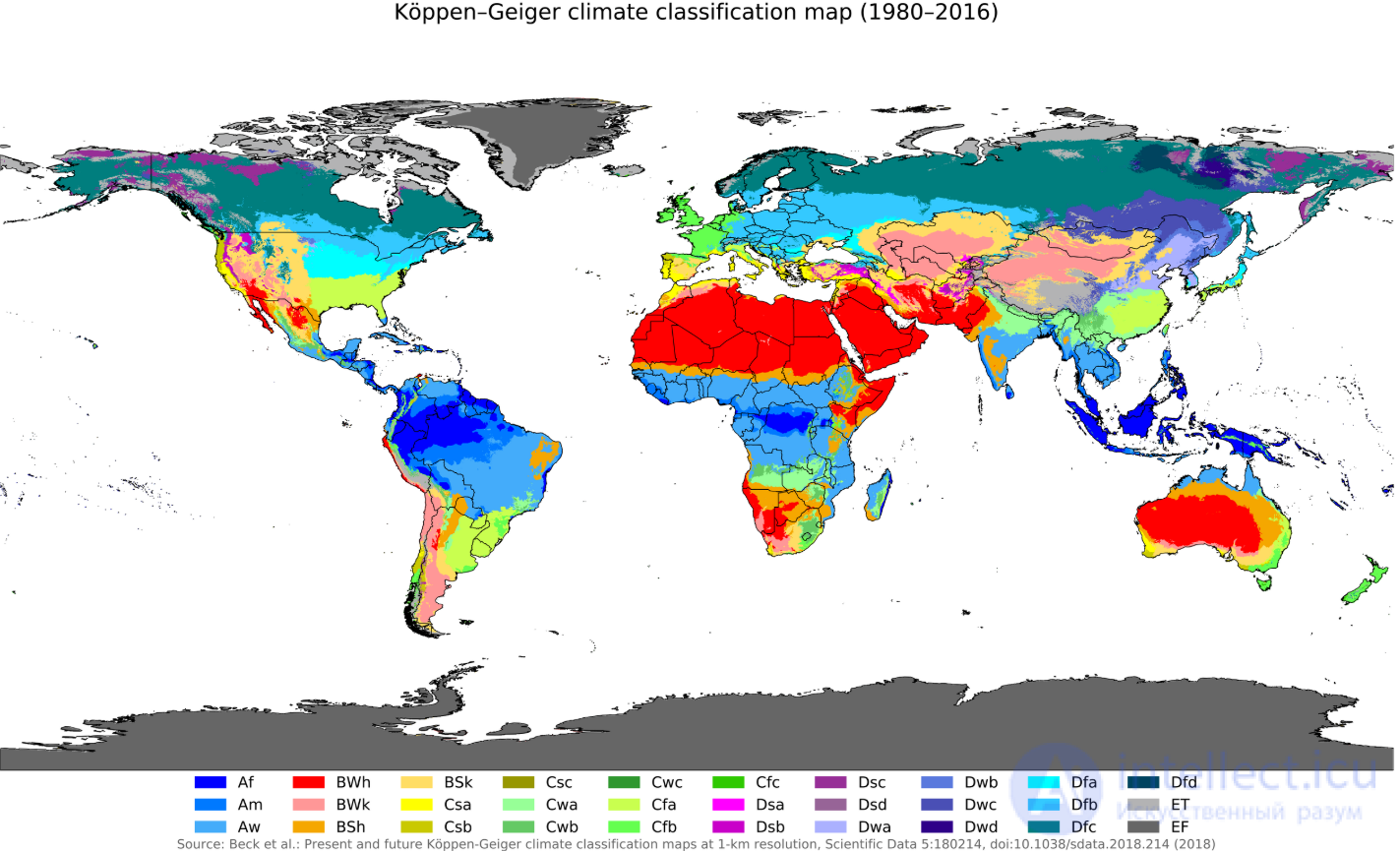
To draw conclusions about the features of a climate, long-term series of weather observations are necessary. In temperate latitudes, 25-50-year trends are used, while in tropical ones — shorter periods. Climatic characteristics are derived from observations of meteorological elements, the most important of which are atmospheric pressure, wind speed and direction, air temperature and humidity, cloudiness, and precipitation. In addition, the duration of solar radiation, the length of the frost-free period, visibility range, the temperature of the upper layers of soil and water bodies, evaporation of water from the Earth's surface, the height and condition of snow cover, various atmospheric phenomena, total solar radiation, radiation balance, and much more are studied.
Applied branches of climatology use the climate characteristics necessary for their purposes:
Complex indicators determined from several key meteorological elements are also used, namely various coefficients (continentality, aridity, moistening), factors, and indices.
The long-term average values of meteorological elements and their complex indicators (annual, seasonal, monthly, daily, etc.), their sums, and periods of recurrence are considered climatic norms. Discrepancies from these in specific periods are considered deviations from these norms.
The study of modern climate includes meteorological data accumulated over many years, such as records of precipitation, temperature, and atmospheric composition. Knowledge about the atmosphere and its dynamics is also embodied in models, both statistical and mathematical, which help integrate various observations and check how well they correspond to one another. Modeling is used to understand the climate of the past, present, and potential future.
Climate research is complicated by large scales, long time periods, and the complex processes governing climate. Climate is governed by physical principles that can be expressed in the form of differential equations. These equations are interrelated and nonlinear, so approximate solutions are obtained using numerical methods to create global climate models. Climate is sometimes modeled as a stochastic process, but this is generally considered an approximation to processes that are otherwise too complex to analyze.
Collecting a long history of climate variables is essential for studying climate. Climatology deals with aggregated data recorded by meteorologists. Scientists use both direct and indirect observations of climate, from Earth observation satellites and scientific instruments such as a global network of thermometers, to prehistoric ice extracted from glaciers. Since measurement technology changes over time, data records often cannot be compared directly. Because cities tend to be warmer than the surrounding areas, urbanization has necessitated constant adjustment of data to account for the urban heat island effect.
Climate models use quantitative methods to model the interaction of the atmosphere, oceans, land surface, and ice. They are used for a wide variety of purposes: from studying the dynamics of the weather and climate system to forecasting future climate. All climate models balance, or nearly balance, incoming energy in the form of shortwave (including visible) electromagnetic radiation to Earth with outgoing energy in the form of longwave (infrared) electromagnetic radiation from Earth. Any imbalance leads to a change in the Earth's average temperature. Most climate models account for the radiative forcing of greenhouse gases such as carbon dioxide. These models predict a tendency toward rising surface temperatures, as well as a faster rise in temperature at high latitudes.
Models can be relatively simple or complex:
In addition, they are available at various resolutions, ranging from >100 km to 1 km. High resolution in global climate models requires large computational costs, and only a few global datasets exist. Examples include ICON or data obtained by mechanical downscaling methods, such as CHELSA (Climatologies at High resolution for the Earth's Land Surface areas).
In ancient China, India, and Egypt, attempts were made at regular meteorological observations, and there existed a rudimentary understanding of atmospheric processes and climate. The most outstanding atmospheric phenomena were recorded in historical chronicles.
Perhaps the very first treatise on climate was "Airs, Waters, Places," written by Hippocrates around 400 BC. This work commented on the influence of climate on human health and cultural differences between Europe and Asia. The idea that climate controls which countries prosper, depending on their climate, or climatic determinism, remained influential throughout history.
The first fundamental work on climatology in a geographical aspect — "Ahsan al-Taqasim fi Ma'rifat al-Aqalim" ("The Best Divisions for Knowledge of the Regions") — was created by the Arab geographer Shams al-Din al-Muqaddasi around 985. The Chinese scholar Shen Kuo (1031—1095) concluded that climate naturally changed over a significant span of time, after observing petrified bamboo found near Yanzhou (modern Yan'an, Shaanxi Province), an area with a dry climate unsuitable for bamboo growth.
Humboldt highly praised the work of José de Acosta on research in the field of meteorology and physics and, for his many discoveries, honored him with the title of one of the Founders of Geophysics. In his History (1590), considerations on the curvature of isothermal lines and on the distribution of heat depending on latitude, on the direction of currents, and on many physical phenomena first appeared: differences in climates, volcanic activity, earthquakes, types of winds, and the causes of their occurrence.
The invention of thermometers and barometers during the scientific revolution made it possible to keep systematic records, which began as early as 1640–1642 in England. Among the first climate researchers was Edmund Halley, who published a map of the trade winds in 1686 after a voyage to the southern hemisphere. Benjamin Franklin (1706–1790) was the first to map the course of the Gulf Stream for use in sending mail from North America to Europe. Francis Galton (1822–1911) introduced the term "anticyclone". Helmut Landsberg (1906–1985) promoted the use of statistical analysis in climatology.
At the beginning of the 17th century, the first meteorological instruments were invented and instrumental observations became possible (the invention of the thermometer and barometer).
M.V. Lomonosov is considered the first meteorologist and climatologist in Russia. He established the influence of winds blowing from the seas on the coastal climate. He also explained the severe winters in Siberia and created a theory of atmospheric electricity.
In 1686, Edmund Halley, after a voyage to the southern hemisphere, compiled and published a map of the trade winds. Benjamin Franklin — one of the titans of the 18th century — was the first to plot the course of the Gulf Stream on a map for use in communication between the United States and Europe. Francis Galton introduced the term anticyclone. Helmut Landsberg introduced statistical analysis into climatology.In 1849, the Main Geophysical Observatory was founded in St. Petersburg. Some time later, a network of meteorological stations appeared in Russia.
At the beginning of the 19th century, German scientists G. Dove and A. Humboldt laid the foundations of a new science – climatology. In Russia, climatology was studied by A.I. Voeikov (fundamental work – "The Climates of the Globe, Especially of Russia"). Foreign scientists made a significant contribution – Ferrel (USA), H. Helmholtz (Germany), and others. The works of Budyko, Brounov, Davitaya, Berlyand, and others played a major role in the development of agricultural meteorology.
International cooperation in the field of meteorology and climatology began in 1873.
At the beginning of the 20th century, climatology mainly focused on describing regional climatic conditions. This descriptive climatology was predominantly an applied science, providing farmers and other interested parties with statistical data on what normal weather was and what the probability of extreme phenomena was. For this, climatologists had to determine the climatic norm, or the average value of weather and extreme weather events over a period, usually 30 years. Although scientists knew about past climate changes, such as ice ages, the concept of climate change was only very gradually useful for descriptive climatology. This began to change in subsequent decades, and although the history of the science of climate change began earlier, climate change became one of the main topics of research for climatologists only in the 1970s and later.
After the Second World War (1946), the World Meteorological Organization was established under the UN. The World Weather Watch is headed by three world centers — Washington, Berlin, Moscow.

The archival retouched photograph shows one of the methods of disseminating hydrometeorological information in the 1960s-70s. Kyiv, Zolotovorotska Street
In the retrospective study of changes in the environment and forest ecosystems, both direct and indirect sources of information are used.
Direct sources include:
Characteristics of direct and indirect sources of climatic information:
| Source | Best time resolution | Time interval (years) | Extractable information |
|---|---|---|---|
| High-resolution sources | |||
| Historical records | days/hours | 103 | t, p, v, e, l, s |
| Tree rings | season/year | 104 | t, p, c, v, e, s |
| Lake sediments | from a year to 20 years | 104−106 | t, p, c, v, e |
| Ice cores | year | 105 | t, p, c, v, e, s |
| Corals | year | 104 | c, l |
| Low-resolution sources | |||
| Spore-pollen spectra | 100 years | 105 | t, p, v |
| Paleosols | 100 years | 105 | t, p, c, e |
| Loess deposits | 100 years | 106 | p, v |
| Ocean cores | 1000 years | 107 | t, c, v |
The main problems in using retrospective bioindication are:

Comments