
Lecture
Let us isolate in the atmosphere a vertical column of air with a cross-section of 1 cm2, and within this column let us isolate a thin layer bounded below by a surface at height z and above by a surface at height z + dz; thus the thickness of the air layer is dz.
The isolated volume is in a state of rest, undergoing neither horizontal nor vertical motion. Then at height z the pressure equals p, and at height z + dz it equals p + dp. The elementary volume of air also experiences the force of gravity, equal to gdz. Since the volume is in a state of rest, we can write:

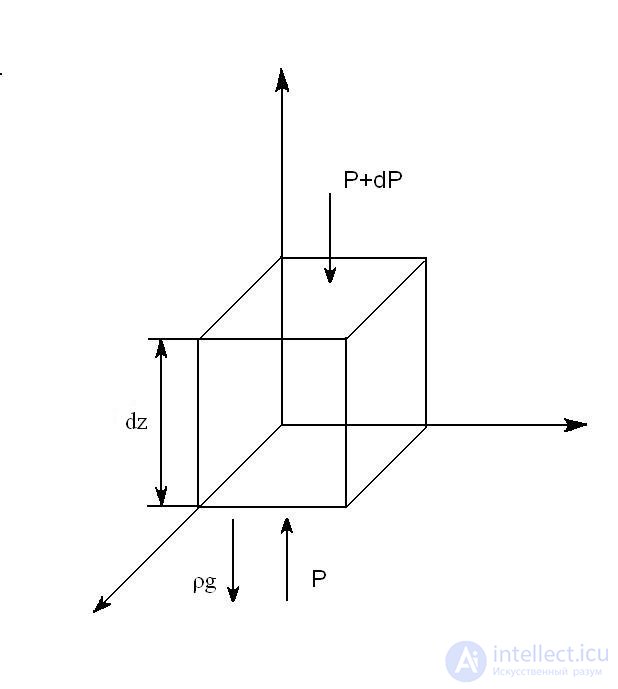

As height increases, pressure decreases.


 ;
;  ;
; 
 ;
; 

 ;
;  - baric Fig. 7 Unit volume formula
The quantity – dp/dz is called the vertical baric coefficient.
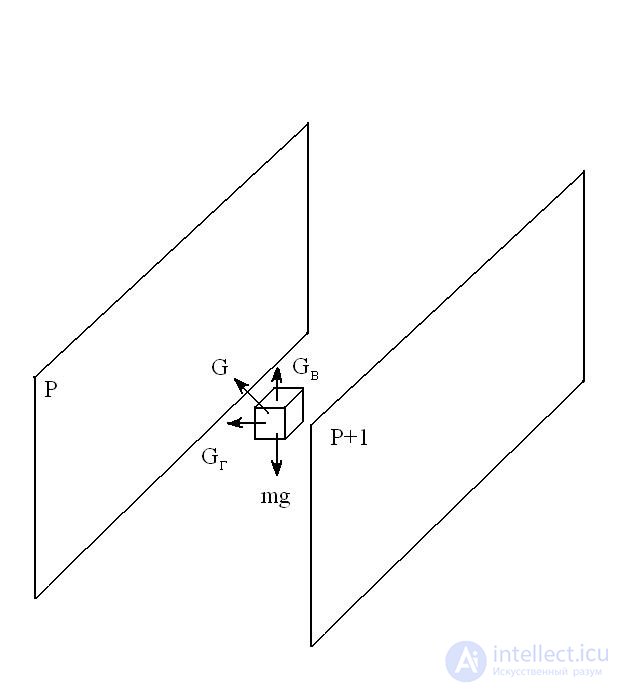
Any motion arises under the action of some force. The force that sets air in motion arises when there is a pressure difference between two points in space. The horizontal pressure difference is characterized by the horizontal pressure gradient. This force is called the driving force of the horizontal pressure gradient, or the gradient force. Let us isolate, in the space between two isobaric surfaces with pressures P and P + 1, a unit volume of air (1 cm3). The condition of equilibrium of this volume is the equality of oppositely directed forces. The force of gravity mg and the pressure forces act on the isolated volume; the resultant of these is the total pressure gradient force G, which is directed perpendicular to the isobaric surfaces – from high pressure to low pressure – and applied at the center of gravity of the air volume. Let us resolve the total gradient
Fig. 8 Gradient Force
force into horizontal and vertical components. The vertical component, in the absence of vertical motions, is balanced by gravity, while the horizontal component, at the moment motion begins, is not balanced by anything and therefore turns out to be the driving force. Under the action of this force the air begins to move toward the region of low pressure. Dividing the driving force by the mass of the isolated volume, we find the force acting per unit mass:

The force FG is precisely the driving force of the horizontal pressure gradient, called the gradient force. It is directed perpendicular to the isobars toward lower pressure and is proportional to the horizontal pressure gradient.
Since air pressure varies both vertically and horizontally, air always moves at some angle to the earth's surface. This angle is small, so usually only the horizontal component of motion is considered.
In practice, wind speed is understood to mean only its numerical value, expressed in m/s. To estimate wind speed, the Beaufort scale was formerly used (0-calm, 12-hurricane).
The direction of the velocity vector is the direction of wind travel. Eight principal compass points are usually used: N, NE, E, SE, S, SW, W, NW. Wind direction is determined using a wind vane; the distribution of directions among the principal compass points is called a wind rose. When speaking of wind direction, one means the direction from which it blows.
Wind speed is determined by anemometers or anemographs. Since wind is the motion of air relative to the Earth, and the Earth rotates about its axis, this must be taken into account, since a body moving in a rotating coordinate system acquires a rotational (Coriolis) acceleration directed at a right angle to the velocity. This rotational acceleration changes the direction of motion. The rotational acceleration on Earth is determined by the formula:

ω – angular velocity of the Earth's rotation, 1/s;
φ – geographic latitude (in the Northern Hemisphere);
ν – wind speed, m/s.
Since the Earth rotates from West to East, air is deflected to the right by a certain angle in the Northern Hemisphere, and to the left of the meridian in the Southern Hemisphere. At the equator, the Coriolis force equals zero.

Comments