
Lecture
The heating and cooling of air, the distribution of air temperatures in the atmosphere, and its continuous variation are called the thermal regime.
The thermal regime of the atmosphere, which is the most important aspect of climate, is determined primarily by heat exchange between the atmospheric air and the surrounding environment.
Heat is transferred from the Earth's surface to the air as a result of:
1) Molecular thermal conductivity of air. Air is in direct contact with the Earth's surface and exchanges heat with it.
2) Turbulent thermal conductivity. Mixing of air occurs near the Earth's surface, producing an intense transfer of heat. Heat exchange between the Earth's surface and the atmosphere by turbulent mixing occurs considerably more intensively than heat exchange due to the molecular thermal conductivity of air (approximately 10,000 times more intensively).
3) Thermal convection - the ordered vertical transport of individual volumes of air. Convection arises as a result of strong heating of the lower layers of the atmosphere.
4) The radiative pathway – due to the absorption of solar radiation in the atmosphere.
5) Evaporation of moisture from the Earth's surface followed by condensation of water vapor in the atmosphere.
The predominant roles in the exchange of heat between the Earth's surface and the atmosphere are played by turbulent thermal conductivity and thermal convection. However, the temperature at a given location can also change as a result of the horizontal movement of air, i.e. during advection. If air arrives that has a higher temperature than the air already present in a given territory, warm advection occurs; if the incoming air has a lower temperature, cold advection occurs.
The Earth's surface (soil, water, vegetation, snow and ice cover) continuously receives and loses heat. Through the Earth's surface, heat is transferred by various paths upward into the atmosphere and downward into the soil or water.
The Earth's surface receives total radiation and the counter-radiation of the atmosphere. These are absorbed to a greater or lesser extent by the surface, i.e. they go toward heating the upper layers of soil and water, while the surface itself radiates heat.
Secondly, heat arrives at the Earth's surface from the atmosphere by thermal conduction, and by the same path heat leaves the Earth's surface for the soil or water (or arrives from the depths of the soil and water).
Thirdly, the Earth's surface receives heat upon condensation of water vapor from the air, or loses heat upon evaporation of water.
In any interval of time, the same amount of heat leaves the Earth's surface upward and downward as it receives from above and below during that time. The algebraic sum of the incomes and expenditures of heat at the Earth's surface equals zero.
The heat balance equation of the Earth's surface has the form:

where: k – the gain or loss of heat via heat exchange with deeper layers of soil or water;
p – the gain of heat or its release into the air;
L – the loss of heat upon evaporation of water or the gain of heat upon condensation of water.
If the heat balance of the Earth's surface equals zero, this does not mean that the temperature of the Earth's surface does not change; a redistribution of energy takes place, part of the heat going downward (into soil, water), part upward (into the air). At night the reverse process occurs.
The thermal regime of soils and water bodies differs. Daily temperature fluctuations in soil extend to a depth of up to 1 m, while in water bodies they extend to 10 m or more. At night, soil gives back to the surface most of the heat it received during the day. A water body accumulates a significant amount of heat during the warm season, which it gradually releases over the course of the cold season.
In the atmosphere, in the troposphere, both an increase and a decrease of temperature with height are observed. An idea of the distribution of temperatures with increasing altitude is given by the vertical temperature gradient  .
.
The vertical temperature gradient is the change in temperature in the atmosphere per unit of height, usually per 100 meters. In the case of a temperature decrease  > 0, in the case of an increase it is < 0, and at a constant temperature it equals 0.
- varies over a wide range; in the lower 10 km of the troposphere it averages 0.6°C/100 m. In the lowest hundreds of meters above a strongly heated underlying surface it can exceed 1.0°C/100 m or more.
There are also cases when the air temperature does not fall with height but rises. Such a distribution of temperatures is called an inversion. Inversions frequently occur at night in the surface layer, but they are also encountered at various altitudes in the atmosphere.
If the temperature in an air layer does not change with height, the gradient equals zero and this state is called isothermal. Atmospheric processes of all scales (vortices, tornadoes, cyclones) are related to the thermodynamic state of the atmosphere, so a fundamental characteristic of the atmosphere is the degree of its thermodynamic stability; the regime of vertical motions of various scales - convection, cloud formation, precipitation - depends on it.
A layer of the atmosphere is called thermally stable if a volume of particles that has been displaced from its initial state tends to return to it ( ).
).
A layer of the atmosphere is called unstable if its particles, when displaced upward or downward with some initial velocity, tend increasingly to move away from their initial position ( ).
).
A neutral regime ( ) is one in which particles of the layer displaced upward or downward with some velocity will have the same temperature as the surrounding air, and therefore remain at these altitudes.
The change in temperature of dry air, or of air not saturated with water vapor, during its adiabatic vertical displacement by one hundred meters is called the vertical dry adiabatic lapse rate:  . The vertical dry adiabatic lapse rate equals 0.98°C/100 m.
The vertical distribution of air temperature, which determines the conditions of distribution in the atmosphere, is called stratification. The curve characterizing the distribution of temperatures with height is called the stratification curve.
Suppose that a certain volume of air, due to a gust of wind or heating, rises upward. If, as a result of its adiabatic cooling, this volume turns out to be colder and therefore denser than the surrounding air at the altitude to which it has risen, it will tend to sink back to its original level. Such equilibrium is called stable equilibrium of the atmospheric layer ( ).
If a volume of air, adiabatically raised to some altitude, acquires as a result of the ascent the same temperature as the surrounding air has at that altitude, then it will remain there. Such equilibrium is called neutral ( ).
If, however, the adiabatically raised volume of air turns out to be warmer than the surrounding air at some altitude, it will continue to rise. Such equilibrium is called unstable ( ).
Let us consider the dependence of atmospheric stratification on the vertical temperature gradient (an air layer 300 m in height, surface temperature 15°C; the vertical gradients being respectively 0.5°C/100, 1.0°C/100, and 1.5°C/100).
Under stable stratification (stable equilibrium; ), a particle, having adiabatically cooled or warmed upon displacement, becomes colder than the surrounding air if raised upward and warmer if lowered. As a result, the particle returns to its original position.
In the case of neutral stratification (neutral equilibrium; ), a particle at any level will have the same temperature as the surrounding air at that level. The particle will cool or warm by 1°C for every 100 m of vertical displacement; but in the surrounding air, too, the temperature will be lower or higher by the same amount compared with the initial level. The particle remains at the new level.
Under unstable stratification (unstable equilibrium; ) the particle has a temperature higher than that of the surrounding air. Left to itself, it will continue to move away from its initial position.
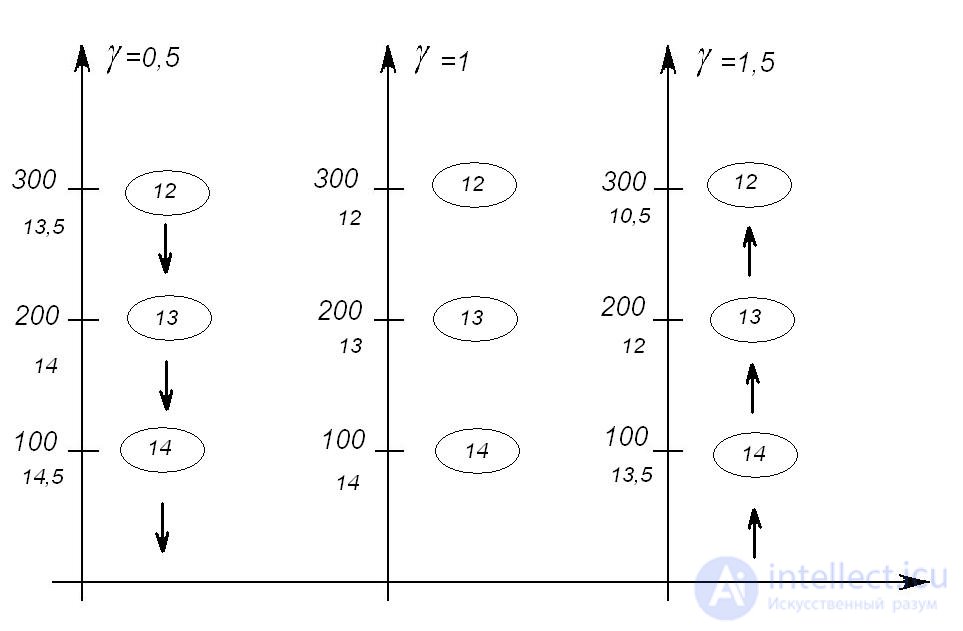
Fig. 3 Dependence of the vertical temperature gradient on stratification
Convection is possible only under unstable stratification of the atmosphere; moreover, the more unstable the stratification, the more the vertical gradient exceeds the dry adiabatic lapse rate.
Over land during the day, the lower layers of air are strongly heated from the soil surface and vertical temperature gradients increase. In the surface layer they can become very large. Unstable stratification and convection are especially pronounced around midday and in the early afternoon hours. Toward evening, stratification becomes more stable, and during the night hours, when the surface air layer is cooled by the soil, stratification can become so stable that surface inversions develop, i.e. the air temperature above the soil does not fall but rises.
A decrease in temperature with increasing height is the normal situation in the troposphere. An inversion is an increase in air temperature with increasing height. Surface inversions and elevated inversions are distinguished.
A surface inversion begins at the underlying surface itself. The lowest air temperature is at the underlying surface, and it rises with increasing height. The increase may be observed up to a height of tens or hundreds of meters. A surface inversion arises as a result of nighttime radiative cooling of the underlying surface - such inversions are called radiative inversions. Surface inversions occur both in spring and in winter (the ground is cold while the air is warm). Terrain relief enhances the inversion, as cooled air flows down into lower-lying areas, undergoing additional cooling as it moves. Radiative inversions associated with terrain features are often called orographic inversions.
An elevated inversion is observed in a certain layer of the atmosphere above the Earth's surface; most often the base of the inversion lies in the troposphere at a height of about two kilometers. The temperature range can vary from one to 10-15°C, and the thickness of the inversion layer from several tens to several hundreds of meters.
Academician S. P. Khromov wrote: «The Earth as a whole, the atmosphere separately, and the Earth's surface are in a state of thermal equilibrium if a long period of observations is considered. The inflow and outflow of heat are equal or nearly equal».
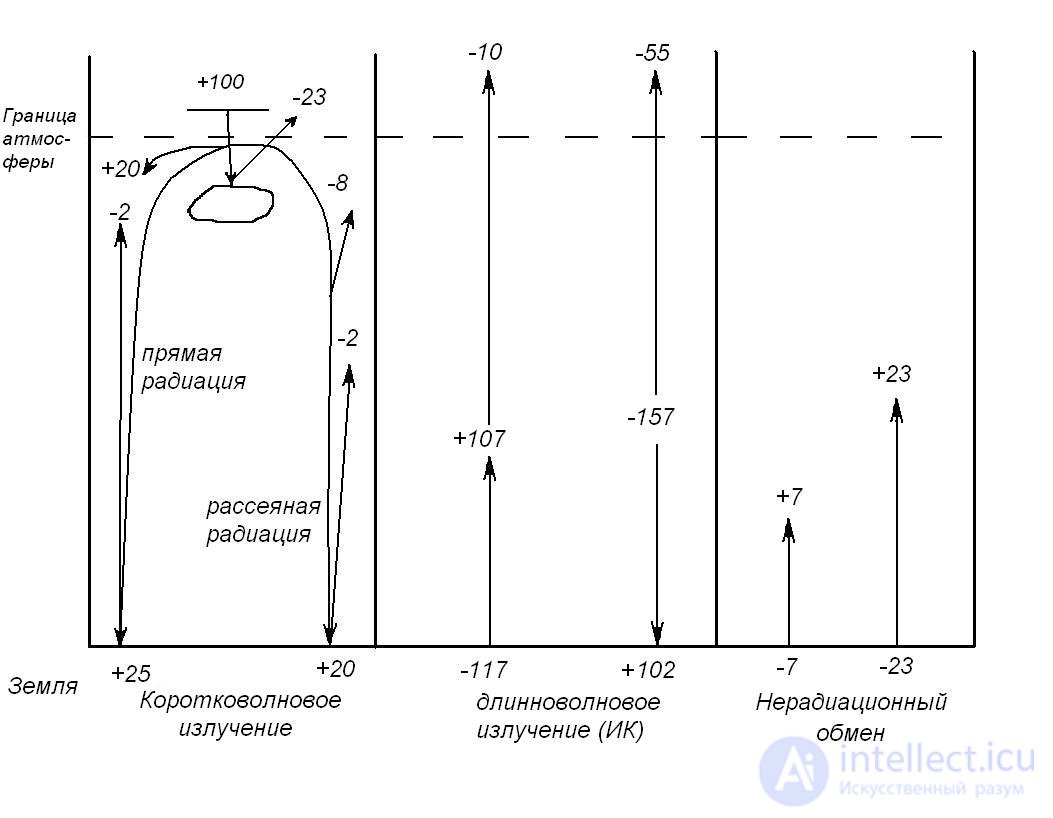
Fig. 4 Radiation Balance of the Earth
The Earth gains heat by absorbing solar radiation in the atmosphere and especially at the Earth's surface. It loses heat by radiating long-wave radiation from the Earth's surface and atmosphere into outer space. The inflow and outflow of heat at the upper boundary of the atmosphere must be equal.
The atmosphere gains heat by absorbing solar and terrestrial radiation and loses heat by emitting it
The radiation balance of the Earth's surface over a year may be either positive or negative, directed either upward (into outer space) or downward (toward the Earth). The atmosphere exchanges heat with the Earth's surface by non-radiative means. Heat is transferred from the Earth's surface into the air or vice versa by thermal conduction. Heat is also expended on the evaporation of water from the underlying surface, and is then released into the atmosphere upon condensation of water vapor.
Finally, at the Earth's surface, the inflow of heat due to the absorption of solar and atmospheric radiation is balanced by the loss of heat through radiation from the Earth's surface itself and by non-radiative heat exchange between it and the atmosphere.
If we take the solar radiation entering the atmosphere as 100 units (Fig. 5): of these, 23 are reflected by clouds and go into outer space; 20 are absorbed by air and clouds and go toward heating the atmosphere; 30 are scattered in the atmosphere (of which 8 go into outer space). 27 units of direct radiation and 22 units of scattered radiation reach the Earth's surface; of these, 25 + 20 units are absorbed and go toward heating the upper layers of soil and water, while 2 + 2 are reflected and go into outer space.
Thus, 35 units of solar radiation leave through the upper boundary of the atmosphere into outer space, i.e. the Earth's albedo is 35%.
To preserve radiative equilibrium, it is necessary that another 65 units of long-wave radiation should leave into outer space.
The Earth's surface absorbs 45 units of direct and scattered radiation. A flux of long-wave radiation from the atmosphere is also directed toward the Earth's surface. The atmosphere, in accordance with its temperature conditions, radiates 157 units of energy, of which: 102 are directed toward the Earth's surface and are absorbed by it, while 55 go into outer space. In total, the Earth's surface absorbs 147 units of heat. Under thermal equilibrium, it must lose just as much heat. Through its own radiation, the Earth's surface loses 117 units of heat, and another 23 units are expended on the evaporation of water. Through thermal conduction, in the process of heat exchange between the Earth's surface and the atmosphere, the surface loses 7 units of heat (heat leaves it into the atmosphere in larger amounts, but this is compensated by return transfer, which is 7 units less). In total, the Earth's surface loses 147 units of heat, i.e. as much as it receives by absorbing solar radiation.
Of the 117 units of long-wave radiation from the Earth's surface, 107 units are absorbed by the atmosphere, and 10 go into outer space.
The atmosphere absorbs 20 units of solar radiation, 107 units of terrestrial radiation, 23 units of heat from the condensation of water vapor, and 7 units as a result of heat exchange with the Earth's surface. This totals 157 units of energy, i.e. as much as the atmosphere itself radiates.
Through the upper boundary of the atmosphere pass 100 units of solar radiation; 35 units of reflected and scattered solar radiation, 10 units of terrestrial radiation, and 55 units of atmospheric radiation return outward; in total - 100 units.
The radiation balance of the Earth's surface over a year is positive or negative depending on the latitude of the location. A surplus or deficit of radiation in individual zones is compensated by non-radiative heat exchange between the Earth's surface and the atmosphere.
In the process of heat exchange, the Earth's surface loses 7 units of radiation. The transfer of heat in this case is driven by the general circulation of the atmosphere, i.e. by the transport of air from some latitudes to others (in the advection of air masses).
Warm air masses flowing into high latitudes give up their heat there, raising the temperature of the atmosphere; cold masses, arriving in low latitudes, remove excess heat from the Earth's surface by thermal conduction, thereby lowering the temperature of the atmosphere. As a result, a more even distribution of heat across the globe is established in the atmosphere. If air temperature were distributed solely in accordance with radiative equilibrium, the mean annual temperature at the pole would be -44°C, and at the equator +39°C; in reality it is -22°C and +26°C. Through advection, enormous quantities of heat are transported in the Earth's atmosphere from low latitudes to high latitudes.
Frosts are a drop in temperature to zero degrees or below, occurring at positive mean daily temperatures. During frosts, the air temperature at the height of a meteorological instrument shelter (2 m) may be positive, while in the lowest layer of air adjacent to the ground it may be negative. According to their conditions of formation, frosts may be radiative, advective, or advective-radiative.
Radiative frosts arise as a result of the radiative cooling of the soil and the layers of air adjacent to it. Their occurrence is favored by cloudless weather and light wind. Radiative frosts are local in character, since they form in lowlands and basins, into which cooled air flows down from plains and slopes.
Advective frosts form as a result of the advection of air with a temperature below zero degrees. Advective frosts cover large areas and depend little on local conditions.
Radiative-advective frosts are associated with the invasion of cold air masses. At night, especially in clear weather, this air undergoes additional cooling due to radiation, and frosts occur both at the surface and in the air.
To combat frosts, smoke screening (in calm, clear weather) and covering plants with various materials are used.
The underlying surface plays a major role in the formation of climate, since the physical properties of the air masses above it depend on it. Under the influence of the underlying surface, continental climates (over landmasses) and marine climates (under the influence of seas and oceans) are formed.
Let us consider two cities lying at the same latitude (62° N) - Tórshavn (Faroe Islands, Denmark) and Yakutsk (Eastern Siberia).
Let us compare the temperature regimes:
Tórshavn: the coldest month is March (+3°C), the warmest is July (+11°C).
Yakutsk: the coldest month is January (-43°C), the warmest is July (+19°C).
A small amplitude of temperature fluctuation is observed at the equator, over the sea, and in territories adjacent to it, and is explained by the great accumulation of heat by water. Marine air carries heat onto land. Thus, in Europe, the transport of air from the Atlantic Ocean prevails year-round, and therefore even in the extreme west of Europe the annual amplitude of air temperature amounts to only a few degrees.

Comments