
Lecture
A comparatively small amount of solar radiation is absorbed in the atmosphere, mainly in the infrared part of the spectrum. This absorption is selective - different gases absorb radiation in different parts of the spectrum and to different degrees.
Nitrogen absorbs short-wavelength radiation in the UV part of the spectrum, but the energy of solar radiation in this part of the spectrum is completely negligible.
Oxygen absorbs solar radiation to a somewhat greater degree, but still very little.
Ozone is present in small quantity, but absorbs hard UV radiation from the solar spectrum (4-6%).
Carbon dioxide, methane, freon, and water vapor strongly absorb radiation in the IR part of the spectrum. A significant portion of IR radiation is absorbed specifically by water vapor. Clouds and atmospheric impurities, i.e., solid particles suspended in the atmosphere, also absorb solar radiation. Overall, 15-20% of the radiation coming from the Sun to the Earth is absorbed in the atmosphere.
Besides absorption, direct solar radiation is attenuated on its way to the Earth's surface by scattering, and the scattering is greater the more aerosol particles the air contains.
Scattering is the partial transformation of radiation traveling in one direction into radiation traveling in all directions.
Scattering is observed in an optically inhomogeneous medium, when the refractive index changes from one point to another. Scattered radiation propagates from the scattering particles as if they themselves were sources of radiation.
About 25% of solar radiation is converted into scattered radiation in the atmosphere. 75% of this radiation goes to the Earth's surface and 25% into space. The attenuation of direct solar radiation as it passes through the atmosphere is characterized by Bouguer's law:
 ,
,
where: I – direct solar radiation per unit surface;
m – the optical mass of the atmosphere traversed by the sun's rays;
р – the atmospheric transparency coefficient (0.6 – 0.85).

Total radiation - all solar radiation arriving at the Earth's surface.  ,
,
where:  - total solar radiation;
 - direct solar radiation;
 - scattered solar radiation.
The composition of total radiation changes depending on:
- the height of the Sun;
- the transparency of the atmosphere;
- the presence of cloud cover.
The radiant energy of the sun is converted into heat, partly in the atmosphere, but mainly at the Earth's surface. This heat goes toward warming the land and water surfaces, and from them - toward warming the air. The heated atmosphere also emits IR radiation. The ratio of the amount of reflected radiation to the total amount of radiation incident on a surface is called the surface albedo.
Thus, out of the total flow of total radiation  , part is reflected from the Earth's surface ( )∙А, and the remaining part ( )∙(1-А) is absorbed by the Earth's surface and goes toward heating the upper layers of soil and water. This part of the radiation is called absorbed radiation.
The albedo of freshly fallen snow reaches 95%, that of dark soils 5 – 15%, that of dry light-colored sand – up to 40%. The albedo of the upper surface of clouds ranges from 5-6% to 80%; that of water surfaces from 3 - 6% to 70%.
The overwhelming part of the radiation reflected by the Earth's surface and by cloud surfaces goes into space. About 1/3 of the scattered radiation also goes into outer space. The ratio of the reflected and scattered solar radiation leaving for space to the total amount of radiation entering the atmosphere is called the planetary albedo of the Earth.
The value of the Earth's planetary albedo is 29 – 35%; the main contribution being the reflection of solar radiation by clouds.
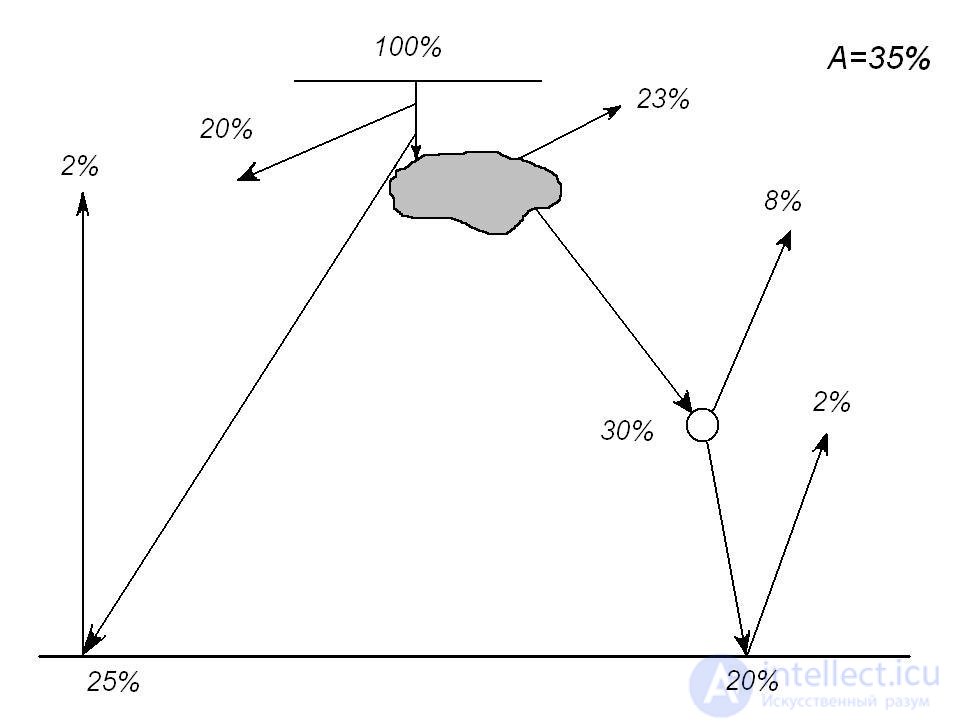
Fig. 2 Earth's Albedo

Comments