
Lecture
Electromagnetic radiation travels from the Sun to the Earth: gamma radiation, X-rays, ultraviolet rays, radio waves; that is, electromagnetic waves traveling at a speed close to 300,000 km/s. In addition to electromagnetic radiation, corpuscular radiation (the solar wind) travels toward the Earth, representing streams of electrically charged particles, mainly protons and electrons, moving at a speed of 300 – 1000 km/s. Below 90 km, corpuscular radiation almost does not penetrate into the Earth's atmosphere.
The wavelength interval of 0.1 - 4 µm accounts for about 99% of all the energy of solar radiation. Only 1% remains for radiation with shorter and longer wavelengths, extending to X-rays and radio waves. The emission spectrum of solar radiation is close to the spectrum of an absolutely black body at a temperature of 6000 K. Visible light (0.39 – 0.76 µm) occupies a narrow interval of wavelengths, yet this interval contains almost half of the radiant energy – 47%, almost as much falls on infrared rays, and the remaining 9% - on ultraviolet rays. The maximum of radiant energy falls on a wavelength of 0.475 µm (green-blue rays).
Electromagnetic radiation with a wavelength of 0.38 – 0.72 µm is called photosynthetically active radiation, since it is this radiation that participates in the process of photosynthesis.
Direct solar radiation – radiation arriving at the Earth's surface directly from the solar disk. Quantitatively, radiation is characterized by the flux of radiant energy arriving per unit time on a unit surface (W/m2∙min).
The maximum amount of solar radiation falls on a surface perpendicular to the rays (fig. 1).
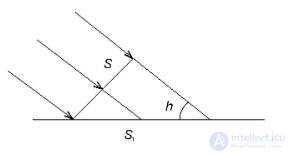
Fig. 1 Direct Solar Radiation
A smaller amount of solar radiation falls on a unit of horizontal surface:

where: h (the height of the Sun) is the angle between the line connecting the observer's eye with the Sun and the plane of the horizon.
The amount of solar radiation falling on a horizontal surface is called insolation.
The flux of solar energy before entering the Earth's atmosphere at the mean distance of the Earth from the Sun is called the solar constant. This value does not depend on the absorption and scattering of radiation in the atmosphere, but depends only on the radiative power of the Sun, and equals 1.38 kW/m2.
Each km2 of the Earth's surface receives, on average, 4.27·1016 J of the Sun's radiant energy per year; to obtain such an amount of energy it would be necessary to burn 400,000 t of coal.
Passing through the atmosphere, solar radiation is partly scattered by atmospheric gases and aerosol particles, turning into a special form of radiation. Scattered radiation is partly absorbed by atmospheric gases and impurities, turning into heat, which goes toward warming the atmosphere.
Solar radiation that is neither scattered nor absorbed reaches the Earth's surface, where it is partly reflected from it, but is absorbed to a greater extent and warms the surface. Part of the scattered radiation also reaches the Earth's surface, part is reflected, but a greater part is absorbed; however, 1/3 of the scattered solar radiation goes into space.
As a result of the absorption and scattering of radiation in the atmosphere, a significantly smaller portion of radiation reaches the Earth's surface than existed at the top of the atmosphere. In the best case, with the Sun high in the sky and clean air, the flux of direct radiation at the Earth's surface is 1.05 kW/m2, and in the mountains at an altitude of 5 km – 1.2 kW/m

Comments