
Lecture
The Gulf Stream (from English gulf stream — a current from the gulf) — is a warm ocean current in the Atlantic Ocean. In the narrow sense, the Gulf Stream refers to the current along the eastern coast of North America from the Straits of Florida to the Grand Newfoundland Bank (as it is specifically marked on geographic maps). In the broad sense, the Gulf Stream often refers to the system of warm currents in the northern part of the Atlantic Ocean from Florida to the Scandinavian Peninsula, Svalbard, the Barents Sea, and the Arctic Ocean. The surface temperature is +25…+26 °C, and at a depth of 400 m it is +10…+12 °C. The length of the current up to Svalbard is about 10,000 km.
The Gulf Stream is a powerful jet current 70—90 km wide, propagating at speeds of up to several meters per second in the upper ocean layer, decreasing rapidly with depth (to 10—20 cm/s at depths of 1000—1500 m). The total volume flow of the current is on the order of 0.1 km³/s. Recent studies suggest that the Gulf Stream's flow gradually increases from 30 Sv in the Florida Current to a maximum value of 150 Sv at 55° west longitude.
The thermal power is approximately  watts. The dynamics of the current change noticeably throughout the year. Thanks to the Gulf Stream, the European countries adjoining the Atlantic Ocean have a milder climate than other regions at the same geographic latitude: the masses of warm water heat the air above them, which is carried to Europe by westerly winds. Deviations of air temperature from the average latitudinal values in January reach 15—20 °C in Norway, and more than 11 °C in Murmansk.
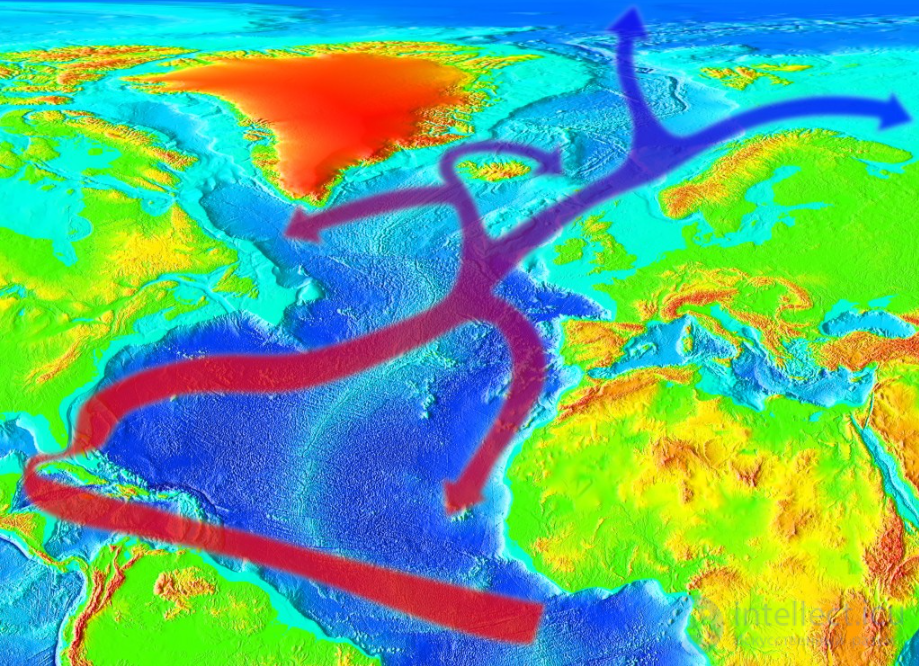
The Gulf Stream carries warm water from the tropics to northern latitudes, warming the atmosphere above the ocean. This heat is carried by westerly winds to Europe, creating a mild climate:
In Norway, the winter temperature is 15–20 °C higher than at similar latitudes in Canada
In Murmansk — 11 °C higher than in Yakutia, despite the same latitude
Type: warm surface current
Location: Atlantic Ocean, from the Straits of Florida to the coast of Europe
Temperature: +25…+26 °C at the surface, +10…+12 °C at a depth of 400 m
Speed: up to 6 km/h, width — 70–90 km
Volume flow: up to 150 Sv (an extremely powerful flow of water)
The Gulf Stream is part of the global thermohaline circulation:
Warm water moves north.
It cools and becomes denser.
It sinks to depth and returns south as a cold current.
This process regulates the climate of the entire planet.
Studies show that the current is slowing down, possibly due to the melting of Arctic ice and changes in salinity2. This may lead to:
Cooling in Europe
Intensification of extreme weather events
Disruption of Atlantic ecosystems
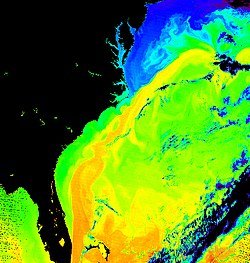
Thermal map of the Gulf Stream off the coast of North America. Source: NASA
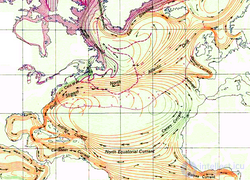
Diagram of North Atlantic currents
On a planetary scale, the Gulf Stream, like any global current, is caused primarily by the Earth's daily rotation, which accelerates the tropical trade winds and trade-wind currents, including the North Equatorial Current, drives an excess amount of water into the Caribbean Sea, and determines the strength of the Coriolis force, which presses the current against the eastern coast of the American continent. Locally, in each individual area, the direction and character of the current are also determined by the outline of the continents, the temperature regime, the distribution of salinity, and other factors.
The precursor of the Gulf Stream, the Yucatan Current, flows out of the Caribbean Sea into the Gulf of Mexico through the narrow strait between Cuba and the Yucatan. There the water either leaves via the gulf's circular current or forms the Florida Current, which passes through an even narrower strait between Cuba and Florida and emerges as a powerful stream into the Atlantic Ocean. The average flow of water in the Straits of Florida is 25 million m³/s.
Having gathered a significant amount of heat in the Gulf of Mexico, the Florida Current joins the Antilles Current near the Bahamas and turns into the Gulf Stream, which flows in a narrow band along the coast of North America. Off North Carolina, the Gulf Stream leaves the coastal zone and turns into the open ocean. The maximum flow of the current at this point reaches 85 million m³/s. About 1500 km further on, the Gulf Stream encounters the cold Labrador Current, which deflects it even further east toward Europe. The eastward shift is also driven by the Coriolis force.
In this area the Gulf Stream often forms rings — eddies in the ocean :87—89. Separating from the Gulf Stream as a result of meandering, they are about 200 km in diameter and move in the ocean at a speed of 3—5 cm/s.
On its way to Europe, the Gulf Stream loses most of its energy due to evaporation, cooling, and numerous lateral branches that reduce the main flow; however, it still delivers enough heat to Europe to create a mild climate unusual for its latitudes.
The continuation of the Gulf Stream to the northeast of the Grand Newfoundland Bank is known as the North Atlantic Current. The North Atlantic Current crosses the Atlantic Ocean in a northeasterly direction, losing a significant part of its energy in branches to the south, where the Canary Current closes the main cycle of North Atlantic currents. Branches to the north into the Labrador Basin form the Irminger Current, the West Greenland Current, and are closed by the Labrador Current. At the same time, the main flow of the Gulf Stream can still be traced further north along the coast of Europe as the Norwegian Current, the North Cape Current, and others. Traces of the Gulf Stream in the form of an intermediate current are also observed in the Arctic Ocean.
It is known that north of Cape Hatteras the Gulf Stream loses stability. Quasi-periodic oscillations with a period of 1.5—2 years are observed in it, similar to the oscillations of the jet stream in the atmosphere, known as the index cycle.
Given the influence of the Gulf Stream on climate, it is suggested that in the short-term historical perspective a climatic catastrophe related to a disruption of the current is possible. Many are concerned that, due to global warming and the melting of the northern ice sheets, the waters are becoming less saline, and since the Gulf Stream forms through the interaction of salt and fresh water, Europe would stop being warmed and an ice age would begin.
At present, the change in the freshwater balance in the North Atlantic is insufficient for a sharp drop in temperature; only a slowdown of global warming in the North Atlantic is possible.
In support of the fundamental possibility of such a catastrophe, data are cited on catastrophic climate changes that have occurred on our planet before. This includes existing evidence of the Little Ice Age and data from the analysis of Greenland ice.
It is also believed that a disruption of the current could result from global warming, since the dynamics of the current are significantly influenced by the salinity of the ocean water, which is decreasing due to melting ice. An influence of the decreasing temperature difference between the pole and the equator, as the greenhouse effect intensifies, is also possible. Thus, «global warming» threatens Europe with catastrophic cooling.
At present, the change in the freshwater balance in the North Atlantic is insufficient for a sharp drop in temperature; only a slowdown of global warming in the North Atlantic is possible.
Scientists at University College London have noted that the Gulf Stream has slowed significantly and has now reached its lowest level in the past 1600 years. This could lead to severe winters in Western Europe, as well as accelerated sea-level rise and weakening of tropical rains. Analysis of the size of dated grains of sand in sediments at Cape Hatteras in North Carolina led to the conclusion that the speed of the Atlantic meridional circulation has reached a record low since the end of the Little Ice Age in the 14th—19th centuries.
In connection with the accidental release of oil from the Deepwater Horizon platform in the Gulf of Mexico in April 2010, reports appeared of disruptions in the continuous flow of the Gulf Stream «…as a result of oil leaking from the damaged well»
At present there is no sufficiently substantiated data on the influence of the aforementioned factors on the climate. There are also directly opposing opinions. In particular, according to Doctor of Geographical Sciences, oceanographer A. L. Bondarenko, «the Gulf Stream's mode of „operation“ will not change». This is argued on the grounds that no actual transport of water occurs, that is, the current is a Rossby wave. Therefore, no sudden and catastrophic changes in Europe's climate will occur.

Comments