
Lecture
Modern signal reception and processing devices (SRPD) consist of radio receiving devices (RRD) proper and signal processing devices. A radio receiving device is understood to be the part of the receiving complex that contains the radio-frequency path, the intermediate-frequency (IF) path, and the demodulator. The remaining part, including decoders, audio-frequency amplifiers, etc., is classified as processing equipment. A radio receiver is a device designed to receive, convert and amplify messages transmitted by means of electromagnetic waves. In the general case, an RRD consists of a receiving antenna, a receiver, and a terminal device. In the antenna (A), under the action of the electromagnetic field, electrical oscillations arise, which are fed to the receiver input. In the receiver, the desired signal is extracted from among many other signals. A signal is the electrical representation of a message that carries useful information. It is usually a voltage or current, one of whose parameters (amplitude, frequency, phase, etc.) varies depending on the nature of the message. Reception can be broken down into three stages: amplification of the useful signal; processing of the received signal to reduce the influence of interference; and detection of the high-frequency signal to extract the message. However, this division is relative, since, for example, the first and second stages can be performed simultaneously by a single functional unit. The reproducing device (RD) registers the message. A loudspeaker, a picture tube, a printing device (printer, plotter, fax), etc. can serve as the RD. The message can also be registered by other devices that store the necessary information (ADC, RAM, magnetic tape, streamer, etc.). Nowadays a television or audio message can be received by a computer, simultaneously processed, recorded, edited and reproduced. RRDs are classified by their purpose, the range of received frequencies, type of modulation, method of path construction, method of power supply, place of installation, etc. However, here too there are no clear boundaries, since a single receiver can combine many functions (an AM and FM receiver, a receiver for the long-wave, medium-wave, short-wave or VHF bands, a portable receiver with a built-in power supply, etc.)
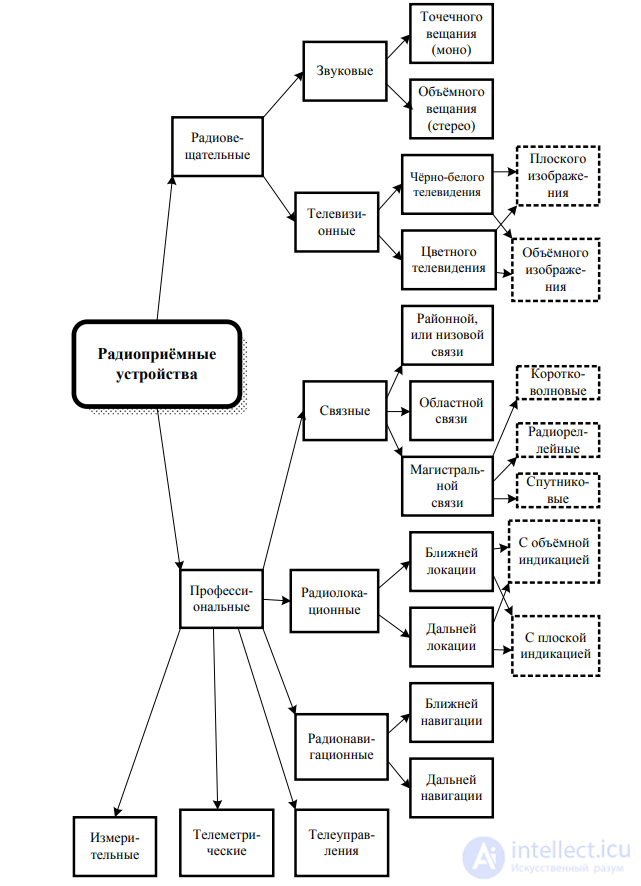
A classification of RRDs by purpose is given in Fig. 1.1.
Thus, it can be said that a receiver is a complex system
of interacting parts. They are all inseparably linked and
work together as one coordinated whole.
In the course of its development, the receiver has traveled a long way — from the lightning recorder (in which the coherer served as a kind of “active element”) to
the modern superheterodyne receiver, built structurally as a single microchip; from the bulky vacuum-tube receiver to
the portable one housed in a telephone handset. All this in a mere
100 years! One can only imagine what lies ahead. Although the possibilities
of reception are limited, who is to say that new technologies will not be found
that raise sensitivity and range to
enormous values? After all, science-fiction writers always “invent” something first,
and only later do our own real-life inventors invent it for real, without the quotation marks. Perhaps the future belongs to the neutrino, which passes effortlessly through steel a galaxy
thick?
Modern receivers can pick up so faint a signal that a coin can be “seen” from an altitude of 300 km (a facility for studying the ionosphere by the method of incoherent radio-wave scattering), or
the universe can be probed out to 20 billion (!) light years, although not everyone can
picture such distances, even a billion millimeters, or 1000 km, even though
this last distance is well within our own, earthly, reach. So it can be said that radio, if not still in its infancy, is at least in its adolescence.

Comments