
Lecture
Laser communication in space - is the use of optical communication in open space. Communication can take place entirely in space (an inter-satellite laser communication link) or in a "ground-to-satellite" or "satellite-to-ground" application. The main advantage of using laser communication compared with radio waves is the increased bandwidth, allowing more data to be transmitted in less time.
In outer space, the range of free-space optical communication currently amounts to on the order of several thousand kilometers and is suitable for inter-satellite service. It has the potential to overcome interplanetary distances of millions of kilometers by using optical telescopes as beam expanders.
Practical mastery of optical-range radio waves for communication purposes became possible with the appearance of fundamentally new sources of coherent electromagnetic oscillations — quantum generators. The operating principle of quantum generators is that, unlike microwave-range generators built on cavity resonators, they generate electromagnetic oscillations that are absorbed and emitted by particles of a specific substance called the working medium. Depending on the frequency, radiation is produced by changes in the structure of molecules (infrared range) or atoms (visible and ultraviolet range). Under certain artificially created conditions, when the absorption and emission of electromagnetic oscillations by individual particles of the substance occurs in an ordered manner, quantum systems operate in the mode of stimulated or induced emission, predicted theoretically by A. Einstein.
Quantum amplifiers and generators of microwave-range electromagnetic oscillations (frequency less than 3.1011 Hz) became known as masers. The word «maser» is derived from the first letters of the English words «Microwave amplification by stimulated emission of radiation». Quantum amplifiers and generators of the optical range are called lasers. The term «laser» was formed by replacing the letter «M» in the word maser with the letter «L» (from the English word «light»).
By the early 1980s, a large number of different masers and lasers had been developed, generating or amplifying radiation with wavelengths from the millimeter range to the ultraviolet. However, due to imperfect characteristics (short service life, instability, low power, high cost, etc.), most of them are not used in communication systems. The gas, solid-state and semiconductor lasers practically used in communication systems generate radiation in a narrow frequency band and are not tunable, so only an insignificant part of the optical range can be used with their help.
Unlike all previously existing light sources, laser radiation is characterized by a very high degree of ordering of the light field (a high degree of coherence). This makes the laser resemble a kind of «optical radio station».
The high coherence properties make it possible to use laser radiation most simply and effectively for communication purposes, for example in space.
Using lasers for communication in the atmosphere and underwater is somewhat more complicated, since this requires large-scale studies of the propagation medium depending on the weather conditions of the communication area. However, experience operating experimental systems in the USSR and abroad has also confirmed the promise of creating laser systems for communication in the atmosphere and underwater.
Laser communication systems are suitable both for transmitting conventional signals — telegraph, telephone and television — and for transmitting telemetry signals at various speeds, as well as data.
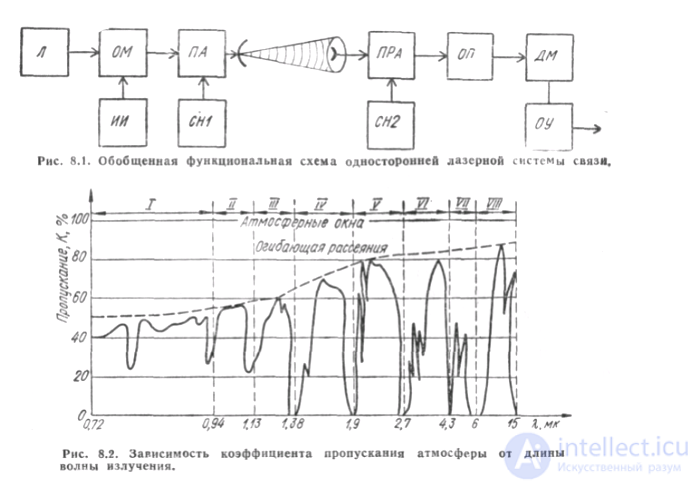
A generalized functional diagram of a one-way laser communication system is shown in fig. 8.1. The radiation of laser L is modulated by the optical modulator OM in accordance with signals arriving from the information source IS. Using the transmitting TO and receiving RO optical systems, this radiation reaches the optical receiver OR, where it is converted into an electrical signal. After being extracted in the demodulator DM, the information is sent to the terminal equipment TE for delivery to the user. Aiming systems AS1 and AS2 serve to align the optical axes of the receiving and transmitting optical systems. The transmission and reception points are separated by a medium (space, atmosphere, water) through which the laser radiation propagates.
It is obvious that the advantages of laser communication links are most fully manifested in space communication systems, and moreover, the greater the length of the communication link, the more these advantages are manifested. For example, when using conventional radio-range communication systems on spacecraft during the first flights toward Mars, Venus and other planets of the solar system, the data transmission rate was only a few binary units per second.
A laser communication system suitable for transmitting information to the vicinity of the planet Neptune, at a rate of 104 bit/s with transmitting and receiving antenna diameters of 0.1 and 16 m respectively, with a pulse duration of 1 ns and a repetition frequency of 500 Hz, would need to provide an average radiated power of only 0.6 W. Calculations show that laser radiation in the form of pulses with an energy of 104 J and a duration of 1 ns, with a divergence of 10-6 rad, can be detected on Earth at a distance of about 10 light years.
The main difficulty in creating laser systems, especially for long-range communication, — is aligning the beam with the receiving antenna and keeping it aligned during the communication session. Typical optical antennas can form a beam whose angular divergence amounts to fractions of an arc second. If such a beam is directed at a distant receiving device, the required accuracy with which the beam must be aimed is approximately half the angular width of the beam. Suppose a transmitter located on a geosynchronous artificial Earth satellite, whose orbital altitude is 35,200 km, radiates in the direction of Earth. With a pointing accuracy of 50 µrad, at this distance the cross-sectional size of the zone of uncertainty of the beam axis position on the ground will be (50 X 10-6) X (35,200) ~ 1.6 km, i.e., the transmitter's beam reaches Earth within a circle 1.6 km in diameter. Radio-range antennas usually have a beamwidth of about 10° and, at the stated distance to the satellite, «cover» a circle on Earth about 6400 km in diameter.
The use of laser ground-based communication links through the atmosphere is considered very promising, despite the selective attenuation of optical radiation in the atmosphere.
Fig. 8.2 shows a simplified dependence of the atmospheric transmittance coefficient K on the radiation wavelength. The decrease in the transmittance coefficient in the range below 2 µm is mainly explained by the effect of scattering. Sharp changes in the transmittance coefficient (dips) are explained by the selective nature of absorption at infrared frequencies. In the wavelength range under consideration there are eight regions of relatively high transmittance values. These regions are called atmospheric transmission windows. As can be seen from the figure, as the wavelength increases (i.e., moving into the infrared range), the transparency of the atmosphere increases and reaches a maximum at a wavelength of 10.6 µm for the carbon dioxide laser.
The optical rangeof the spectrum consists of electromagnetic oscillations whose wavelengths lie between 1 m and 1 nm*. Within the optical range, a distinction is made betweenvisible( λ =0.38...0.78 µm),infrared(λ=0.78...1000 µm) andultraviolet(λ=0.001...0.38 µm) radiation (fig. B.1).
Light waves- electromagnetic waves of the optical range.
Monochromatic radiation- optical radiation characterized by a single frequency (a single wavelength) of light oscillations.
Quantum amplifier- an amplifier of electromagnetic waves based on the use of stimulated emission.
Quantum generator- a source of coherent radiation based on the use of stimulated emission.
Laser* (optical quantum generator)- a quantum generator (amplifier) of optical radiation.
Maser- a quantum generator (amplifier) of radio-range electromagnetic radiation.
Stimulated radiation- coherent electromagnetic radiation arising as a result of stimulated emission.
Stimulated emission- the coherent emission of a photon during a quantum transition of a system as a result of interaction with an external electromagnetic field.
Coherence- the coordinated progression in time and space of oscillatory or wave processes. An electromagnetic wave is called coherent if its amplitude, frequency, phase, direction of propagation and polarization are constant or change according to a definite law (order).
The main properties of laser communication systems, which provide a very substantial increase in the security and reliability of information exchange, can be identified as follows:
practically absolute protection of the channel from unauthorized access and, as a consequence, a high level of noise immunity and jam resistance, due to the possibility of concentrating all the signal energy within angles ranging from fractions of an arc minute (in laser space communication systems) to tens of degrees (full-access indoor communication systems);
high information capacities of the channels (up to tens of Gbit/s), which provides the possibility of robust encryption with a high level of redundancy;
the absence of pronounced telltale signatures (mainly spurious electromagnetic emissions) and the possibility of additional masking, which makes it possible to conceal not only the transmitted information but also the very fact of the information exchange.
In addition, many specialists note the biological safety of these systems, since the average power density of the radiation in laser systems of various applications is approximately 10 3 - 10 6times lower than the irradiance produced by the Sun, as well as the simplicity of their design and operating principles and their relatively low cost compared with traditional means of transmitting information for similar purposes.
One of the main factors determining the possibility of using these links is stable operation under the effect of interference of various origins, both natural and artificial, in particular fog, smoke, smog and other similar phenomena. Theoretically assessing the effect of such interference on the link's operating efficiency under specific conditions (a particular natural-climatic zone) is extremely difficult due to the high degree of uncertainty in the initial data. Such results are obtained mainly experimentally.
Theoretically, the communication range is determined by the simple relationship
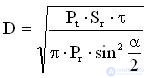
where Pt and Pr are the power of the laser transmitter and the threshold power of the photodetector device, Sr is the aperture area of the photodetector device, a is the divergence angle of the laser radiation, t is the total loss coefficient of the laser radiation due to absorption and scattering in the atmosphere, optical systems and other elements of the channel.
An analysis of the data obtained during experimental work, as well as other results from trial operation, showed that at distances of up to 2-3 km the effect of natural interference is practically imperceptible, i.e., the link functions under any weather conditions. Increasing the communication range leads to an increase in the interference level, and at a range of 10 km the total time of conditions unfavorable for communication amounted to 1.5-2% of the total operating time.
Among the influencing factors, in order of the intensity of their effect at a communication range of 10.2 km, the following can be identified:
snowfall - (more than 50% errors);
fog - (about 30% errors);
smog, chimney smoke, etc. - (approximately 20% errors).
+It should also be noted that, as an analysis of typical conditions for using such links in urban environments has shown, the communication range mostly lies in the range from 1-2 to 4-5 km. At such ranges, the time of weather conditions unfavorable for communication can be expected to decrease to 0.01-0.001% of the total operating time. It should also be noted that not all cases of conditions unfavorable for communication result in complete loss of communication; in a number of cases only a decrease in the rate of information exchange is observed, due to retransmission of information.
It should also be noted that the use of laser equipment for organizing information exchange removes one of the most complex issues characteristic of radio-range communication systems — the need for coordination and obtaining authorization for their operation from the state bodies for control and oversight of telecommunications. This is due to the fact that, firstly, the radiation frequency of laser communication systems lies outside the range for which coordination is required (in Russia), and secondly, to the lack of practical means of detecting and identifying them as information exchange equipment.
Laser communication link equipment usually includes a laser transmitter (emitter) and a photodetector device, combined by a common control system and channel-forming equipment (fig. 1).
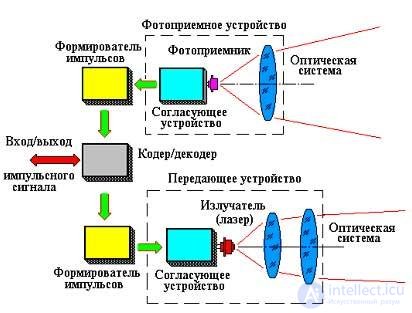
Fig. 1. Laser communication link equipment
Receiving and transmitting devices are usually equipped with optical systems designed to shape the radiation patterns. By changing the position of the emitter and the photosensitive element relative to the focal point of the optical systems, the beamwidth of the radiation pattern can be varied over a wide range, from fractions of an angular minute to several tens of degrees. The complexity of the optical system's design is determined primarily by the requirements placed on the radiation pattern. For example, for a pattern width of up to 10 – 15 angular minutes, the simplest single-lens optical system can be used, whereas achieving an angular divergence of 0.1 – 0.3 angular minutes requires a complex multi-element mirror-lens system. Naturally, in addition to technical requirements, the choice of optical system type for each specific case is also influenced by cost constraints. In the vast majority of cases, this constraint is the reason for carrying out a comprehensive set of work to optimize the entire laser system.
One of the main problems in the development and operation of laser systems for various purposes is the justification and selection of the type of line code that would best correspond to the specific operating conditions of the given system. For example, if the communication range does not exceed 2 – 3 km, or the divergence angle of the laser beam does not exceed a few angular minutes, then using any type of signal with continuous (analog) amplitude modulation is not advisable, owing to the high level of spurious modulation (the depth of which can reach 80 – 90%) of the optical radiation caused by atmospheric turbulence. As shown by a series of studies conducted in Moscow, Voronezh, and Novosibirsk since the late 1960s, the most rational solution to this problem, including from the standpoint of technical implementation, is the use of pulse modulation methods when coding the transmitted signals. These methods are based on the principle of average power limitation, which consists in the invariance of the average power radiated by a semiconductor laser with respect to the product of peak power, pulse duration, and pulse repetition frequency. This makes it possible, within certain limits, by varying these parameters — in particular, by reducing the optical pulse duration — to ease the laser's operating regime, increase its overall efficiency, and significantly extend its service life, while also improving the channel's protection against unauthorized access and against the natural and man-made interference mentioned above. For example, coding information with optical pulses no longer than 10 ns duration provides virtually complete elimination of interference caused by atmospheric turbulence (whose frequency range does not exceed 300 – 1000 Hz) and reduces the influence of background (solar) active interference by 40 – 80 dB. Technically, this is achieved using appropriate frequency and pulse selectors in the receiving and channel-forming equipment. In addition, the use of short pulses based on the wavefront reversal effect makes it possible to detect attempts at unauthorized access to the channel and to determine the range to the location of an interception system within the emitter's main radiation pattern. It should be noted, however, that as studies have shown, the probability of such an event is extremely low, and such costly modifications are usually ordered only for systems requiring enhanced, virtually absolute, protection against unauthorized access. Along with the elements listed above, laser equipment may include a number of other auxiliary devices, the composition of which is determined by the specific type of task being solved (equipment for technical encryption of transmitted information, sensors for signaling attempts to tamper with the equipment, and similar devices).
Conventionally, the application areas of laser systems being developed and manufactured can be divided into five groups, interconnected by technical means:
transmission of information in telecommunication systems, telephone extenders, insertion links, transmission of television images, and solving similar tasks;
covert transmission of information in special-purpose «point – to – point» communication systems between mobile or fixed subscribers;
analysis of the characteristics of the transmitted optical signal for detecting and identifying objects within the field of view in active-type security alarm systems;
remote measurement of microdeformations of dielectric surfaces in covert information-retrieval systems;
protection against optical surveillance systems and covert information-retrieval systems.
It should be noted here that, regardless of the application area, laser communication equipment is built on the principles discussed above, while the application area imposes constraints on mass, dimensions and power consumption, as well as on the possible ways of organizing the communication channel.
Transmission of information in public communication systems.
When laser systems are used in this case, one of their advantages often cited is the short deployment time and the ability to operate several communication links simultaneously and in parallel (Fig. 2).
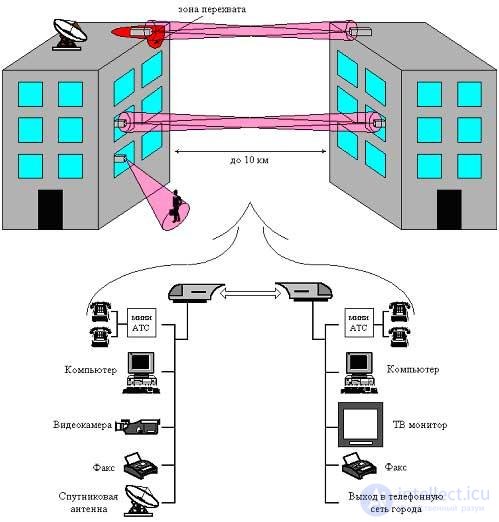
Fig. 2. Operation of laser communication links
This makes it possible, alongside the use of these links in public communication systems such as links between mini-PBXs, computers, fax machines and other similar equipment, to use these links to organize dedicated communication channels.
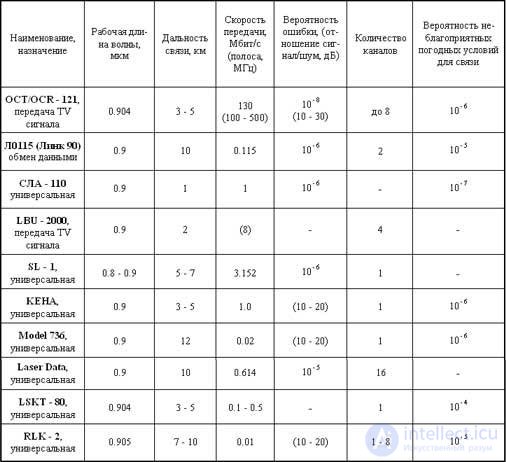
For example, in New York such equipment provides communication between the World Trade Center building and satellite telephone communication stations, while at the central research laboratory of Hitachi such links provide communication between computers located in different buildings. The overcrowding of the radio spectrum and the need to protect information transmitted from remote television cameras led to the development and deployment of the LBU-2000 laser links, developed by Sony, which implement the concept of a dedicated, isolated channel in television image transmission systems. The main characteristics of this link and other public laser communication systems are given in Table 1.
Practical experience with these links has shown that their use makes it possible to virtually eliminate the need for additional information-security measures and to reduce the costs associated with ensuring information security by roughly a factor of 2 – 3. At the same time, an improvement in both the quality of the transmitted signal and the reliability of the link has been noted.
+One of the main factors determining a channel's protection against unauthorized access is the zone of reliable signal detection. It is approximately determined by the radiation pattern of the transmitting device and the sensitivity of the equipment used for interception. Typical values of this zone are, for example, about 100 m for the domestic laser link L0115 at a communication range of 10 km, while at a distance of 4 – 5 km this zone shrinks to 30 – 40 m. In this case there is, as a rule, no practical possibility of placing interception equipment for the transmitted signal or of introducing jamming.
Table 1.
Typical representative laser communication systems.
On January 20, 1968, the television camera of the lunar probe Surveyor 7 successfully detected two argon lasers from the Kitt Peak National Observatory in Arizona and the Table Mountain Observatory in Wrightwood, California.
In 1992, the «Galileo» probe demonstrated successful one-way detection of laser radiation from Earth, as two ground-based lasers were visible from a distance of 6 million km.
The first successful laser communication link from space was carried out by Japan in 1995 between the JAXA ETS-VI GEO satellite and the 1.5-m NICT ' optical ground station in Tokyo (Japan), achieving 1 Mbit/s.
In November 2001, the world's first laser inter-satellite link was established in space using the European Space Agency's Artemis satellite, which provided an optical data link with the CNES SPOT 4 Earth observation satellite. A rate of 50 Mbit/s was achieved over a 40,000 km LEO-GEO link distance. Since 2005, ARTEMIS has been relaying two-way optical signals with KIRARI, a Japanese engineering test satellite for optical inter-satellite communication
In May 2005, the Mercury Laser Altimeter aboard the MESSENGER spacecraft set a distance record for two-way communication. This diode-pumped neodymium infrared laser, designed as a laser altimeter for the Mercury orbital mission, was able to establish communication at a distance of 24 million km (15 million miles) as the spacecraft approached Earth during a flyby. [10]
In 2006, Japan carried out the first laser downlink communication «LEO–to–Earth» from the JAXA OICETS LEO satellite to the NICT optical ground station. [11]
In 2008, ESA used a laser communication technology designed to transmit 1.8 Gbit/s over a 45,000 km LEO-GEO link distance. This terminal was successfully tested during an in-orbit verification using the German radar satellite TerraSAR-X and the American satellite NFIRE. The two laser communication terminals (LCTs) [12], used during these tests were built by the German company Tesat-Spacecom [13] in cooperation with the German Aerospace Center (DLR). [14]
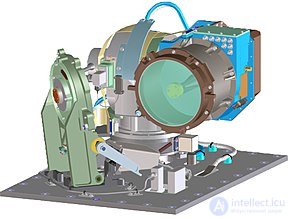
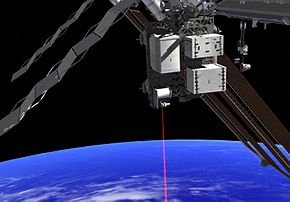
In January 2013, NASA used lasers to transmit an image of the Mona Lisa to the Lunar Reconnaissance Orbiter at a distance of approximately 390,000 km (240,000 miles).
Initial data obtained from the Lunar Laser Communication Demonstration (LLCD) equipment on LADEE set a space-communication bandwidth record in October 2013, when the first tests using a pulsed laser beam to transmit data over a distance of 385,000 km (239,000 miles) between the Moon and Earth achieved a record download rate of 622 megabits per second (Mbit/s)» [17], and also demonstrated an error-free upload data rate of 20 Mbit/s from an Earth ground station to LADEE in lunar orbit. LLCD was NASA's first attempt at two-way space communication using an optical laser instead of radio waves, and is expected to lead in the future to operational laser systems on NASA satellites
In February 2016, Google X announced that it had achieved stable laser communication between two stratospheric balloons at a distance of 100 km (62 miles) as part of Project Loon. The connection remained stable for many hours during both day and night and achieved a data transfer rate of 155 Mbit/s.
The Laser Communications Relay Demonstration (LCRD) is a NASA mission that will test laser communication in space over very long distances.
It is integrated into STPSat-6, part of STP-3, which is currently scheduled to launch in late 2021 on an Atlas V 551.
The LCRD mission was selected for development in 2011, with launch aboard a commercial satellite planned for 2019. The technology-demonstration payload will be located above the equator, which is an excellent location for direct line of sight to other orbiting satellites and ground stations. Space laser communication technologies can provide 10 to 100 times higher data rates than traditional radio-frequency systems at the same mass and power. On the other hand, numerous NASA studies have shown that a laser communication system will use less mass and power than a radio-frequency system at the same data rate.
The LCRD mission is managed by NASA's Goddard Space Flight Center.
In May 2018, the Government Accountability Office (GAO) reported that there had been delays, funding cuts, and cost overruns, but that it should be ready for launch by November 2019 as a payload of the U.S. Air Force Space Test Program mission STP-3, on an Atlas V 551
By April 2020, after further delays and cost overruns, it was expected to launch in January 2021 as a payload on a U.S. Air Force Space Test Program satellite (STPSat-6, part of the STP-3 launch). STPSat-6 is designed to enter an orbit slightly above geostationary orbit.
This concept was first tested in outer space aboard the Lunar Atmosphere and Dust Environment Explorer (LADEE) spacecraft in 2013. LADEE's pulsed laser system Lunar Laser Communication Demonstration (LLCD) conducted successful tests on October 18, 2013, transmitting data between the spacecraft and its ground station on Earth at a distance of 385,000 km (239,000 miles). This test set a downlink data-transmission record of 622 megabits per second from the spacecraft to the ground, and an «error-free upload data rate of 20 Mbit/s» from the ground station to the spacecraft.
The goal of the Laser Communications Relay Demonstration project is to prove the usefulness of two-way optical relay communication services between geosynchronous orbit and Earth. The project supports key research areas in advanced communications, navigation, and avionics. This effort will confirm that optical communication technology will work under operational conditions, providing data rates up to 100 times faster than current radio-frequency-based communication systems. The demonstration will make it possible to measure and characterize system performance under various conditions, develop operating procedures, assess applicability to future missions, and provide an in-orbit capability for testing and demonstrating optical relay communication standards. This capability, if successfully demonstrated, could be rapidly adopted by NASA missions, other federal agencies, and U.S. satellite manufacturers and operators, given the growing demand for bandwidth. The laser relay demonstration will fly as a hosted payload under the U.S. Air Force Space Test Program (STPSat-6). Following a successful flight demonstration, NASA will provide the communications industry with access to the integrated system to test these new capabilities for commercial applications.[12]
LCRD will conduct a flight demonstration lasting at least two years to advance optical communication technology for adoption in operational systems approaching Earth, while simultaneously expanding capabilities among industry sources. The goals include: [12]
On November 29, 2020, Japan launched a geostationary-orbit data-relay inter-satellite satellite equipped with high-speed laser communication technology called LUCAS (Laser Utilizing Communication System).
In June 2021, the U.S. Space Development Agency plans to launch two 12U CubeSats aboard a SpaceX Falcon 9 spacecraft into sun-synchronous orbit. The mission is expected to demonstrate laser communication between the satellites and a remotely piloted MQ-9 Reaper.
The information carrier in a laser system is a modulated laser beam. The receiver and transmitter are located at some distance from each other. The laser beam propagates through the atmosphere, so the signal's energy density decreases during transmission. Scattering of the laser beam's energy occurs because the atmosphere's refractive index differs from unity. Transmission quality is affected by microscopic dust particles and by the presence of vapor or liquid droplets in the air, which cause diffraction or interference of the signal. The fewer such obstacles there are, the higher, naturally, the quality of the link. Temperature fluctuations or precipitation (rain, snow) change the density of the atmosphere and consequently cause scattering of the wave. Direct interference of sunlight with the laser beam right at the transceiver cannot be ruled out either.
If some large object briefly enters the path of the beam (birds or foliage), the transmission is automatically repeated and no information is lost. It should be noted that birds can see the laser beam and avoid it, but even if they do enter the beam's path, they are not harmed in any way: the radiated power of commercial lasers is too low and is therefore completely harmless (the only exception being military lasers).
External factors can also affect the device itself (sometimes this can damage the laser). Developers of laser systems therefore have to create a design that can compensate for interference or diffraction of the signal in the environment, as well as the relative shift of buildings (which is especially important for high-rise buildings, whose oscillation amplitude can at times reach several meters). Each device is housed inside an aluminum enclosure resistant to environmental effects. The laser's protective housing must ensure reliable operation of the device in any weather, so laser devices are tested for corrosion resistance and durability under conditions of high humidity, low and high temperatures, and so on.
Most laser systems operate in rain with precipitation rates of up to 8 cm per hour and in snowfall of up to 5 cm per hour, and even under conditions of dense fog.
Laser communication provides a high level of protection for information against unauthorized interception, whereas radio transmission can be intercepted and recorded even at a considerable distance from the transmitting equipment. To ensure information security, a communication scheme using an N-slit laser interferometer has been proposed, in which the laser signal takes the form of an interference pattern, and any attempt to intercept the signal causes the interference pattern to collapse. [65] [66] This method uses groups of indistinguishable photons [65] and has been demonstrated to work at propagation distances of practical interest [67], and, in principle, it can be applied over long distances in space.
Assuming currently available laser technologies, and taking into account the divergence of interference signals, the range for satellite-to-satellite communication was estimated at approximately 2000 km. [68] These estimates apply to a constellation of satellites orbiting the Earth. For spacecraft or space stations, the communication range increases to 10,000 km. [68] This approach to secure space-to-space communication was selected by Laser Focus World as one of the major photonics achievements of 2015
Unlike radio-based systems, no license is required to use laser communication, while the cost of the equipment is roughly the same. In addition, manufacturers of laser communication systems have good technological potential for reducing prices in the near future.
Thus, laser communication can be used on Earth for:
In space, for:

Comments