
Lecture
Scrambler (from English scramble — to encrypt, to shuffle) — a software or hardware device (algorithm) that performs scrambling — a reversible transformation of a digital stream, without changing the transmission rate, aimed at giving the stream the properties of a random sequence. After scrambling, the appearance of «1» and «0» in the output sequence is equally probable. Scrambling is a reversible process, meaning the original message can be recovered by applying the inverse algorithm.
In telecommunication systems, scrambling improves the reliability of synchronization between devices connected to the communication line (it ensures reliable clock recovery directly from the received signal) and reduces the level of interference radiated onto adjacent lines of a multi-core cable. Another application of scramblers is protecting transmitted information from unauthorized access.
For scrambling algorithms, operating speed and the random nature of the sequence are extremely important, so that it cannot be reconstructed if intercepted by an adversary. The scrambling process may involve adding certain components to the original signal or altering important parts of the signal in order to make it more difficult to recover the shape of the original signal, or to give the signal certain statistical properties.
Scramblers are used in public telephone networks, satellite and radio-relay communications, digital television, and also to protect optical discs from copying.
Scrambling is usually performed at the last stage of digital processing, immediately before modulation.
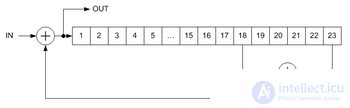
Self-synchronizing scrambler
The main part of the scrambler is a pseudo-random sequence (PRS) generator in the form of a linear n-stage register with feedback, forming a maximum-length sequence  .
.
A feature of the self-synchronizing scrambler (SS scrambler) is that it is driven by the scrambled sequence, i.e. the one transmitted into the channel. Therefore, this type of scrambling does not require special initialization of the scrambler and descrambler states: the scrambled sequence is written into the shift registers of the scrambler and descrambler, bringing them into an identical state. If synchronism between the scrambler and descrambler is lost, the time to restore synchronism does not exceed a number of clock cycles equal to the number of cells in the scrambler register.
At the receiving side, the original sequence is recovered by modulo-2 addition of the received scrambled sequence with the sequence at the output of the shift register. For example, for the circuit shown in the figure, the input sequence  is converted by the scrambler, according to the relation
 into the transmitted binary sequence
  . At the receiver, from this sequence, the same shift register as at the transmitter forms the sequence
 .
.
As follows from the operating principle of the circuit, a single error in the sequence also results in errors in the subsequent eighteenth and twenty-third symbols (in this example). In general, the effect of an erroneously received bit will be felt a times, where a — the number of feedback connections in the shift register. Thus, the SS scrambler-descrambler has the property of error multiplication. This drawback of the SS scrambler-descrambler limits the number of feedback connections in the shift register; in practice this number does not exceed a = 2.
The second drawback of the SS scrambler is related to the possibility that, under certain conditions, so-called «critical situations» may appear at its output, when the output sequence acquires a periodic character with a period shorter than the length of the PRS. To prevent this, the scrambler and descrambler include special additional monitoring circuits that detect the presence of periodicity in the input elements and disrupt it.
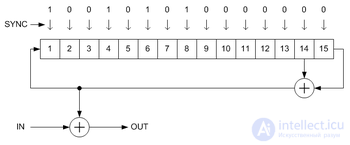
Additive scrambler
With additive scrambling, an identical preliminary setting of the register states of the scrambler and descrambler is required. In a scrambler with setting (AD scrambler), as in the SS scrambler, the input signal and the PRS are summed, but the resulting signal is not fed to the register input. In the descrambler, the scrambled signal likewise does not pass through the shift register, so error multiplication does not occur.
The sequences summed in the scrambler are independent, so their period is always equal to the least common multiple of the periods of the input sequence and the PRS, and no critical state occurs. The absence of an error-multiplication effect and of the need for special protection logic against undesirable situations makes the additive scrambling method preferable, disregarding the cost of solving the scrambler-descrambler synchronization problem. The frame synchronization signal is used as the setting signal in digital data transmission systems.
Audio scramblers are widely used to protect telephone conversations. Scrambling can transform the speech signal along three parameters: amplitude, frequency, and time. However, in mobile radio communication systems, mainly frequency and time transformations of the signal, as well as their combinations, have found practical application. Possible interference in the radio channel significantly complicates accurate recovery of the speech signal's amplitude, which is why amplitude transformations are practically not used in scrambling.
The main methods of speech signal transformation:
With frequency inversion, the transformation of the speech signal spectrum is equivalent to rotating the signal's frequency band around a certain center frequency Finv — the inversion frequency.
A somewhat more complex signal transformation method, compared with frequency inversion, is provided by a scrambler that splits the speech signal band into subbands with frequency inversion of the signal in each subband (a band-shift inverter). Splitting the band into 2 subbands is typically used.
Band scramblers use the method of splitting the speech signal band into several subbands with frequency permutation of these subbands. A band scrambler can be implemented based on the fast Fourier transform (FFT). In such a scrambler, on the transmitting side a forward FFT is performed, followed by frequency permutation of the bands, and then — an inverse FFT. On the receiving side, analogous transformations are carried out with the inverse frequency permutation of the bands. In FFT-based scramblers, a high degree of information protection can be achieved by increasing the number of bands being mixed; however, in practice this scrambling method is rarely used in mobile radio communications due to the complexity of its technical implementation. In addition, FFT-based scramblers introduce a time delay into the communication channel.
The simplest form of time transformation is time inversion, in which the original signal is divided into a sequence of time segments, each of which is transmitted inverted in time — from end to beginning.
In a scrambler with time permutations, the speech signal is divided into time frames, each of which is in turn subdivided into segments, and then the segments of the speech signal are permuted.
To further increase the degree of speech privacy, a combination of time and frequency scrambling is used. In such a scrambler, after analog-to-digital conversion, the spectrum of the digitized speech signal is divided into time-frequency elements, which are then mixed on the time-frequency plane in accordance with one of the cryptographic elements and summed, without going beyond the frequency range of the original signal.
Scramblers are used in digital and cable television to provide access to paid content and to prevent theft of the broadcast signal. Early versions of these devices inverted one of the components of the television signal, restoring it at the client side. Later, more advanced scramblers began to filter out one of the signal components and transmit the data without it. Recovery of the original sequence by adding back the missing part of the signal takes place at the user's side.
The need for scrambler synchronization led James Ellis[en] to the idea of public-key cryptosystems, which later led to the creation of the RSA encryption algorithm and the Diffie-Hellman protocol.
Modern scrambling systems differ greatly from the original scramblers. These are complex digitizing devices combined with encryption devices. In such systems, the original signal is converted into digital form, after which the data is encrypted and transmitted. Being combined with asymmetric encryption systems, these «scramblers» are more cryptographically robust than their earlier counterparts. Only such systems are considered reliable enough for handling important data.

Comments