
Lecture
Electronic warfare (EW, radio-electronic combat) — is a type of armed struggle in which radio emissions (radio jamming) are used against the enemy's radio-electronic control, communication, and reconnaissance equipment in order to degrade the quality of the military information circulating within it, to protect one's own systems from similar effects, and also to change the conditions (properties of the medium) for the propagation of radio waves.
The history of the creation and development of electronic warfare (EW) began with the advent of radio communication and radar. EW is a set of measures aimed at disrupting or suppressing the enemy's radio communication, radar, and other electronic systems. This field of military activity developed in parallel with the development of radio technologies and electronics. Let us look at the key moments in the history of the creation and development of EW:
First steps: Electronic warfare began its development during the First World War. During this time, the first radio stations and radar systems were created. With the advent of radio communication on the battlefield, it became clear that control over the radio-frequency spectrum was of strategic importance.
The Second World War: During the Second World War, EW came to be actively used by both sides of the conflict. Means of suppressing radio communication and radar were developed, such as electronic jamming, radio reconnaissance, and radar detection. This made EW an important part of military strategy.
The Cold War: After the Second World War, EW continued to develop, especially during the Cold War between the USSR and the USA. Both sides actively used electronic means for radio-electronic reconnaissance and warfare.
The present day: Under modern conditions, EW has become an incredibly important component of military strategy. The development of modern radio technologies and electronics has led to the creation of more sophisticated EW systems, capable not only of suppressing the enemy's radio communication and radar, but also of protecting one's own communication and detection equipment.
Types of EW: Modern EW equipment includes electronic jamming, radio reconnaissance, radar detection, systems for suppressing unmanned aerial vehicles (UAVs), and many others. EW is also used in cyber warfare to defend against cyberattacks and to suppress enemy networks.
International cooperation and rules: As EW developed, it became necessary to establish international rules and agreements regulating the use of these technologies by armed forces. For example, there is the Vienna Convention on Electronic Warfare and the Paris Convention on Electronic Warfare.
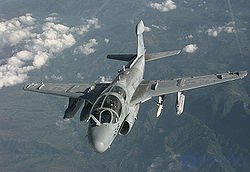
Electronic warfare was first used by the Russian Navy during the Russo-Japanese War. On April 15, 1904, during an artillery bombardment that a Japanese squadron was conducting against the inner roadstead of Port Arthur, the radio stations of the Russian battleship «Pobeda» and the coastal post «Golden Hill» seriously hindered the transmission of telegrams from the enemy's spotter ships by creating deliberate interference (this is considered to be, apparently, the first such case in the world).
Nevertheless, radio equipment at that time was mainly used to ensure communication, identify the enemy's communication channels, and intercept the information transmitted over them. Preference was given to intercepting radio transmissions rather than suppressing them. However, during the First World War, radio jamming began to be used sporadically to disrupt radio communication between the headquarters of armies, corps, and divisions, and between warships. At the same time, special radio-jamming stations had already appeared in the German army.
In the period between the world wars, radio communication developed actively, and means of radio direction-finding, radio control, and radar appeared. As a result, the concept of command and coordination among ground forces, the air force, and the navy changed radically. All this led to the further development of methods and technology for countering the enemy's radio-electronic equipment.
During the Second World War, the participating countries actively used means of electronic and sonar (hydroacoustic) suppression. Special radio-jamming units and subdivisions were formed and widely used to support combat operations. Extensive experience was accumulated in conducting reconnaissance and creating radio jamming, as well as in electronic protection.
Electronic warfare assets were employed on a large scale in the summer of 1944, when the Allied landings in Normandy opened the second front.
In preparation to meet the landing force, the Germans had concentrated an enormous number of detection stations along the northern coast of Europe, monitoring the surrounding space and every scrap of land. Before the landing began, the Allies destroyed about 80 percent of the German stations with artillery fire and air strikes, and roughly 700 jamming stations were deployed to suppress the enemy's remaining assets.
A number of deception operations were carried out under the codenames «Glimmer» and «Taxable» , aimed at misleading the Germans as to the true direction of the invasion.
A grand hoax began: Allied aircraft patrolled continuously over the English Channel, using reflectors and special signals to create false targets first here, then there. Confused by this, German pilots were thoroughly worn out by the constant false alarms.
Using an enormous number of false signals and targets for more than four hours, the Allies simulated a landing force moving toward Boulogne and eventually forced the Germans to concentrate all their forces in the Boulogne and Calais areas. Meanwhile, Allied troops were landing in Normandy, where the German defenses were so weakened that of the 2127 ships taking part in the landing, the Germans managed to sink only 6.
The development of electronic warfare assets continued in the postwar period. In the local wars of the second half of the 20th century, electronic warfare became a critically important component of military operations, and its role and significance steadily increased.
New ship- and aircraft-based radio jamming assets are emerging .
In modern wars and armed conflicts, the role of electronic warfare (EW) continues to grow. The development and fielding of precision-guided, high-technology weapons by many states is giving rise to new targets for electronic attack. The use of anti-radiation missiles significantly reduces the survivability of modern radio-electronic assets (radars, air defense systems) built around active radar means. The widespread use of satellite reconnaissance, communication, and navigation systems creates a need to neutralize them, including through electronic suppression. Portable electronic reconnaissance and jamming assets are being developed to counter new communication and navigation systems and to search for and neutralize radio-controlled mines and other remote detonation devices. EW assets have also gained the ability to exert system-level software effects on automated control systems (ACS) and other computing complexes.
The evolution of EW content can be described by the quantitative and qualitative characteristics of its elements. The main ones are: the scale of the tasks assigned to troops for which EW forces and assets are employed; the composition and affiliation of these forces and assets; the scale of maneuver of forces and assets during EW operations; the spatial scope of the actions; the response time to changes in the situation; the extent to which enemy actions are constrained during systematic EW operations; the level of detail of signal and RES (radio-electronic system) parameter reconnaissance; the nature and depth of penetration of electronic effects; and the composition of RES equipped with countermeasure protection.
An analysis of the evolution of EW content is presented in Table 1.
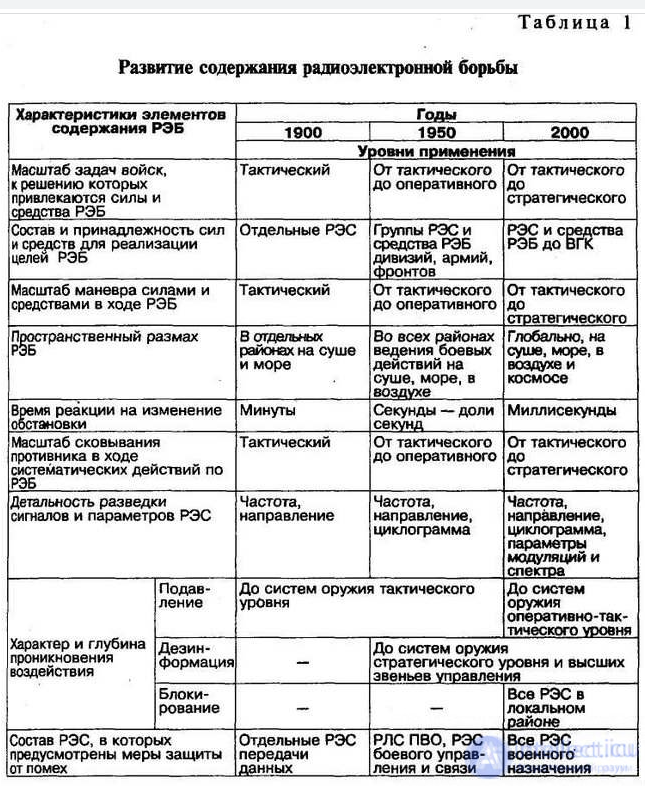
The table shows that at the beginning of the century EW was of an auxiliary nature and was characterized by: an extremely limited set of assets (one or a few RES) adapted for conducting it; the absence of specialized EW assets (jamming, reconnaissance, etc.); rarely realized joint, integrated use of RES in the interests of all EW elements; the conduct of EW in local areas (on land and at sea) within the framework of individual tactical-scale combat episodes; and the creation (to disrupt radio communication) of only masking barrage jamming, with a response time to changes in the situation on the order of several minutes. World War II gave a powerful impetus to the development of EW content: RES were used on a broad scale to solve not only tactical but also operational tasks.
Under modern conditions, when forces and assets can be employed to accomplish tasks at the operational and even strategic level with global spatial scope and an almost instantaneous response time to changes in the situation, electronic warfare is gradually acquiring, in its content, the features of a distinct type of combat operations aimed at achieving an advantage (or denying the enemy an advantage) in the information component of armed conflict provided by radio-electronic assets.
The analysis conducted makes it possible to define the content of EW as a set of organizational and technical measures for preparing and employing RES in an operation (battle), carried out with the aim of gaining an advantage (or denying the enemy an advantage) within specific spatial and temporal scales by disorganizing the functioning of the enemy's radio-electronic assets, systems, and RES groupings, restricting or constraining them, and protecting one's own RES and systems from similar enemy actions.
In line with the evolutionary change in EW content, its new forms have also taken shape over the course of several decades.
By the form of EW we mean the organization of the employment of forces and assets under a single concept and plan to achieve a specific EW objective in a given operational-tactical situation. The dynamics of the development of EW forms are presented in Table 2.
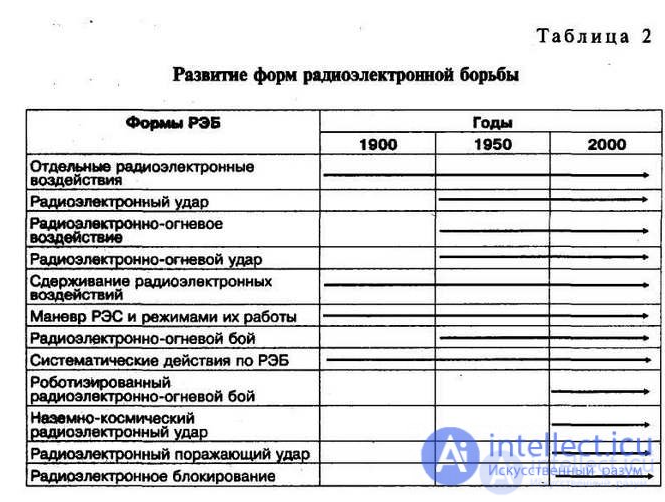
For all the variety of jamming techniques (in terms of nature of application, depth of effect, and other parameters), they all initially took a single form that first appeared during the Russo-Japanese War of 1904-1905 — individual electronic actions. This is explained by the fact that, up until the 1940s, the introduction of radio electronics into the armed forces proceeded comparatively slowly.
The large-scale use of RES during World War II stimulated the emergence of new forms of EW. Radio-electronic assets began to be used more often for short periods, unexpectedly for the enemy, in a given area or direction, to disorganize communication and control assets and create preconditions for seizing the initiative. In operational art, this form of operational (combat) employment of forces and assets is characterized as a strike. Since this involves an effect on the enemy produced by radio-electronic assets with damaging factors not characteristic of other means of destruction, it would be legitimate to single out this type of strike and define it as an electronic strike. Accordingly, an electronic strike can be described as a set of relatively short-duration effects coordinated in objectives, tasks, place, and time, carried out by EW forces and assets under a single concept and plan in accordance with the electronic situation, to accomplish the tasks of disorganizing the functioning of radio-electronic assets and systems (including troop and weapon control systems) within set time frames. Depending on the composition of the forces and assets involved, electronic strikes may be single strikes carried out by individual units, group or massed strikes carried out by operational-tactical groupings, and, depending on the spatial scope of the action, concentrated (a strike against a single object or a local grouping of objects) or dispersed (a strike against several spatially separated objects).
When disorganizing highly protected radio-electronic systems, the available RES resource may prove insufficient. This is why the combined use of fire-strike assets and EW assets is often necessary. In local wars, beginning with the Vietnam War, a tactic became fairly typical for aviation penetrating an air defense system, whereby EW assets engaged reconnoitered air defense radars from a great distance, forcing backup radars to switch on; these, in turn, were struck at closer range by fire strikes using weapons homing on emissions (missiles, bombs, etc.). Such a combined effect, in the form of an electronic-fire effect, is especially effective when there is a shortage of intelligence data on the deployment and characteristics of the radio-electronic assets being suppressed (destroyed).
When the task is to disable, for a set period, deeply echeloned air defense radar systems and widely branched, duplicated communication and command-and-control systems, it is expedient to apply electronic and fire effects simultaneously against the most important directions or key links of these systems in the form of a strike. By analogy with, for example, a missile-and-aviation strike, such a strike can be defined as an electronic-fire strike. An electronic-fire strike is a set of electronic, electronic-fire, and fire effects coordinated in objective, tasks, place, and time, carried out by heterogeneous forces and assets under a single concept and plan in accordance with the operational-tactical situation, to accomplish the tasks of disorganizing the use of radio-electronic assets and systems along individual directions. Examples of electronic-fire effects and electronic strikes can be found in practically all the local wars and armed conflicts of the 1960s-1990s.
Alongside the development of techniques for electronic effects, techniques for countering them also evolved. The form of action taken by RES crews, units, and formations to implement techniques and methods ensuring the stable functioning of RES under conditions of deliberate electronic effects can be characterized as countering the enemy's electronic effects. It should be noted that, despite the constant improvement in the effectiveness of countermeasures, at any stage in the development of radio electronics the means of generating electronic effects were potentially always able to suppress any RES with fixed operating modes and a fixed location, however effective the techniques and methods for ensuring RES jam resistance, and however promptly and fully countermeasures against electronic effects were implemented. For this reason, measures supporting the use of RES under conditions of electronic effects came to be organized so that the defending side could combine countermeasures with maneuvering its operating modes and, where possible, the location of its RES.
Maneuvering radio-electronic assets and their operating modes emerged and was practiced as early as the beginning of the century and, in modern terms, consists of changing positions and operating modes, using backup (duplicate) radio-electronic assets and systems, and creating false positions, groupings, and networks of RES.
The high effectiveness of RES maneuver was convincingly demonstrated in the Persian Gulf theater. After 10 days of deliberate Multinational Force (MNF) combat operations to disable Iraq's air defense system and control system, about 20% of Iraq's air defense radars survived thanks to the reserve on hand, and by creating false radio links, the Iraqi command managed to retain control of its forces. Despite five months of reconnaissance conducted from the ground, from the air, and from space, American intelligence services were never able to uncover the true deployment locations of the enemy's mobile missile complexes or establish their exact number. Iraq achieved this concealment by installing a large number of radio-emitting decoy launchers. Thus, the scale of RES maneuver and operating-mode maneuver in the interests of conducting EW was practically realized in combat operations at the operational-tactical level.
In addition to countering electronic effects and protective maneuvering of RES and their operating modes, active EW actions are usually also envisaged, in the form of retaliatory electronic effects and strikes. The exchange of such effects leads to an organized armed clash between formations, units, and subunits (including EW units and subunits), which by its form is defined as combat. Accordingly, a set of individual electronic effects, electronic and electronic-fire strikes, countermeasures against electronic effects, and RES maneuver coordinated in objective, place, and time, aimed at damaging the enemy and/or preventing damage to one's own forces, can be defined as electronic-fire combat. As recent combat experience has shown, this form of EW is especially effective in organizing defense against the enemy's precision-guided weapons (PGW). The purpose of conducting EW against PGW, as an information-intensive type of weapon, is to maximally restrict the enemy's ability to acquire and transmit information, thereby eliminating its main advantage over other types of weapons. This can be achieved through electronic effects and strikes against PGW reconnaissance, guidance, navigation, and control assets, by disrupting the normal state of the atmosphere and, if necessary, of outer space using EW assets, while organizing the maneuver of one's own forces and assets and delivering fire strikes against PGW carriers.
It is evident that effective conduct of EW during combat operations presupposes the advance creation of the appropriate conditions. This can be achieved through the electronic equipping of positional areas, information support for EW, and concealing important information about one's own RES from the enemy. As a rule, these measures are advance, continuous, and systematic in nature; they constrain and limit the actions of the opposing side and create preconditions for inflicting damage on it in both peacetime and wartime. This form of action (characteristic above all of Air Defense Troops, the Air Force, and the Navy) is characterized as systematic combat operations and, as applied to electronic warfare, can be called systematic EW actions.
The analysis conducted makes it possible to identify the main trends shaping the development of EW content and its corresponding forms. These include: first, a sharp increase in the degree of automation of reconnaissance and jamming processes, and the expanding use of artificial intelligence methods in EW complex control systems; second, the advanced development and fielding, ahead of other systems, of ELINT (electronic intelligence) and monitoring systems used as the information component of reconnaissance-strike and reconnaissance-fire complexes; third, a significant increase in the massed employment of EW forces and assets, expanding the spatial areas covered by electronic effects through an increase in the number of assets and the power of the electronic effects generated by individual EW assets; fourth, greater integration of EW forces and assets with fire-strike assets when delivering combined electronic-fire strikes; and fifth, the expansion of spatial scope and the gradual extension of EW methods into outer space.
These trends make it possible to outline directions for the further development of EW content and forms. The intensively developing robotization of military equipment has also been reflected in EW technology. Notable progress has been made in creating unmanned reconnaissance aircraft, jamming platforms, and carriers of emission-homing weapons, whose use in combat significantly supplements other airborne EW assets. However, their greater maneuverability, survivability, and ability to perform tasks in extreme situations will apparently, in the future, allow the range of tasks solved by robotic EW assets to be expanded. Their mass employment by both sides will, in the course of combat operations, lead to a bilateral exchange of electronic and fire strikes along individual directions, which in form may constitute robotic electronic-fire combat.
The expansion of the spatial scope of electronic intelligence gathering through the use of space-based systems, and the use of its results to organize EW on land, in the air, at sea, and in space, provide grounds for characterizing such systematic EW actions as global. The possible combined use, in this case, of space-based and other reconnaissance assets together with jamming assets makes it possible to speak of a fundamentally new and promising form of strike — the ground-space electronic strike. It will be distinguished by an instantaneous response to changes in the electronic situation and by the considerable size of the spatial areas covered by individual sources of electronic effects anywhere on Earth and in space.
The formation of dense RES groupings and the drive to increase the effectiveness of electronic effects will lead to further enrichment of EW content through the creation of electronic warfare techniques and assets capable of exerting a suppressive effect not on a single asset but on an entire RES grouping. Such assets include sources of powerful high-frequency ultra-short-pulse radiation, whose use could lead to the mass disabling of RES electronic devices in local areas. Since such an electronic effect, in the form of a strike, results in the destruction of RES (as components of weapons and military equipment), it will take the form of an electronic destructive strike. Another possible direction for increasing the massed™ nature of electronic effects is the use of so-called geophysical means of creating artificial zones of increased ionization in the atmosphere and/or outer space, which impede the propagation of radio waves and block the exchange of information over radio links between a local area on the ground or in space and other areas. In this case, the scope of EW measures covers groupings of forces and assets at the local operational-tactical level and can expand to the global level when information exchange over critical space radio links is disrupted. In this case, EW content is characterized by the formation of one or more electronic effects coordinated in place and time, with the tasks of «cutting off» the RES of a local area from others, excluding the most important links from control loops or information interaction, and blocking sources or consumers of information. Such operational-tactical techniques are widely used in air and naval combat operations, for example to prevent aircraft from taking off from home airfields or ships from leaving sea ports or straits. One or more electronic effects and/or strikes coordinated in place and time, carried out by a designated composition of EW forces and assets to exclude information exchange over the radio links of a local area with other areas, has a specific form — electronic blocking.
The history of the formation of Russia's electronic warfare (EW) troops is dated from 15 April (2 April, Old Style) 1904. On that day, during the Russo-Japanese War, the signalmen of the battleship «Pobeda» and of the naval telegraph station on Golden Hill (Zolotaya Gora) managed, by setting up radio jamming, to completely suppress the radio transmitter of a light Japanese protected cruiser that was within direct line of sight but out of firing range, thereby disrupting the radio-corrected shelling of the Russian squadron and the Port Arthur fortress by the Japanese armored cruisers «Nisshin» and «Kasuga» and by obsolete cruisers with heavy armament. Instead, by correcting the fire of their own battleships from the heights themselves, they were able to threaten the enemy with 12" and 10" shells fired along a steep trajectory with unpredictable consequences, forcing the Japanese to retreat.[14] This was the first recorded instance in world history of the suppression of communications used as a weapon for military purposes.
15 April was declared a holiday in honor of this event — «Electronic Warfare Specialist Day».
Before World War I, in 1911—1912, radio intelligence was conducted by intercepting the German High Seas Fleet transmissions using land- and ship-based stations at Libava, and disinformation was employed. During World War I, the communications of the headquarters of armies, corps, and smaller units of the principal adversaries — the armies of Germany and Austria-Hungary — were disrupted.
14 December 1942 — Memorandum from the People's Commissar of Internal Affairs of the USSR, L. P. Beria, to the Chairman of the State Defense Committee of the USSR, I. V. Stalin, on the need to establish, within the Red Army, a «Service for Jamming German Radio Stations Operating on the Battlefield»
16 December 1942 — I. Stalin signed State Defense Committee Resolution No. GOKO 2633 ss, «On the Organization, within the Military Intelligence Directorate of the Red Army General Staff, of a Department for Directing the Operation of Jamming Radio Stations»
23 September 1953 — the position of Assistant Chief of the General Staff for Electronic Intelligence and Jamming was established within the General Staff of the USSR Armed Forces
4 November 1953 — the staff of the Assistant Chief of the General Staff for Electronic Intelligence and Jamming was organized
26 June 1960 — the staff of the Assistant Chief of the General Staff for Radio Countermeasures was reorganized into the 9th Department of the General Staff (for combating the enemy's radio-electronic assets).
22 April 1964 — the 9th Department of the General Staff was incorporated into the Main Operations Directorate (GOU) of the General Staff.
22 January 1965 — the 9th Department was withdrawn from the Main Operations Directorate of the General Staff and re-designated as the 9th Department of the General Staff (for combating the enemy's radio-electronic assets).
8 July 1968 — the General Staff Electronic Countermeasures Service was formed on the basis of the 9th Department of the General Staff and the 8th Department of the General Staff Directorate.
8 April 1972 — the General Staff Electronic Countermeasures Service was reorganized into the 5th Directorate of the General Staff.
22 January 1974 — the 5th Directorate of the General Staff was reorganized into the 1st Directorate of the 2nd Main Directorate of the General Staff.
13 May 1977 — the General Staff EW Directorate was organized on the basis of the 1st Directorate.
6 June 1986 — the General Staff EW Directorate was transformed into the EW Directorate of the USSR General Staff's Main Directorate of Automated Control Systems and EW.
3 June 1989 — following the disbandment of the Main Directorate of Automated Control Systems and EW of the General Staff, the General Staff EW Directorate was separated out as an independent directorate.
3 May 1999 — Electronic Warfare Specialist Day was established, which is observed annually on 15 April.
19 January 2009 — the founding date of the Electronic Warfare Troops of the Russian Armed Forces
According to specialists, while the army and navy as a whole are expected to transition to the newest weapons by 70-75% by 2020, the strategic potential of the electronic warfare troops will be renewed by 100%.
Today, electronic warfare (EW) plays an important role in military strategy, performing two main functions. On the one hand, it is aimed at affecting the enemy's radio-electronic systems, using electromagnetic radiation to destroy or disrupt the transmission of important information in troop and weapons control systems. On the other hand, EW also provides protection for one's own radio-electronic systems against the effects of the enemy's EW forces and assets.
In modern military operations, EW has become one of the key elements of operational support for combat operations. The experience of recent armed conflicts shows that the use of EW can significantly increase the combat effectiveness of ground forces, reduce losses in aviation and among warships, and contribute to disorganizing the enemy's control systems.
The role of EW also extends beyond operational support and is becoming an important type of combat operation in its own right. Troops equipped with modern EW assets can independently perform tasks to disorganize the enemy's troop control systems and protect their own control systems.
The development of EW continues alongside changes in the military and economic spheres, the transformation of the defense industry, and the expanding use of radio-electronic assets in civilian fields. The growing role of EW in military operations underscores its strategic importance and relevance in modern military strategy.
Electronic warfare remains an important element of modern military strategy and continues to develop along with technology. It plays a key role in ensuring information superiority on the battlefield and in protecting one's own communication and detection assets from modern threats.The history of electronic warfare (EW) is a history of continuous progress in the field of electronic attack and electronic protection. Over the decades it has undergone significant changes, and its importance in military strategy has continuously grown. Thus, EW is an integral part of modern military strategy, playing a key role in ensuring information superiority and protecting one's own communication and detection assets from a variety of threats. The development of technology continues to shape its future, making this field even more important and dynamic in the sphere of national security and defense.

Comments