
Lecture
ADS-B (Automatic Dependent Surveillance-Broadcast) — a technology that allows both pilots in the aircraft cockpit and air traffic controllers at ground facilities to observe the movement of aircraft with greater accuracy than was previously available, and to receive aeronautical information; it is currently being introduced in the USA, Russia and other countries.
ADS-B also transmits real-time weather information to pilots. This information significantly enhances pilots' situational awareness and improves flight safety. Access to ADS-B information is free and open to everyone.
An aircraft equipped with an ADS-B transponder transmits its coordinates to everyone throughout the entire flight, along with other data such as heading, altitude, and horizontal and vertical speed. ADS-B receivers, built into air traffic control systems as well as installed on board aircraft, ensure accurate display on the radar screen of the movement of ADS-B-equipped aircraft, both in the air and on the ground.
Historically, ADS-B evolved from the following systems:
Aircraft coordinates are transmitted only in Mode-S.
When an aircraft's transponder receives a request from a ground radar, it acknowledges receipt of the request by emitting a pulse-position modulated (PPM) signal at a frequency of 1090 MHz.
Regardless of whether a request has been received from a ground radar, approximately once every second the aircraft transmits an extended squitter; this squitter contains the aircraft's location coordinates.
ADS-B is based on the GPS system (not strictly required, an IRS is sufficient) to determine the aircraft's precise coordinates in space. This positional information is combined with other information, such as the aircraft type, speed, its tail number, flight number, heading, vertical speed, and is then broadcast approximately once every second.
Other aircraft and ground stations equipped with ADS-B, within a radius of approximately 150 miles, receive this information. Ground stations combine the information received from various points with additional information obtained from ground radars for non-ADS-B-equipped devices, and relay the data to all aircraft within the service radius.
Traffic situation and weather information can be displayed in the cockpit if the aircraft is equipped with ADS-B.
ADS-B receivers (ADS-B IN) — devices of this class receive ADS-B data, but cannot transmit ADS-B data to other aircraft or ground stations. The receiver obtains both traffic information and weather information. At present the FAA has limited the implementation of ADS-B such that ground stations will transmit traffic data (including radar data) only after receiving information from at least one ADS-B transmitter aboard an aircraft, transmitted within the service radius. Thus, an aircraft equipped with an ADS-B receiver may not «see» traffic data if there are no aircraft with ADS-B transmitters in the coverage area, or if they are not transmitting a signal. Weather information, however, is always transmitted by ground stations and is always available for reception via an ADS-B receiver along air routes.
ADS-B transmitters (ADS-B OUT) — devices of this class are able to transmit ADS-B data. Transmitters can also «wake up» ADS-B ground stations and switch them into a mode that broadcasts the air traffic picture to aircraft within their coverage area. ADS-B devices capable of transmitting an aircraft's position and flight path must be certified by the FAA.
ADS-B transceivers — this is a class of devices capable of both transmitting and receiving ADS-B data. ADS-B transceivers can «wake up» FAA ADS-B ground stations and switch them into a mode that broadcasts traffic to aircraft within their coverage area. ADS-B devices capable of transmitting an aircraft's position and flight path must be certified by the FAA.
Traffic Information Services-Broadcast (TIS-B) — a component of ADS-B technology that provides a free air traffic surveillance service for aircraft equipped with ADS-B receivers.
TIS-B allows aircraft equipped with non-ADS-B transponders to transmit their location (obtained using radar) to aircraft equipped with ADS-B.
Flight Information Services-Broadcast (FIS-B) — a component of ADS-B technology that broadcasts free weather information, flight time restrictions and special air traffic information.
With ADS-B, pilots see the same kind of aircraft traffic information on their cockpit displays as is shown on controllers' screens. This greatly improves pilots' situational awareness, since they know their position relative to other aircraft and receive information about deteriorating weather and about difficult terrain.
ADS-B provides a greater margin for conflict detection, since its effective range exceeds 100 miles. Pilots can see the location, heading, speed and altitude of other aircraft. ADS-B provides pilots with services such as graphical display of weather conditions and text flight advisories at a lower cost than was previously possible, and without paid subscriptions to such services.
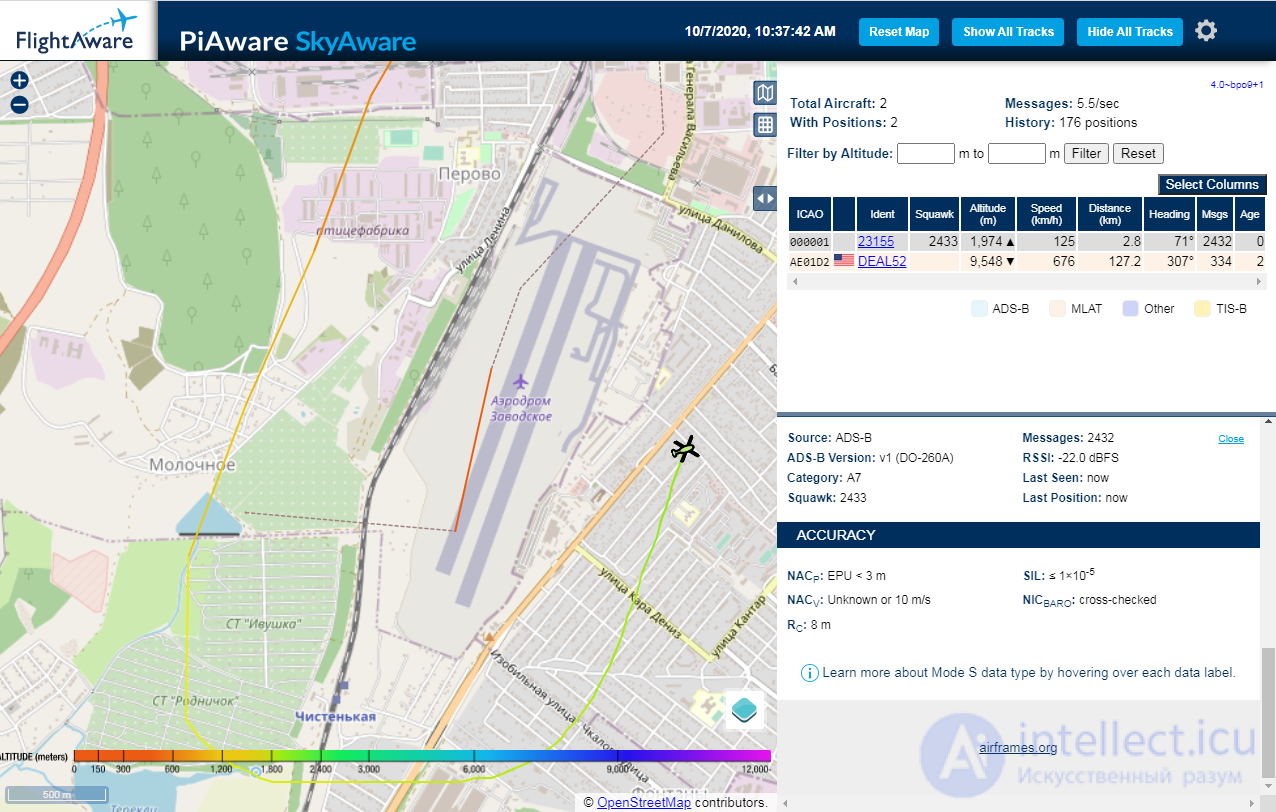
There are projects for tracking aircraft in flight using ADS-B receivers installed by enthusiasts in their homes and other locations. Data from these receivers is sent over the Internet to a central server, where it is combined from thousands of volunteers and enthusiasts and plotted on a map. Because aircraft generally fly at high altitude, the radio line-of-sight range is sufficient to allow observation within a radius of up to hundreds of kilometers. In this way it is possible to cover large territories in different countries around the world. One of the best-known such projects is Flightradar24.
Thanks to the use of SDR technology, receiving ADS-B signals is possible at minimal cost.

Comments