
Lecture
Phase-shift keying (PSK, English: phase-shift keying (PSK)) — is one of the types of phase modulation in which the phase of the carrier wave changes abruptly depending on the information message.
In quadrature phase-shift keying (QPSK — Quadrature Phase Shift Keying, or 4-PSK), a constellation of four points placed at equal distances around a circle is used. Using 4 phases, QPSK carries two bits per symbol, as shown in the figure. Analysis shows that the data rate can be doubled relative to BPSK for the same signal bandwidth, or the rate can be kept the same while halving the bandwidth.
Although QPSK can be regarded as quadrature amplitude modulation (QAM-4), it is sometimes easier to think of it as two independent modulated carriers shifted by 90°. In this approach, even (odd) bits are used to modulate the in-phase component {\displaystyle I} , while odd (even) bits modulate the quadrature component of the carrier {\displaystyle Q}
 . Since BPSK is used for both carrier components, they can be demodulated independently.
Under coherent detection, the bit error probability for QPSK is the same as for BPSK:
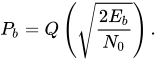
However, since there are two bits per symbol, the symbol error rate increases:

At a high signal-to-noise ratio (which is required for real QPSK systems), the symbol error probability can be approximately estimated using the following formula:
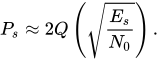
As with BPSK, there is a problem of initial-phase ambiguity at the receiver. Therefore, in noncoherent detection, QPSK with differential coding is more commonly used in practice.
The difference between QPSK and the earliest types of modulation (ASK, FSK) is that the density of transmitted information per unit of channel bandwidth (per symbol, per hertz) is greater than one.
For example, in ASK the density is much less than one (0,1—0,001 bit/Hz) — this is due to the need to accumulate energy in the filters of the early, low-sensitivity receivers (for instance, the Russian radio inventor A. S. Popov used ASK in the world's first receiver). In FSK, this figure approaches one (0,1—1) bit/symbol (bit/Hz). For example, in GMSK, used in GSM, the information density equals 1.
This type of modulation is used, for example, in the CDMA2000 1X EV-DO cellular communication standard.
Shown here are two separate constellations using Gray coding, rotated 45° relative to each other. Typically, even and odd bits are used to determine the points of the corresponding constellation. This leads to a reduction of the maximum phase jump from 180° to 135°.
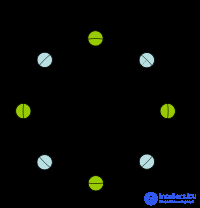
Phase constellation for quadrature π/4 PSK.
On the other hand, the use of π/4-QPSK leads to simple demodulation, and as a result it is used in cellular communication systems with time-division multiplexing.
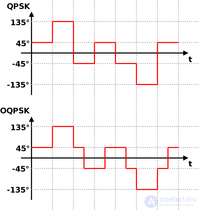
Comparison of OQPSK and QPSK

Comments