
Lecture
A Cognitive Radio System (CRS) is a radio system capable of obtaining information about the characteristics of its own operation and, on the basis of this data, adjusting its operating parameters.
Cognitive radio (CR) is a radio receiver that can be programmed and dynamically configured to use the best wireless channels in its vicinity, in order to avoid user interference and congestion. Such a radio station automatically detects available channels in the wireless spectrum and then adjusts its transmission or reception parameters accordingly, to enable simultaneous wireless communication within a given spectrum band in a single location. This process is a form of dynamic spectrum management.
Cognitive radio is an advanced technology on the way to more rational use of the radio-frequency spectrum
The mechanism of dynamic spectrum management is applied in intelligent radio systems. The term cognitive radio (CR) has been proposed to describe them. A distinctive feature of such systems is:
ITU-R Report 2117
“Cognitive radio is a radio system that uses radio communication technologies with programmable parameters and other technologies to automatically configure its operating mode in order to achieve desired objectives. Such a radio system is capable of accumulating knowledge about operating conditions, as well as dynamically and independently adapting its operational parameters to the corresponding environment, and can remember the results of its actions and the models used for a given environment
Cognitive radio is not a separate radiocommunication service, and can be used as a technology within any of the existing radio services. For a radiocommunication service to use cognitive radio systems in a given frequency band, that service must have an allocation in the corresponding frequency band with the right to operate on a primary or secondary basis.
Cognitive radio technologies can be used when reconfiguring connections between terminals and multiple radio systems, by radiocommunication system operators for more efficient management of the radio-frequency spectrum resources they use, as a tool for collective access to the radio-frequency spectrum, and as a tool for organizing more flexible access to the radio-frequency spectrum.
The following classification of cognitive devices has been adopted, based on the method they use to access the radio-frequency spectrum, ensuring the exclusion of radio interference to existing radiocommunication facilities:
A combination of these methods is also possible.
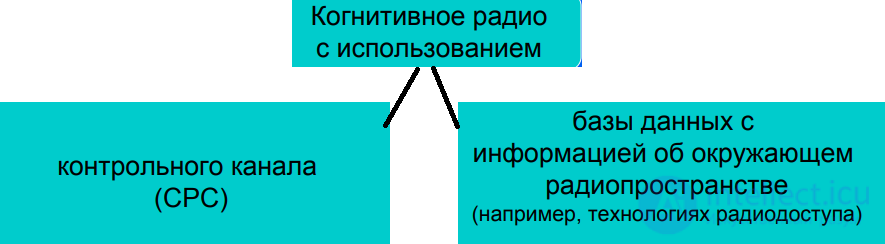
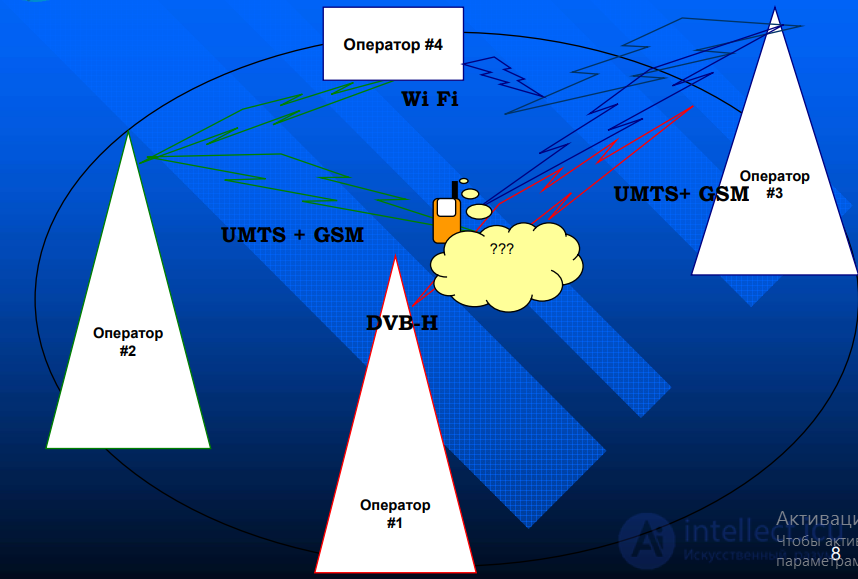
Cognitive system with a control channel
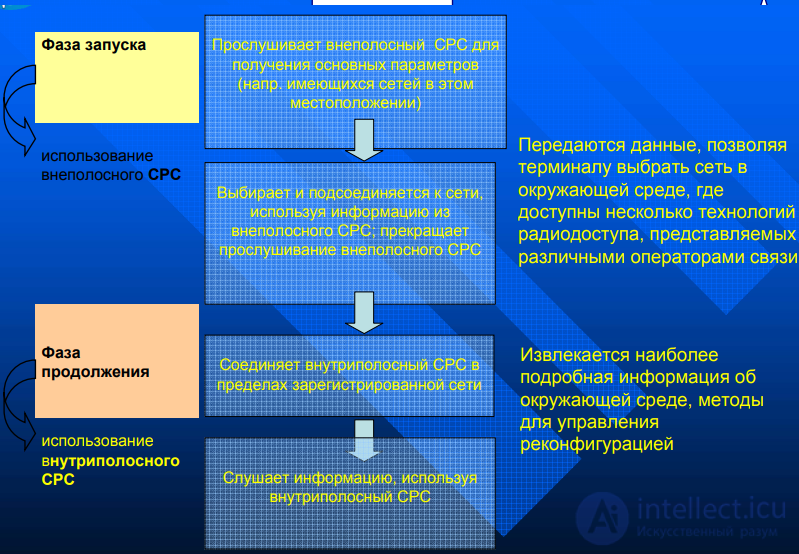
Terminal operation process with a control channel (CRS)
Main functions of the control channel:
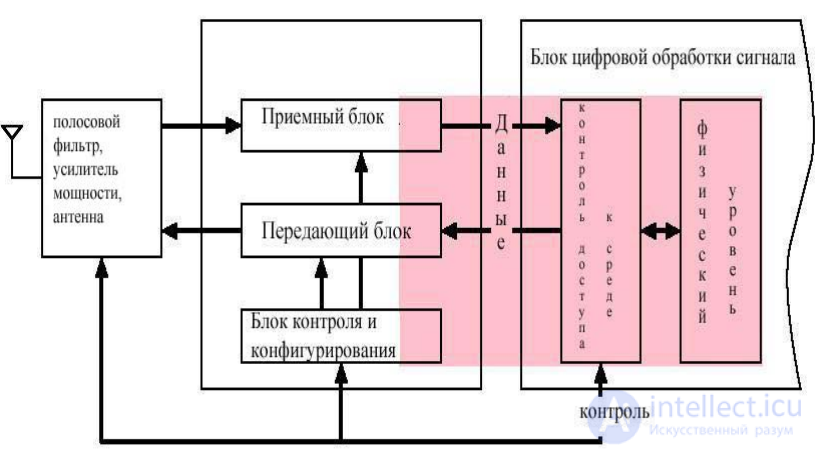
Cognitive radio systems can cover a range of Radio Access Technologies, and self-configuring networks of various network topologies will be able to make use of spectrum based on what is available locally. In this connection, it is necessary to determine the location and characteristics of other radio access technologies within the frequency band covered, which is reachable from a mobile terminal, as well as to scan the entire tuning range, in order to determine local spectrum usage.
Within the European Union, it was determined that devices must:
Research conducted to date has shown that to guarantee the exclusion of interference to existing radio equipment from cognitive radio systems, it is necessary to use a geolocation database containing information on the location and operation of protected radiocommunication facilities . The database ensures the selection of operating frequencies for cognitive radiocommunication systems in such a way as to ensure both the possibility of their operation and the absence of interference to other radiocommunication systems and facilities. In this case, other radio-electronic facilities (operating under the normal frequency assignment procedure) have priority in the use of radio-frequency channels over cognitive radio systems.
In practice, this means that if a certain frequency band or radio channel begins to be used by other radio equipment, the cognitive radio system using that band or channel must switch to another frequency/channel. Thus, cognitive radio technology cannot in principle be used as the sole technology for providing, for example, paid services, since the constant availability of radio-frequency spectrum for cognitive radio operation is not guaranteed.
Depending on the transmission and reception parameters, two main types of cognitive radio are distinguished:
Other types depend on the parts of the spectrum available to the cognitive radio:
Although cognitive radio was originally conceived as an extension of software-defined radio (full cognitive radio), most of the research work has focused on spectrum-sensing cognitive radio (especially in television bands). The main challenge of spectrum-sensing cognitive radio is the development of high-quality spectrum-sensing devices and algorithms for exchanging spectrum-sensing data between nodes. It has been shown that a simple energy detector cannot guarantee accurate detection of signal presence, [14] requiring more sophisticated spectrum measurement methods and requiring regular exchange of spectral measurement information between nodes. Increasing the number of cooperating sensing nodes reduces the probability of false detection. [15]
One possible approach is adaptive filling of free radio-frequency bands using OFDMA. Timo A. Weiss and Friedrich K. Jondral of the University of Karlsruhe proposed a spectrum pooling system, in which free bands (sensed by nodes) were immediately filled with OFDMA sub-bands. Applications of spectrum-sensing cognitive radio include higher throughput for emergency networks and WLANs and increased transmission range. Cognitive radio is evolving towards cognitive networks; the concept of cognitive networks is the intelligent organization of a network of cognitive radios.
The main functions of cognitive radio:
Practical implementation of spectrum management functions is a complex and multifaceted matter, since it must comply with numerous technical and legal requirements. An example of the former is the choice of an appropriate sensitivity threshold for detecting other users, while an example of the latter is the need to comply with the rules and regulations established for access to the radio-frequency spectrum in international (ITU Radio Regulations) and national (telecommunications law) legislation.
Smart antennas (or smart antenna systems) are an antenna technology that uses spatial beamforming and spatial coding to suppress interference; nevertheless, applications are emerging for extending intelligent multiple or cooperative antenna arrays for use in complex communication environments. Cognitive radio, by comparison, allows user terminals to determine whether a portion of the spectrum is being used, for spectrum sharing with neighboring users. The following table compares the two:
| Point | Cognitive Radio (CR) | Smart Antenna (SA) |
|---|---|---|
| Primary goal | Open spectrum sharing | Spatial reuse of the environment |
| Interference handling | Avoidance via spectrum sensing | Cancellation via spatial pre-coding/post-coding |
| Key cost | Spectrum sensing and multi-band RF | Multiple or cooperative antenna arrays |
| Complex algorithm | Spectrum management technology | Intelligent spatial beamforming/coding technology |
| Applied techniques | Cognitive software radio | Generalized dirty paper coding and Wyner-Ziv coding |
| Baseline approach | Orthogonal modulation | Smaller-sized cellular communication |
| Competing technology | Ultra-wideband for greater band utilization | Multi-sectoring (3, 6, 9, etc.) for higher spatial reuse |
| Summary | Cognitive spectrum-division technology | Intelligent spectrum-reuse technology |
Note that both methods can be combined, as shown in many modern transmission scenarios. [28]
Cooperative MIMO (CO-MIMO) combines both methods.
Cognitive Radio (CR) can sense its environment and, without user intervention, can adapt to the user's communication needs while complying with FCC rules in the US. Theoretically, the amount of spectrum is infinite; in practice, for propagation and other reasons it is finite, owing to the desirability of certain portions of the spectrum. Assigned spectrum is used far from fully, and its efficient use is a growing concern; CR offers a solution to this problem. CR can intelligently determine whether any portion of the spectrum is in use, and can temporarily use it without interfering with the transmissions of other users. [29] According to Bruce Fette, «some of the other cognitive capabilities of a radio include determining its location, determining spectrum use by neighboring devices, changing frequency, adjusting output power, or even changing transmission parameters and characteristics. All these capabilities, along with others yet to be implemented, will give wireless spectrum users the ability to adapt to spectrum conditions in real time, offering regulators, licensees and the general public flexible, efficient and comprehensive use of the spectrum».
Examples of applications include:
Currently, modeling and simulation is the only paradigm that allows complex behavior in cognitive radio networks of a given environment to be modeled. Network simulators such as OPNET, NetSim, MATLAB and ns2 can be used to model a cognitive radio network. CogNS [37] is an open-source NS2-based modeling platform for cognitive radio networks. Research areas using network simulators include:
Network Simulator 3 (ns-3) is also a viable option for modeling CR. [40] ns-3 can also be used for simulation and experiments in CR networks using standard hardware, such as Atheros WiFi devices. [40]
The success of the unlicensed band in accommodating a range of wireless devices and services has prompted the FCC to consider opening additional bands for unlicensed use. In contrast, licensed bands are underutilized due to static frequency allocation. Recognizing that CR technology can make use of inefficiently used licensed bands without causing interference to existing users, the FCC issued a Notice of Proposed Rulemaking that would allow unlicensed radios to operate in television broadcast bands. The IEEE 802.22 working group, formed in November 2004, is tasked with defining an air interface standard for wireless regional area networks (based on CR sensing) to operate in the unlicensed spectrum of the distributed television service.[41]To comply with the FCC's later rules on unlicensed use of TV spectrum, IEEE 802.22 defined interfaces to a mandatory TV white space database, in order to avoid interference to existing services.
Further work on the development of cognitive radio:
Development of provisions for equipment certification and compliance;
The E2R Consortium, together with the European Telecommunications Standards Institute (ETSI), is conducting a study of the following issues:
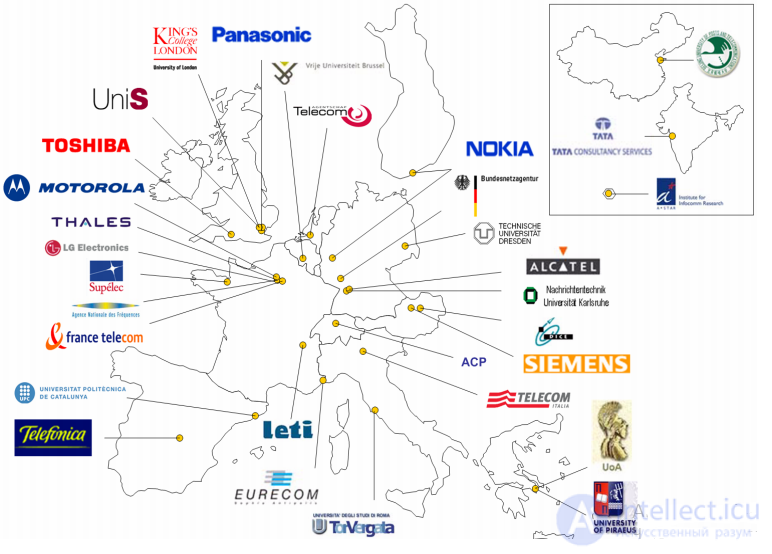
32 organizations from 14 countries, budget of 19.0 million euros
The E2R Consortium, including the largest telecommunications operators

Comments