
Lecture
Pricing policy is an important element of the marketing mix. Pricing policy — is the principles and methods of determining prices for goods and services. There are micro- (at the firm level) and macro- (in the sphere of state regulation of prices and tariffs) levels of price formation.
It should be noted that price has significant advantages as an element of sales policy. First, in this case there are no additional costs for advertising the product, organizing its promotion to the market, etc.
Second, consumers assess the attractiveness of goods expressed in price much faster than on the basis of advertising, product individualization, etc.
The essence of pricing policy consists in establishing the optimal price level, its change over time by products and markets to achieve certain goals.
In this case, the goals may include:
- maximizing sales profitability, that is, the ratio of profit to the total amount of sales revenue;
- achieving higher rates of sales growth;
- solving the problem of overstocking under conditions of a general decline in purchasing power, or the presence of morally obsolete products;
- increasing financial stability through replenishing the settlement account with cash;
- staying in the market under conditions of economic decline or intensified activity of competitors;
- strengthening the enterprise's market position, increasing its share in a particular product market.
Price formation involves taking into account the following main factors:
Pricing methods:
1) cost-based methods;
2) demand-oriented methods;
3) methods of setting prices with an orientation toward competitors.
The cost-oriented methods include:
- markup method;
- method of ensuring a target return on capital;
- break-even analysis method.
Cost-based methods are simple to calculate, lead to a reduction in price competition when these methods are used by all manufacturers, and achieve a certain fairness by
maximally taking into account the interests of buyers and manufacturers.
However, they result in low motivation to reduce cost prices and do not take into account the state of demand and the level of competition. The main factor in setting prices based on demand is the buyer's sensitivity to price. Marketing assessment methods involve determining the price level at which the buyer will purchase the product. Prices in this case are oriented toward increasing
the product's competitiveness rather than toward satisfying the enterprise's need for financial resources to cover costs. Methods of setting prices with an orientation toward competitors involve taking into account the price level of similar competitors' products and the distinctive properties of the products. Depending on the enterprise's goals and the competitiveness of the products, the following pricing strategies can be distinguished (Table 10.1). The chosen strategy predetermines the price level, which should lie within a certain range, the «field of play» for setting prices. The «field of play» represents the difference between the upper and lower boundaries. The upper price boundary is determined by demand. This price is usually set for products with low price elasticity of demand, of very high quality, possessing some special, unsurpassed properties. In this case, selling at a high price is possible only if there is a sufficient segment of the market of buyers ready to pay a somewhat higher price than the majority of potential customers. Therefore, in this
case, justifying the price level requires the constant conducting
of marketing research.
Table 10.1 – Pricing strategies
| Types of pricing strategies |
Essence of the strategy |
Conditions of application |
| Strategy of premium pricing or skimming |
Setting prices somewhat higher than competitors |
The product possesses special properties that are of primary importance for the buyer |
| Strategy of neutral pricing |
Setting prices at the level of competitors |
The products of the enterprise and of competitors are identical in their consumer properties |
| Strategy of price breakthrough or reduced prices |
Setting prices lower than competitors |
The enterprise's goal – is to expand its presence in the market |
Setting low prices is economically justified in the following cases:
The lower price boundary must ensure simple reproduction for the manufacturer, that is, cover the costs of its production and sale. In addition, not all expenses are covered by the cost price (taxes, financing of capital investments, etc.). Calculating the threshold level of price reduction requires the use of a direct costing accounting and control system, the meaning of which lies in dividing costs into variable and fixed. A model based on the relationship between sales volumes, costs, and minimum prices is presented in Figure 10.1
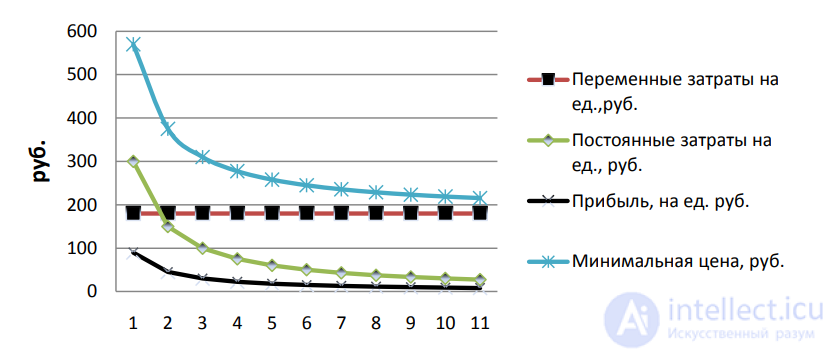
Figure 10.1. Relationship between sales volume, costs, and minimum prices
However, this model is relevant only under high price elasticity of demand.
In critical cases, the minimum price boundary may not cover the sum of fixed and variable costs. In this case, the price must ensure
a positive marginal income, which is calculated as the sum of profit from the production and sale of products and fixed costs.
Losses within the limits of fixed (overhead) costs are considered recoverable, and the loss of this amount is not critical.
Selling products at prices set at the level of variable costs is an extreme and temporary step that may be justified when there are
highly profitable products for which demand is limited. Excluding unprofitable products in this case would increase the cost of the highly profitable products and reduce their profitability.
Prices should have a certain flexibility, that is, they should react quickly to changes in market conditions and vary depending on the terms of purchase. This differentiation of price levels is achieved through a system of discounts and surcharges, which serve as
one of the main elements of a company's pricing policy.
Surcharges to the price are not provided for under the current pricing legislation. In this connection, let us consider the main aspects of establishing and justifying the size of discounts to the
price.
In global practice, the following types of discounts are the most common:
bonus discounts are given to regular customers if, over a certain period of time, they purchase an agreed quantity of goods of one type or of different items for an agreed amount.
cumulative discounts – these are discounts for purchasing goods worth a certain amount without any time limit;
dealer discounts are provided to dealers to cover their sales and service costs and to ensure profit;
quantity discounts are given as a certain percentage when goods are purchased in large batches;
cash discounts – these are discounts granted for making payments earlier than the deadlines set
by the contract;
special discounts are given to customers with whom the company has long-standing, close relationships, as well as to privileged customers whose orders are of particular interest to the company. Special discounts include discounts on trial batches and for regularity of orders. The size of such discounts is a trade secret.
seasonal discounts represent a price reduction for customers who make off-season purchases of goods. This is a flexible means of reducing inventory during periods when sales are difficult or when production capacity utilization is low.
A company's pricing policy is formed within the framework of the company's overall strategy and includes a pricing strategy and pricing tactics. Pricing strategy involves positioning the offered product in the market. There are various approaches to defining the target segment and building strategy (the Ansoff matrix, the BCG matrix, the Porter matrix). Pricing strategy also involves choosing the methods used to determine (set) prices, as well as the forms of price discrimination.
Subsequently, as part of implementing the strategy, tactical measures are developed (to stimulate sales), including systems of price discounts and non-price incentives for buyers.
In the course of implementing pricing policy, company management must adjust specific measures and monitor the timing of strategy changes. Prices are actively used in competition to ensure a sufficient level of profit. Determining the prices of goods and services is one of the most important problems for any enterprise, since an optimal price can ensure its financial well-being. The pricing policy pursued largely depends on the type of goods or services offered by the enterprise. It is formed in close connection with planning the production of goods or services, identifying consumer needs, and stimulating sales. Price should be set in such a way that, on the one hand, it satisfies the needs and wants of buyers, and on the other — contributes to achieving the goals set by the enterprise, which consist in ensuring the inflow of sufficient financial resources. Pricing policy is aimed at setting such prices for goods and services, depending on prevailing market conditions, as will allow the enterprise to obtain the planned amount of profit and solve other strategic and operational tasks.
Within the framework of the overall pricing policy, decisions are made in accordance with the enterprise's position in its target market and the methods and structure of its marketing. The overall pricing policy involves carrying out coordinated actions aimed at achieving the enterprise's long-term and short-term goals. In doing so, management determines the overall pricing policy, linking individual decisions into an integrated system: the interrelation of prices of goods within the company's product line, the frequency of using special discounts and price changes, the ratio of prices to competitors' prices, and the choice of method for setting prices for new products.
Determining pricing policy is based on the following questions:
The company's overall policy should ultimately be aimed at satisfying specific human needs. However, if a consumer is hesitant about which product to prefer, often basing the choice on unconscious considerations, the company, through an active sales policy, should try to influence the choice in favor of its own products. Therefore, determining pricing policy is one of the most important areas of a company's practical activity, since under no circumstances is it acceptable to set prices without a serious analysis of the possible consequences of each option for resolving this issue.
Pricing policy reflects the overall goals a company seeks to achieve by setting the prices of its products. Price policy — these are the general principles that a company intends to adhere to in setting the prices of its goods or services.
Using various pricing methods, a specific price is set depending on particular circumstances or the goals pursued. To make a final decision on prices, a manager must consider all the proposed price calculation options. In the process of setting a product's price, the enterprise (company) must clearly define the goals it wants to achieve. The clearer the understanding of these goals, the easier it is to set prices for new products. Possible pricing policy goals include:
When analyzing a competitor's price, primary attention should be paid to the system of discounts it offers. Global practice recognizes around 20 types of price discounts:
At the level of the economic system, general principles for price formation in the country are established (administratively or on the basis of a market mechanism). Subsequently, the government may intervene in the pricing of individual enterprises both within the framework of antimonopoly policy (tariff policy) and within the framework of maintaining price stability (price restrictions).
This type of policy is implemented as part of antimonopoly activity and support for competition in markets. As a rule, tariff (price) policy is used to regulate natural monopolies.
These are used by the government to curb inflation (as in France in the 1960s within the framework of indicative planning), as well as to support low-income citizens during periods of high inflation (restrictions on price increases for essential goods).
In their book "The Strategy and Tactics of Pricing," Thomas Nagle and Reed Holden identify nine "laws," or factors, that influence how a consumer perceives a given price and how sensitive to price they will be when making various purchasing decisions.
They are:

Comments