
Lecture
Product policy – a defined set of actions or deliberately considered methods and principles of activity, through which the continuity and purposefulness of measures for forming and managing the product assortment are ensured.
The term product policy is quite broad and covers various aspects of the enterprise's product strategy and tactics. It includes the formation of the product assortment, the modification of existing goods, the discontinuation of obsolete ones, the development and launch of new products into production, and ensuring an appropriate level of their quality and competitiveness. Therefore, it is important to create attractive product packaging, use a barcode, develop an effective brand and its official registration. The position of the product is reinforced by the organization of service, the guarantees provided by the firm, delivery terms, and the like. All of this together constitutes the essence of the firm's marketing product policy, aimed at maximally satisfying the needs of target consumers.
In other words – this is a set of measures where one or several products are used as the main tools of the firm's production and sales activity.
The main task of product policy is to create such a product or service and manage it in such a way that other elements of marketing activity are either used minimally as auxiliary means to achieve the firm's set goals, or are not needed at all.
Product policy — is the basis of any marketing concept. A product — is a carrier of expected utility for sellers and buyers. From the point of view of the manufacturing enterprise, the product or service is a means of achieving entrepreneurial goals (profit, turnover, market share, etc.). Figure 1 shows the main directions of product policy development.
Product policy is one of the types of economic policy .
The development and implementation of product policy require compliance with the following conditions :
The development of product policy involves performing the following list of tasks :
Goals of product policy:
Within the implementation of product policy, it is envisaged
to address the following issues:
Product strategy is developed for the future and may include
three strategic directions for improving the attractiveness of the product
range of the enterprise:
The product innovation strategy determines the program for developing and
introducing new products.
The product innovation process includes six stages:
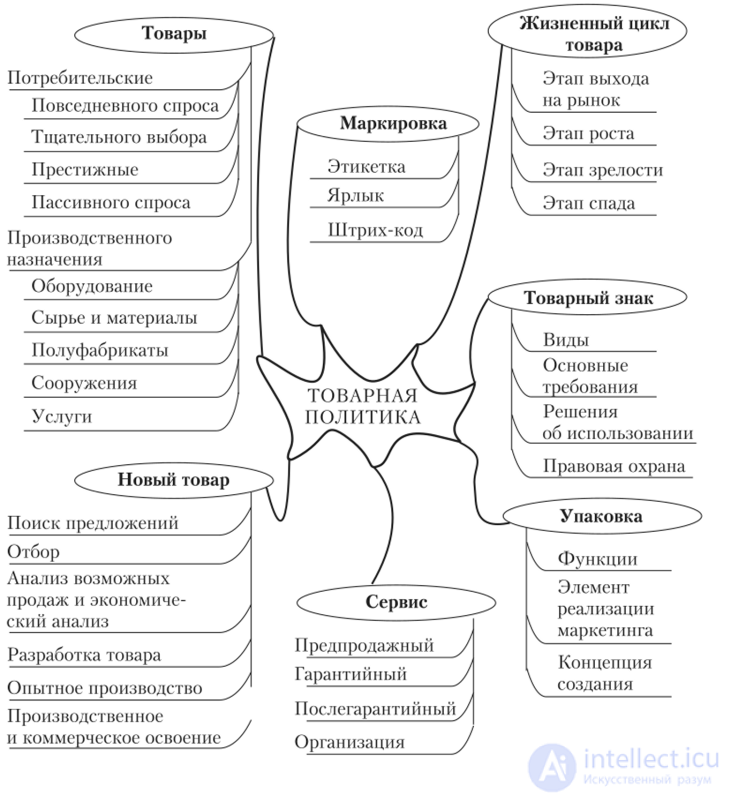
Fig. 1. Directions of product policy development
The process of developing a new product should reasonably be viewed as
a combination of two stages: 1) formation of technical parameters; 2)
formation of market parameters.
The formation of technical parameters is associated with endowing the new
product with such functional properties that will satisfy
the identified wishes (needs) of the buyer.
The formation of market parameters is achieved through
the development of the product's design, its shape, color, weight, packaging, name, and brand.
Trademark - is a name, sign, symbol, drawing, term, or a
combination thereof, intended to identify the product of one or
several manufacturers (sellers) and to distinguish it from competitors' products.
A brand may include a brand name, a brand mark, and a trademark.
Brand name - the part of the brand consisting of letters, words and/or their combinations,
which can be pronounced. A brand mark (logo) – is the part of the brand
that can be recognized but cannot be pronounced.
A trademark - a mark or part of it, legally protected, which gives
the seller the exclusive right to use the brand name and brand mark.
To ensure effective entrepreneurial activity of the
enterprise, the use of trademarks is of great importance. A trademark
represents a certain name, sound, sign, symbol, drawing, or
combination thereof, used to designate goods and allowing
the enterprise's goods to be distinguished from similar goods of competitors.
A trademark must be distinctive, simple, recognizable, and
attractive to potential consumers. It must also possess
the properties of protectability.
An enterprise may create its own trademark,
use the trademark (trade mark) of an intermediary, and also
obtain permission to use a well-known trademark from its
owner. If an enterprise has decided to use its own trademark, it
must first of all analyze the possible options for its application.
An individual trademark can be used for each
assortment item. It is also possible to apply a common trademark for
all of the enterprise's products. A single trademark can be used
for one or several assortment groups. Finally, an individual
trademark can be supplemented with the enterprise's name. Each of the indicated
options has both its own advantages and certain drawbacks.
Having a trademark allows an enterprise to conduct a more
effective policy of promoting the product to the market. At the same time, a widely
recognized trademark is usually called a brand. Ensuring broad
recognition of a trademark and making it successful is quite difficult.
Given this, some enterprises resort to counterfeiting or imitating
an already existing trademark, and sometimes even use it illegally.
To rule this out, most countries in the world have a
legislative framework that provides legal protection for trademarks. In
accordance with these laws, it is sufficient to register the trademark
with the appropriate government agencies to protect it. In
some countries (for example, in the United Kingdom), along with registering
the trademark, it is necessary, while using it, to carry out several sales
of the given product.
For manufacturers, a trade mark largely determines
subsequent advertising and sales activity, protects the owner
of the mark from unfair competition, allows for expanding or
diversifying the product assortment without additional advertising
costs, since the mark's recognition can be extended to new
products. In addition, trade marks help the seller segment the
market and increase the degree of control over marketing programs. Strong
marks help strengthen the firm's image and secure
the favor of intermediaries and consumers.
The role and importance of a trade mark for consumers lies in the fact
that it allows identifying products and their manufacturers, thereby
making it easier to choose among similar products, guaranteeing the same level
of quality for products with the same mark, and that customers' expectations will be
justified.
The process of managing trade marks:
In the process of creating and managing the company's brand, it will be necessary to solve
several serious tasks. Decisions when adopting a product brand:
Packaging refers to the container or wrapping of a product. It serves to
preserve the product, provide convenience in handling the product and its
transportation, and also performs such important marketing functions
as attracting consumers' attention, identifying the product, advertising and
information notification, and image formation. The importance of the marketing
functions of packaging is constantly increasing. This is due to such factors
of market reality as the development of self-service, the growth of
consumer welfare, the informatization and computerization of the economy,
and the recognition of company and trade mark image as factors accelerating
the purchase-and-sale process.
The process of developing packaging includes making the following decisions:
justification of the packaging concept, formation of additional
packaging characteristics (size, shape, material, color, text, placement
of the brand), packaging testing.
Packaging must be designed taking into account the following requirements: it must be
original and have patent protection; meet aesthetic
conditions; ensure functionality, i.e., be an element of the product;
exert an advertising effect; be inexpensive; ensure
the safety of the product on its way to the consumer; contribute to the rationalization
of storage and transportation costs; be convenient for selling the product;
reflect the product's competitiveness and its environmental friendliness; be
environmentally friendly; possess the ability to be used as secondary
raw material.
On the product's packaging or directly on the product itself, a
certain text is placed, symbols or drawings are applied, allowing
the product or its individual properties to be identified, and conveying to the consumer
information about the product and its manufacturer. This information is
the product's marking. Production marking and trade
marking are usually distinguished. The main purpose of marking — is to ensure the fulfillment of
informative, identifying, emotional, and motivational
functions.
The main carriers of marking can be labels, collar labels,
inserts, tags, tags, stamps, price tags, product or cash receipts, etc.

Comments