
Lecture
A company's marketing communication – a comprehensive influence
on the internal and external environment aimed at creating favorable conditions
for the company's stable and profitable operation on the market.
The communication process can be represented as follows (Figure 12.1).
Figure 12.1. The marketing communications process
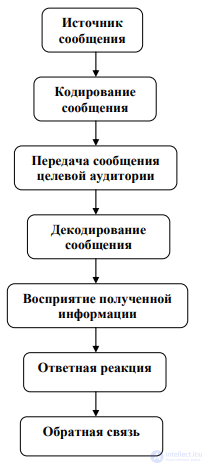
Message source->Message encoding->Message transmission->target audience->Message decoding->Perception of the information received->Response->Feedback
The set of communication tools is inseparably linked with a company's
marketing activity and to a large extent ensures its
effectiveness. It represents a two-way process:
The main task of the communication mix – is promoting
the product on the market.
Promotion – is the creation and maintenance of a company's ongoing ties
with the market in order to boost product sales and form a
positive image of the company on the market.
The main functions of communication policy are:
The main stages in developing and implementing a
communications system:
The main elements of the marketing communications system are:
Advertising – is a type of activity, or the output produced as a result
of it, the purpose of which is to accomplish the sales or other objectives
of enterprises by disseminating information paid for by them,
formulated in such a way as to exert a stronger influence on
mass or individual consciousness, evoking a desired response from the chosen
consumer audience.
The main types of advertising are product advertising and prestige advertising.
Product advertising informs the consumer about the properties and merits of a
product and arouses interest in it; the consumer seeks to establish
contact with the seller and turns from a passive, potential buyer into an
active one interested in purchasing.
Prestige, or corporate, advertising is advertising of
a company's merits that favorably distinguish it from competitors.
Depending on the means used, various types of advertising
are distinguished:
An advertising campaign – is the carrying out of comprehensive advertising activities, linked in a certain sequence, that help
increase interest in a product and are aimed at firmly establishing the product on the market.
When implementing a promotion policy, the specifics of the product should be taken into account (Figure 12.2).
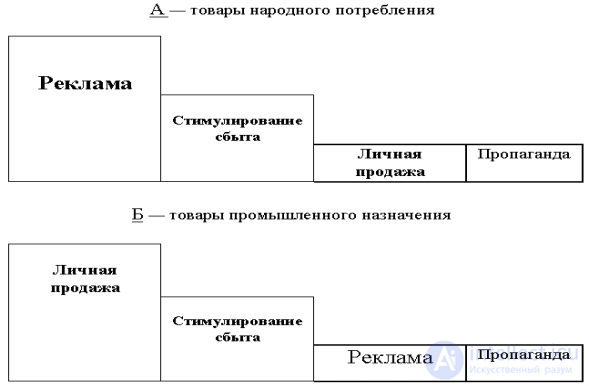
Figure 12.2. The relative importance of individual components
of the communications mix in different markets
The stage of the product life cycle should also be taken into account. For
consumer goods at the introduction stage, advertising and public relations
are of the greatest importance. Sales promotion and
personal selling follow.
At the growth stage, advertising also remains of primary importance
for promoting the product. However, the importance of public
relations decreases significantly, while sales promotion and personal
selling become more significant.
At the maturity stage, sales promotion becomes of primary
importance, while advertising is used only to remind consumers
of the product's existence. The importance of personal selling and public relations
remains roughly the same as at the growth stage.
At the decline stage, sales promotion is also of the greatest importance
for promoting the product; public relations are practically
not used, minimal attention is given to personal selling, and advertising
is used to remind consumers of the product's existence.
Planning an advertising campaign is carried out in the following
stages:
1) the objects of advertising (the product or the company) are determined, as well as the content
of the information about the product that needs to be communicated to active and
potential buyers;
2) the subject (addressee) of the advertising is determined, i.e., the group of consumers,
buyers, or persons influencing the purchase decision, to whom the
advertisements are addressed;
3) the motive of the advertising is determined – what is emphasized in the advertisement
in order to attract buyers' attention to the product;
4) the types of advertising media are chosen and the optimal
combination and ratio of them is determined (channels for distributing advertisements);
5) the advertising message is composed – a headline is formulated,
text is written, illustrations are determined, a character,
media, and musical piece are chosen;
6) a schedule of advertising appearances is drawn up – advertising
activities are coordinated in time (by month, week, day, hour,
minute, and second), by type of advertising and the media used to distribute it;
7) an estimate of expenses for advertising activities is drawn up –
the total amount of expenses is determined, along with expenses broken down by individual
items;
8) advertising effectiveness is preliminarily determined –
the sales advantages to be gained from the planned advertising
campaign are calculated in quantitative terms.
Sales promotion strategies fall into three main types:
1. Sales promotion aimed at end users, or
consumers. Intended to increase the volume of purchases made by consumers.
The main advantages of such promotion methods lie in their
variety and flexibility.
Let us consider the main methods of consumer promotion:
1. Price-based measures – a temporary reduction in a product's price. They are widely used to encourage the "trial" purchase of a new product or to
persuade existing consumers to buy more and more often. They are effective only when price is an important factor in
choosing a brand, or when consumers are not brand-loyal. There are two types of consumer price-based measures.
2. Non-price methods: encouraging the purchase of a product by pairing it with another product, indirect variants (tastings, samples, packaging designed for multipurpose
use), etc.
2. Trade/personnel incentives.
3. Incentives for intermediaries.

Comments