
Lecture
To ensure effective implementation of marketing, it is necessary
to have complete, reliable, and timely information on all
areas of the enterprise's activity, including in the field of marketing.
Such information can be obtained from various sources. These may
be data from the enterprise's internal and external reporting, materials
from government administrative bodies and statistical reporting data, as
well as information contained in various documents of ministries and
agencies, materials of research organizations, universities, exchanges,
auctions, tenders, and other enterprises. Using all these sources,
a database is created and continuously improved, the main component
of which is information about the micro- and macro-environment of marketing. This
database is constantly replenished thanks to the analysis of marketing information
contained in management decisions being made, as well as based on
the use of the results of marketing research conducted.
Marketing research represents a purposeful
study of a certain problem for the purpose of developing recommendations for
ensuring its best solution. These problems can be
caused by various factors. Most often they are caused by certain
difficulties arising in selling manufactured goods. Therefore
most often studies are conducted of the market, the product, competitors,
consumers, price, and the effectiveness of promotion policy. In all such
cases the studies conducted are independent, however each
of them is considered a specific case of marketing research
in general.
Marketing research is understood as the systematic collection,
recording, and analysis of data on various aspects of marketing
activity. Marketing research — this is a function that, through
information, links marketers with markets, consumers,
competitors, and with all elements of the marketing external environment.
Marketing research is connected with decision-making on all aspects of
marketing activity. It reduces the level of uncertainty and
concerns all elements of the marketing mix and its external environment with respect to those
components that have an effect on the marketing of a particular
product in a specific market.
A marketing information system (MIS) — this is a set
(unified complex) of personnel, equipment, procedures, and methods
intended for processing, analyzing, and distributing, at the appointed
time, reliable information necessary for preparing and making
marketing decisions.
The MIS transforms data obtained from internal and external
sources into information needed by managers and specialists
of marketing departments. The MIS distributes information among managers and
specialists of marketing departments who make the relevant decisions.
In addition, the MIS, interacting with the enterprise's other automated systems,
supplies the necessary information to managers of the enterprise's other
departments (production, R&D, and others).
The classification and goals of marketing research are presented in
Figure 5.1 and Table 5.1.
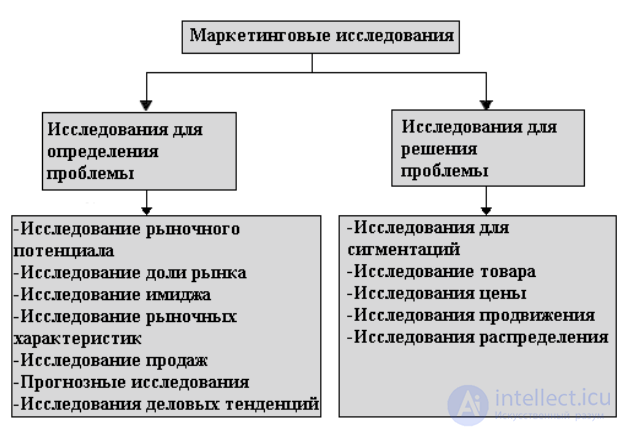
Figure 5.1. Goals of marketing research
Table 5.1. Classification of marketing research
| Classification criteria |
Types of research |
| 1. Depending on the nature of the goals of the marketing research |
– exploratory research; – descriptive research; – causal research. |
| 2. By the object of study |
- market research; -research into individual elements of the marketing mix; - research into consumer behavior and the activity of competitors |
| 3. By the nature of the information collected and analyzed |
- quantitative research; - qualitative research; - research based on secondary information (desk research); - primary information (field research) |
| 4. Depending on the level of research |
research into market characteristics, i.e., the macro level; - research at the micro level. |
The marketing research process includes the following stages and
procedures:
I. Defining the problem and objectives of the research.
1.1. Determining the need to conduct marketing research.
1.2. Defining the problem.
1.3. Formulating the objectives of the marketing research.
II. Developing the research plan.
2.1. Choosing the methods for conducting the marketing research.
2I.2. Determining the type of information required and the sources for
obtaining it.
2.3. Determining the methods for collecting the necessary data.
2.4. Developing forms for data collection.
2.5. Developing a sampling plan and determining the sample size.
III. Implementing the research plan.
3.1. Data collection.
3.2. Data analysis.
IV. Interpreting the results obtained and presenting them to management (preparing and presenting the final report).
When conducting any marketing research, it is very important
to correctly select the sources of information and establish
the necessary volume of it. First of all, it should be determined whether
field research or desk research will be conducted. In desk research
the researcher limits themselves to using already available (usually
published) secondary information.
Primary information is collected directly by the
researcher themselves. In doing this, they conduct field research. In
such research, a survey, observation, experiment, and simulation are used to
collect primary information.
When conducting a survey, the opinion of a certain circle of people
directly related to the problem being studied is elicited.
The researcher can survey all such persons. Conducting a complete
census survey in this case, they typically spend a great deal of time and resources,
ultimately obtaining the same result that could have been obtained by
surveying only part of the persons (a sample) of the given population. Therefore
researchers most often conduct a sample survey. When forming the sample
the researcher can use the method of random selection of
respondents, or they can form the sample by selecting respondents according to
certain rules or characteristics. The reliability of
the results obtained in the course of the marketing research ultimately depends on how many respondents
are selected and who these respondents are. If
the results are fully justified and reliable, then the sample is
considered representative.
When conducting marketing research, the researcher can
carry out either sporadic or panel surveys. In sporadic
surveys, which are conducted when it becomes necessary to solve an emerging
problem, the researcher forms and surveys a certain
group of people directly related to the given problem each time.
Panel surveys are repeated at certain intervals of time and
involve eliciting the opinion of a specific, specially selected, same
group of people (a panel). In enterprise practice, sporadic surveys are
used most often, while panel surveys
are conducted much less frequently, although they are the most valuable, since they allow
tracking the dynamics of ongoing processes.
At the heart of the process of choosing target markets lies the study of such a
basic indicator as market demand. Market demand — this is the total volume of
sales in a given market (partial or aggregate) of a specific brand of
product or set of product brands over a given period of time.
The size of demand is influenced both by uncontrollable factors
of the external environment and by marketing factors, which represent the
combined marketing efforts applied to the market by competing
firms.
Depending on the level of marketing effort, a distinction is made between primary
demand, market potential, and current market demand.
Primary or unstimulated demand — the total demand for all
brands of a given product, sold without the use of marketing.
Market potential — this is the limit toward which market
demand tends as marketing spending in the industry approaches a level at which
its further increase no longer leads to growth in demand under certain
conditions of the external environment. Furthermore, current market demand is distinguished,
characterizing the sales volume over a given period of time under
given conditions of the external environment at a given level
of use of marketing tools by enterprises in the industry.

Comments