
Lecture
Marketing or marketing (from English marketing, «market activity») — an organizational function and a set of processes for creating, promoting and delivering a product or service to customers and managing relationships with them for the benefit of the organization. More briefly, marketing is an activity aimed at satisfying market needs for the purpose of extracting profit. In a general sense, the purpose of marketing is to «identify and satisfy human and social needs».
The term «marketing» comes from the English word «market» and literally means market activity. There are many definitions of marketing.
Marketing as a way of thinking proceeds from the premise that any activity in the market begins with demand and ends with it, and that any actions of market subjects should be directed at satisfying it. Marketing as a type of activity is a comprehensive system for organizing production and sales, oriented toward the fullest possible satisfaction of the rapidly changing, diverse needs of specific groups of buyers, and toward achieving on this basis competitive advantages that contribute to sustainable profit. Whatever definition of marketing we adhere to, its key terms always remain need and demand, as presented by consumers in the market.
A need (a person's felt lack of something vitally necessary) gives rise to a want, which finds real expression in demand. This, in turn, is satisfied through the exchange of money for the necessary product. Thus, demand arises in the market for goods and services, and it is precisely the market that is the main object of marketing. A company's marketing achieves its stated goals of optimizing profit by studying the market and regulating it based on the knowledge obtained about it. The formation of marketing as a business philosophy began at the end of the 19th century. Its emergence was driven by the need to improve the existing system of managing market activity. Under modern conditions, marketing is an integral part of the management activity of business structures, and its main purpose comes down to ensuring the production of goods and the provision of services with regard to consumer demands. Marketing theory places emphasis on the specific consumer
with their real needs and wants, and a modern marketing methodology has been formulated. According to this methodology, all of an enterprise's activity (a firm, corporation, association) must
be carried out with constant regard for the state of the market, based on precise knowledge of consumers' needs and wants, their assessment and consideration of possible future changes. Thus, the real needs and wants of specific consumers form the starting point for implementing marketing. Human needs are numerous and varied and represent a sense of a lack of something. This lack is perceived differently by different people and depends primarily on the cultural and personal state of the individual, which finds its expression in specific wants. Wants are constantly increasing and expanding. Some of them become so pressing that they prompt (motivate) a person to seek ways and means of satisfying them.
In its development, marketing as a concept has passed through the following stages:
- the production concept appeared when production was mass-scale. Producers in their activity were guided by the slogan:
«Produce as much as you can».
- the product concept holds that consumers favor a product with the highest quality, best performance properties and characteristics.
- the selling concept holds that a consumer will not buy an enterprise's goods in sufficient volume unless it undertakes sufficient efforts to promote and sell them.
- the traditional marketing concept is based on the idea that an enterprise's success depends on the degree to which consumer demands have been studied and on a more effective way of satisfying them than competitors.
- the societal marketing concept assumes that an enterprise's activity must take into account three factors: buyers' needs, the enterprise's goals, and the welfare of society.
- the relationship marketing concept holds that the object of marketing management becomes relationships with the consumer and other subjects
- production of goods based on precise knowledge of buyers' needs, the market situation and the enterprise's real capabilities;
- the fullest possible satisfaction of buyers' needs, providing them with goods and services matching demand;
- efficient sale of products and services in specific markets in planned volumes and within scheduled timeframes;
- ensuring the long-term profitability of the enterprise's activity, which presupposes building up a certain reserve of scientific and technical ideas and developments for preparing the production of market-
novel goods;
- unity and continuity of the firm's strategy and tactics in order to ensure the fastest adaptation to changing market conditions and
consumer demand.
The marketing complex is a set of controllable marketing variables which an enterprise uses in an effort to elicit the desired response from the target
market.
Elements of the marketing complex (4P):
In the history of marketing's development, the following concepts are distinguished (Table 1.1).
Table 1.1 Concepts in the development of marketing
| Name | Years | Essence |
| Production | 1900-1920s | Improving production, growing sales, maximizing profit |
| Product | 1920 - 1930 | Improving the consumer properties of the product |
| Selling | 1930-1950 | Intensifying the sale of goods through marketing efforts in promotion and distribution of goods |
| Traditional marketing | 1960-1980 | Satisfaction of the needs of target markets' consumers |
| Societal marketing |
1980-1995 | Satisfaction of the needs of target markets while economizing on labor, material and other resources, and protecting the environment |
| Relationship marketing |
Since 1995 to the present |
Satisfying the needs of consumers, the interests of partners and the state in the process of commercial and non-commercial interaction |
Functions of marketing:
A wide range of data is used in marketing. Below is a list of data types actively used in marketing:
Depending on the stages of marketing's evolution, its spheres of application, and the nature of demand in the market for goods and services, such characteristics of marketing as kinds, forms and types of marketing are distinguished.
G. L. Bagiev and A. N. Asaul, in the book «Organization of Entrepreneurial Activity», give the following classification of marketing[13]:
Depending on the type of activity of an individual person or organization, there can be: organizational marketing, individual personal marketing (ego-marketing), place marketing[36], social marketing and others.
By sphere of application, consumer, industrial, investment marketing and services marketing are distinguished.
By sphere of exchange or territorial characteristic, national (regional, local) marketing and international (export, global, world) marketing are most often distinguished.
Depending on the purpose of the exchange and the results of a given activity, commercial and non-commercial marketing are distinguished.
However, individual schools of marketing (American, Scandinavian, Western European and others) classify marketing differently.
Below is a classification of marketing depending on the state of demand in the market and on market coverage.
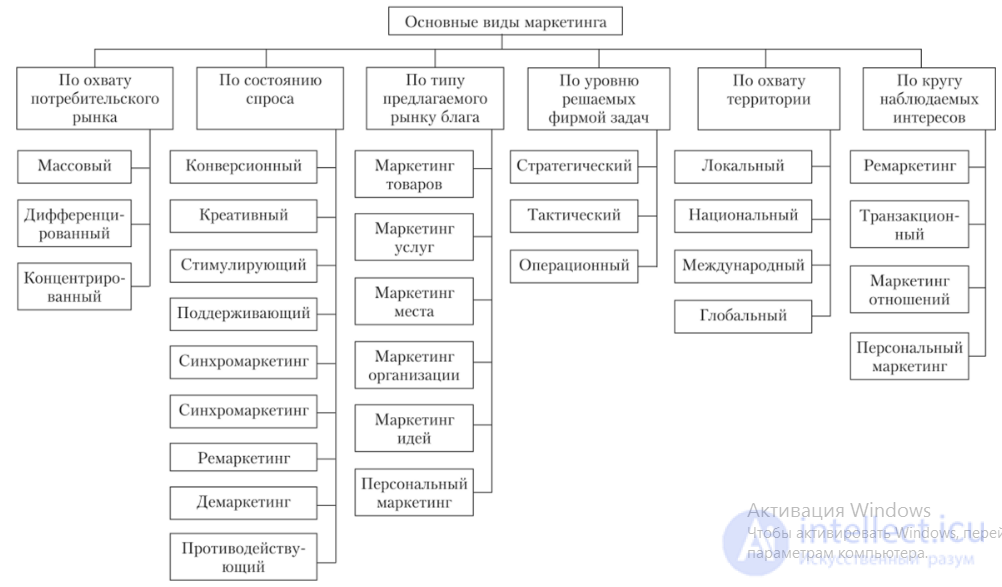
Fig. 1.1. Types of marketing
Depending on the stages of marketing's evolution, its spheres of application, and the nature of demand in the market for goods and services, such characteristics of marketing as kinds and types of marketing are distinguished.
The main types of marketing are: undifferentiated, differentiated, concentrated, and complex marketing.
Undifferentiated (mass) marketing (which developed actively in the 1950s) does not involve dividing the market into segments. This type of marketing is associated with providing mass production, distribution and sales promotion of the same product for various buyers. The features of differentiated marketing took shape in the 1960s, when
production began to be viewed as a supplier to the market, and research into the demand of various groups of buyers unfolded. During this time three directions of segmentation were scientifically established:
territorial, product-based and consumer-based. The development of the idea of segmentation led to a new type of marketing — concentrated marketing, the essence of which lies in concentrating marketing efforts on a single, least-studied and least-covered market segment possessing good purchasing power.
All the tasks and functions described above are carried out using the following marketing methods:
Advertising on billboards, bus stops, transport, etc. Works well for a local audience and building brand awareness.
Advertising in search engines (for example, Google Ads, Yandex.Direct), displayed based on keywords. Effective for attracting hot leads.
Advertising on social networks (Instagram, Facebook, VKontakte, etc.) based on user interests, behavior and demographics.
Advertising that looks like part of the content (for example, a sponsored article on a news site). Gently promotes the product without triggering rejection.
Clips on YouTube, social networks, etc. Emotionally engaging, suitable for storytelling and demonstrating a product.
Content that spreads on its own through users. Often — humorous, shocking or unusual.
Promotion through social networks — posts, stories, engaging with followers, contests.
Building a positive image through the media, interviews, press releases, participation in events.
Working with customers via WhatsApp, Telegram, Viber — newsletters, chatbots, support service.
Promotions, discounts, bonuses, «1+1», coupons and other ways to encourage purchases here and now.
Selling through direct communication — most often in B2B or the premium segment. Requires preparation and sales skills.
Email newsletters: news, promotions, email sequences, automation of interaction.
Short messages to phones and in-app notifications — fast and direct channels of communication with the customer.
Sales and consultations by phone. Effective for B2B or repeat sales.
Systems for maintaining a customer database, automating sales and marketing, and personalizing communication.
Marketing through stories — helps evoke emotions and strengthen the connection with the brand.
Appealing to the senses: scents in stores, music, design and tactile sensations.
Advertising with a social mission: environmental care, charity, inclusivity, etc.
Creating useful and interesting content (articles, blogs, videos) to attract and retain an audience.
Optimizing a website for search engines — free traffic from Google, Yandex and others.
Promotion through a company's own app, working with notifications, collecting analytics about users.
Optimizing an app's listing in stores (App Store, Google Play) to increase installs.
Systems of bonuses, accumulations and discounts for regular customers.
Tracking the sources of calls from a website or advertising to evaluate channel effectiveness.
Attracting contacts of potential customers (leads) for the purpose of subsequent sale.

Comments