
Lecture
The following key areas of consumer research can be identified:
— attitude toward the company itself;
— attitude (opinion, preferences) toward various aspects of the company's activity in terms of individual elements of the marketing mix
(products currently manufactured and new products of the company, characteristics of products being modernized
or newly developed, pricing policy, the effectiveness
of the distribution network and product promotion activities — that is, what is often
called individual instruments of marketing activity);
— the level of satisfaction of consumer requests (consumer expectations);
— consumer intentions;
— making purchase decisions, determining the structure of the buying
center;
— consumer behavior during and after the purchase;
— consumer motivation.
Consumer assessments are based both on their knowledge and on emotional aspects of perception.
The buying behavior model looks as follows.
1) Marketing stimuli and other irritants enter
2) the «black box» of the buyer's consciousness and
3) trigger certain response
reactions.
|
MARKETING STIMULI |
OTHER IRRITANTS |
―> |
THE BLACK BOX OF THE BUYER'S CONSCIOUSNESS |
―> | BUYER'S RESPONSE REACTIONS |
|
|
Economic Scientific and technical Political Cultural |
Buyer characteristics |
Decision-making process by the buyer |
|
|
Fig. Expanded model of buying behavior
In the consumer market, consumer behavior is determined by
their direct activity, conditioned by the acquisition of
necessary goods and services, and includes actions related to substantiating and
making a purchase decision, the purchase itself, and the post-purchase assessment
of the acquired goods. Consumer behavior is determined by a whole range of
factors. These factors are conventionally divided into internal and external.
Among the external factors, environmental and marketing factors are usually distinguished,
while internal factors are divided into psychological and personal. Under
the influence of external factors, primarily marketing ones, in the consciousness
of the consumer, corresponding conclusions are formed about the expediency
of making a purchase. The content of these conclusions, as well as the process itself of making a
purchase decision, are determined by the personal and psychological
characteristics of the buyer.
The main external factors are the marketing ones. They
include product, price, distribution, and promotion. The availability of the necessary
product, its acceptable price and place of sale, as well as the consumer's
awareness of the product, its price, and the possibilities of purchasing it, determine the main
motives for making purchases. Consumer behavior in the
market, the nature of purchases, are determined by their personal, cultural,
social, and psychological factors, the study of which is
one of the most important tasks of marketing research.
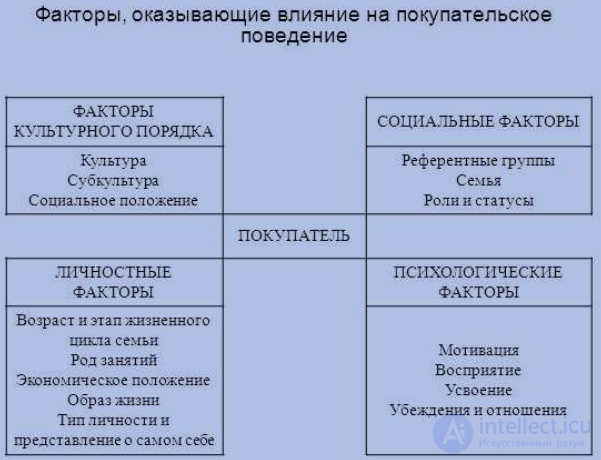
Personal factors include age, the stage of the
family life cycle, occupation, economic status (the level of
income per family and per individual family member), lifestyle, personality type, and
self-image.
Cultural factors include culture, subculture, and
membership in a social class. It is very important for the marketer to have
an understanding of changes in cultural factors, in order to respond to them
with an offer of new products.
Social factors include small groups, subdivided into membership groups, reference groups, family, social
roles, and status.
Psychological factors include motivation,
perception, learning, belief, and attitude. These factors have
a strong influence on consumer behavior.
Needs, perception, attitude, and the beliefs that make it up
have the most direct influence on consumer behavior. This
influence must be constantly taken into account when analyzing the purchase
decision-making process. Such a process depends on how strong the consumer's
habit of buying the same brand of product is, and how important the
product is to them. With this in mind, four models of consumer behavior are considered,
corresponding respectively to complex, exploratory, uncertain, and
simplified buying behavior.
In the simplified model of the purchase decision-making process,
the consumer either does not search for information to assess
the product at all, or uses it to a limited extent. In this case, the
purchase decision-making process itself contains only three stages: awareness of need,
purchase of the product, post-purchase evaluation. The number of such stages increases in
subsequent models and usually reaches seven in the complex model.
The initial stage in such a model is the consumer's awareness of
the need for the corresponding product. The consumer's next action
is the search for information about the required product. It may
be stored in the person's memory. If they do not have sufficient knowledge of the product,
then they collect the information they need from the external environment. The motivation for
this information search is the desire of every person to make
the choice of a product that most fully satisfies their conscious need.
Having gathered the necessary information, at the third stage of the decision-making
process, the consumer evaluates the possible alternatives in
the choice of product and establishes the most acceptable option for them.
The consumer's next action is the purchase of the product they have chosen.
They will take such action when they have no doubts
regarding the chosen brand of product, and when the place, time,
quantity of the product to be acquired, and the operations performed during the purchase have been determined.
Having made the purchase, the consumer, at the stage of the purchase decision
process, evaluates their satisfaction with the given product and, on this basis,
determines their further actions regarding its use in the future.
When it comes to buying ordinary everyday goods,
the selection process, as a rule, has a simpler character,
called simplified, or "low-involvement." In this
case, certain stages of the purchase are usually skipped or happen quickly.
For example, purchasing such simple products as salt, sugar,
matches – these are low-involvement purchases.
Frequently purchased products are, as a rule, less expensive and
are meant to serve a purely functional role; their purchase
represents a simplified decision-making process. With low
involvement, the customer, as a rule, relies more on their own
knowledge, acquired as a result of successful past experience buying
similar products; even if the product has a relatively high price,
the process may become simplified due to satisfaction
with a previous purchase of this product.
A consumer may show loyalty to a brand or
a store because in the past they were deeply satisfied with previous
purchases, and for this reason will settle on the simplified method of choice.
The consumer's further actions are determined by their evaluation of the product during
consumption. Depending on this evaluation, at the final, seventh stage,
the consumer decides what to do with the already partially
used product. They may sell it, give it to acquaintances, friends,
or other people who need the product. They may exchange it for another
product they need, simply throw it away, hand it over for recycling, or
disposal.
Retail products can lead to a complex
decision-making process, since the purchase is almost always personal and is thereby
associated with a relatively high degree of risk.
Perceived risk quite often relates to the problem of making the wrong choice.
This can be explained in terms of concern over the economic,
physical, psychological, and functional aspects of the purchase. These
aspects should be taken into account when modeling buyer behavior.

Comments