
Lecture
A product in marketing – is everything that can satisfy a want or need and is offered to the market for the purpose of attracting attention, acquisition, use, or consumption (physical objects, services, persons, organizations, ideas); it is a combination of tangible and intangible components combined for the purpose of giving consumers what they would like to have.
Needs precede products; the main task of marketing departments – is to research needs, create a product that satisfies them, and offer it for sale.
A product in marketing is considered from technological, economic, and psychological perspectives.
In the technological aspect, a product is understood as an object possessing various physical, chemical, and other technical properties and described by parameters reflecting the level of these properties.
In the economic aspect, a product is a tangible or intangible object possessing a certain potential of usefulness and thereby satisfying consumers' needs.
In the psychological aspect, a product is viewed as a complex of the consumer's perceptions, existing in their individual imagination as the product's image. These three sides are considered and presented to the market as a whole and ultimately determine the product's competitiveness.
As can be seen from the definition, the concept of "product" is ambiguous and has several levels. Each level increases the value of the product for the consumer. In marketing, three levels of a product are distinguished (Fig. 3.1):
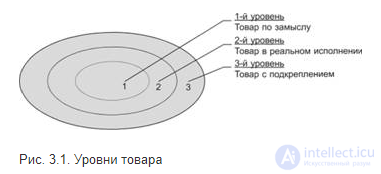
Fig. 3.1. Levels of a product
In addition to these three levels, in a number of cases a fourth level is also considered. This is the product for the consumer. It combines the previous three levels plus product characteristics that provide the consumer with social recognition, image, and new opportunities for self-expression.
For the proper organization of marketing activity, it is necessary to clearly classify the enterprise's products. There are many classification criteria.
The main areas of research into consumer goods are:
Every product has a certain period of market stability, that
is, it is sooner or later pushed out of the market by another, more advanced or
cheaper product.
Graphically, the product life cycle can be described in the form of a curve (Fig. 6.1).
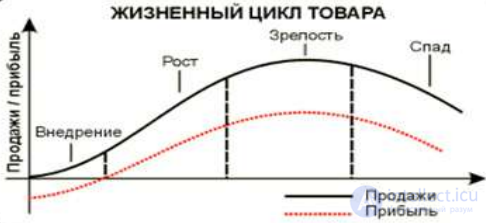
Figure 6.1. Product life cycle
The life cycle of different products proceeds differently. During
the first stage, the market-entry stage, sales volumes grow slowly, however
the enterprise does not yet have a profit. In the subsequent stage — the growth stage —
sales volumes grow rapidly and reach a significant magnitude,
and the enterprise's profit is also significant. In the maturity stage — the rate of growth
in sales volume decreases, sales volume reaches its maximum
level and begins to decline, and profit decreases as well. A more substantial
decline in sales volumes is characteristic of the last stage of the product
life cycle — the decline stage. At this stage, spending on promoting
the product decreases and ultimately a decision is made to withdraw the product from
production and from the market.
At each stage of the product life cycle, the enterprise faces
certain problems and searches for ways to resolve them.
For each stage of the product life cycle, marketing practice
uses various marketing strategies.
In marketing practice, when developing marketing strategies, the following
classification of products, taking the life cycle into account, is used:
The same product of an enterprise can be found in different markets and
be at different stages of the life cycle. Therefore it is very important to determine
how many and which products at each of the life-cycle stages should be kept,
in order to ensure the effective business operation of the
enterprise both in the period under review and going forward. To do
this, one can use the "Boston Consulting Group" matrix
(Figure 6.2)
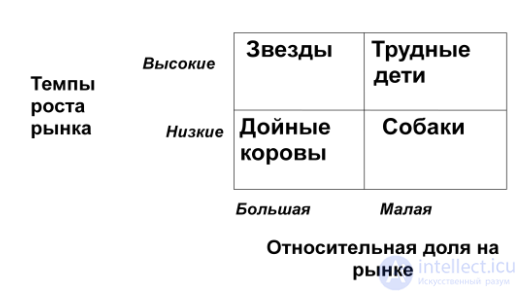
Figure 6.2. The BCG matrix
Product competitiveness – is the ability of a product to meet the requirements of a competitive market and the demands of buyers, in comparison
with other similar products presented on the market.
Competitiveness is determined only by those properties that are of noticeable interest to the buyer. All product characteristics
falling outside the scope of these interests are regarded, when assessing competitiveness, as irrelevant under the given specific
conditions.
A competitive product must possess some competitive advantages. Competitive advantage is divided into two main types: lower costs and product differentiation.
Differentiation is the ability to provide the buyer with unique and
greater value in the form of a new quality of the product, special consumer
properties, or after-sales service.
In general, the competitiveness of a product is determined by
the following elements:
The competitiveness of a product is determined by the following parameters:
1. Product quality – this is an integral property that
determines the demand for the product by the consumer. Conventionally,
consumer quality can be broken down into two components, one of
which depends directly on the characteristics of the product, and the other – on trust
in the product.
The following indicators directly characterize the quality of a product:
of the manufacturer and service stations in the buyer's region, the quality of
technical maintenance, repair, and other services provided.
Trust in a product is conditioned by the social, psychological, and
emotional attitudes of the consumer. It is expressed through the degree of trust
in the country and firm of the manufacturer, the familiarity of the product in public opinion,
the effect of advertising, etc. It is determined by means of:
2. Economic parameters, which characterize the sale price,
the costs of operation or consumption of the product.
Let us consider the most common basic methods for assessing
competitiveness, used in the practice of enterprises.
1. Assessing the competitiveness of a product based on the sales level.
The method is based on the indirect measurement of competitiveness by sales volume. In doing so, it is assumed that the sales volume of competing products,
indicates consumer preferences and can therefore serve as a
criterion of competitiveness. Based on this, the criterion of
competitiveness is the relative share of sales (Ki) of the product being assessed
compared to the competitor, which is calculated using the formula:
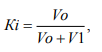 (1)
(1)
where V0 – the sales volume of the given product over a certain period;
V1 – the sales volume of the competitor's product over the same period.
2. Method based on a system of single, group, and integral indicators.
A single indicator characterizes the competitiveness
of the product being assessed when compared with a standard on one specific
indicator. In this case, the product being assessed and the competitor's product must have
not only similar purposes and conditions of use, but also
be intended for the same group of consumers. It represents the
ratio of the value of the parameter of the product being assessed (Pi) to the value
of the parameter of the standard (base sample) (Pb):
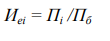
If the technical parameters of the product do not have a quantitative
assessment, expert evaluation methods in points are used to give these
parameters quantitative characteristics.
A group indicator characterizes a group of homogeneous properties
of the product. It is determined by the aggregate of single indicators:
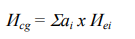
where ai – the weight of the i-th parameter in the overall set, reflecting the degree of its
influence on the consumer;
g – the number of the parameter group.
The basis for determining the significance of each parameter in the overall
set is expert assessments, based on the results of market
research, consumer surveys, seminars, and sample exhibitions.
The integral indicator represents the final assessment of
competitiveness. It reflects the difference between the compared
products in the consumer effect per unit of costs
incurred by the buyer in acquiring and consuming the product. It is determined as the
ratio of the integral consumer quality of the product to the cost
of the product.
3. Rating assessment, which is widely used in world
economic practice. The essence of the rating assessment lies in the fact
that in the course of the expert review, the most important parameters of the product are determined and ranked in order of significance
. Experts evaluate the properties
of the product on the selected scale.

Comments