
Lecture
Hallin's spheres (Hallin's spheres) — a theory of journalistic objectivity proposed by the journalism historian Daniel C. Hallin in the book “The Uncensored War: The Media and Vietnam” (The Uncensored War: The Media and Vietnam, 1986) , in which he explains the mechanism of coverage of the Vietnam War (1957—1975) in the media. Hallin divides political discourse into three spheres: the sphere of consensus, the sphere of legitimate controversy, and the sphere of deviance. The sphere of consensus presupposes journalists' agreement with public opinion. The sphere of legitimate controversy corresponds to political debates, in which journalists do not gravitate toward any particular position and maintain neutrality. Subjects of discussion that fall within the sphere of deviance drop out of the political discourse of the sphere of legitimate controversy, and journalists may ignore them. The boundaries between these spheres shift as public opinion changes.
Hallin's spheres correlate to a considerable extent with the Overton window model (the window of discourse) — a concept of the existence of a framework of the acceptable spectrum of opinions in public statements from the standpoint of public morality, whose author is the American lawyer Joseph Overton. This concept relates to public opinion as a whole and proposes a shifting scale of public opinion (from “unthinkable” to “current policy”) regarding any issue.
In his work Hallin used the concept of frames to describe the coverage of issues and the reaction to them in society. Hallin also addressed the phenomenon of the corridor of opinion, in which the sphere of public opinion narrows, and positions and views falling outside this sphere are equated with deviance.
In short, as public opinion changes, these boundaries shift. What we consider acceptable discourse depends on where the topic is (at present) within these spheres.
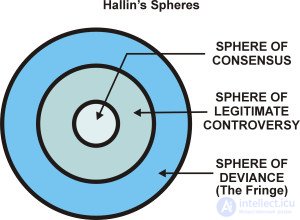
The outermost Sphere of Deviance represents taboo topics that journalists are unlikely to consider worthy of credence. Nowadays this might be something like a discussion of the merits of vaccines. At least, let's hope so.
Throughout history social norms have changed, as has their placement within these spheres. Consider the right to vote. At one point the question of women's suffrage was considered a “fringe” idea, until it turned into a controversial issue, or something worth discussing. Finally, it moved squarely into the Sphere of Consensus . Similarly, same-sex marriage was once taboo. Topics of gender and transphobic experience are still being debated, but are moving toward the inner circle of consensus, if the return to transphobic comments by J. K. Rowling is any indication.
Nevertheless, topics close to my own experience, such as the idea that we should not use animals for food, remain, perhaps, in the outer sphere of deviance, since more than 95% of people eat animals or strongly defend doing so. Some might argue that animal rights lie within the sphere of legitimate controversy, since at least half of us agree that animals should be treated humanely, even though in our industrialized (or even smaller private) systems there is no accounting for such treatment.
Daniel Hallin's book “The Uncensored War: The Media and Vietnam” was published in 1986, a decade after the end of the Vietnam War.
There was a widespread opinion about the Vietnam War, formulated by the journalist Robert Elegant: “For the first time in modern history, the outcome of a war was determined not on the battlefield, but on the printed page and, above all, on the television screen” . In his book Hallin analyzed the coverage of the war in the New York Times in the period from 1961 to 1965 and on television in evening news broadcasts from August 1965 to January 1973, and called this statement by Elegant into question. Having analyzed the mechanism of media operation during the war, Hallin concluded that control of the media by the state in a democratic society is easily achievable, and that the media begin to doubt the political agenda only when the government itself behaves indecisively. In the book, Hallin proposes dividing political discourse into three spheres and describes each of them in detail.
The sphere of consensus includes those topics and positions on which there exists in society an almost complete unanimity, or whose coverage does not provoke a negative reaction. Within this sphere journalists “freely invoke the pronoun ‘we’ in generalized statements and take for granted shared values and shared assumptions” . Examples might include freedom of speech, the abolition of slavery, or human rights. For coverage of these topics “journalists are not required to present an opposing point of view or act as disinterested observers” .
The views of informed people regarding topics within this sphere differ. Therefore, on the one hand, these topics are the most important to cover, while on the other hand — in covering these topics, journalists must remain impartial, rather than adhere to one point of view or another . As Schudson emphasizes, Hallin in his study asserts that journalism's commitment to objectivity has always been divided and was not uniform: within a certain sphere — the sphere of legitimate controversy — journalists consciously strive to be objective and disinterested .
Journalists reject topics located within this sphere, since they consider them insignificant for general consideration. These topics are perceived as unfounded, taboo, or so inconsequential after coverage that they never even become news hooks. Hallin asserts that in the sphere of deviance “journalists also depart from the accepted norms of objective coverage and feel entitled to treat these topics as marginal, ridiculous, dangerous, or as laughable people and groups that fall far outside the range of deviation accepted as legitimate” .
Craig Watkins uses Hallin's theory in studying the coverage on ABC, CBS and NBC news of the “Million Man March” — a march of African Americans on Washington on October 16, 1995. Watkins analyzes the dominant frame-building practices (problem definition, rhetorical devices used, sources and images used) that journalists use to make sense of a specific expression of political protest. He holds that Hallin's spheres are a means by which media framing practices shape specific broadcast contexts, and that each particular sphere develops its own distinct style of news presentation using different rhetorical tropes and discourses .
Piers Robinson uses Hallin's spheres in connection with the debate over the extent to which the mass media serve the interests of the elite or, conversely, play an important role in shaping the political agenda and the consequences of political decisions. His article addresses Hallin's spheres as an example of the relationship between media and the state, which highlight the theoretical and empirical shortcomings of the “manufacturing consent” thesis (N. Chomsky, R. McChesney) . Robinson insists that a more nuanced and bidirectional understanding of the direction of influence between the state and the media is necessary, one that builds on existing theoretical explanations rather than rejecting them .
Hallin's theory presupposes a relatively homogenized media environment in which most content producers try to reach the largest number of consumers. A more fragmented media landscape may challenge this assumption, since different audiences may assign topics to different spheres[10]. This correlates with the concept of the filter bubble, which implies that many consumers of media content prefer to limit their consumption to those areas of consensus and deviance that they themselves choose.

Comments