
Lecture
Longread (English longread; long read — literally “long reading”) — a format for presenting journalistic material on the internet (Long-form journalism). Its specificity lies in a large volume of text broken into parts with the help of various multimedia elements: photographs, video, infographics and so on . The longread format presupposes reading the material from various electronic devices. It also allows the reader to overcome “information noise” and become fully immersed in the topic .The most important distinguishing feature is the presence of a substantive foundation, by which one should in fact understand a literary work. A properly constructed longread should be perceived as a coherent story. Among internet users a minimum publication length of 1,500 characters has taken hold, although the number is not limited and is determined by the depth of the topic's development. A longread is designed as a separate site, with its own unique layout and design, which again distinguishes it from an ordinary article .
Longread – is not simply a long text, but an article divided into semantic parts with the help of infographics, photographs, and images that help immerse the reader in the topic. On the internet the word has acquired an additional shade of meaning: the article must fully reveal the topic.
The longread as a phenomenon arose quite a long time ago. In Western practice there exists such a phenomenon as Longform journalism (long-form). In contrast to contemporary journalism, which tends toward short article forms, long-form sits between the “traditional” article and the novella. It often takes the form of creatively reworked non-fiction literature or narrative journalism texts. It is precisely narrative journalism that is the original source, the basis for the emergence of the new format. The pioneer in creating “new journalism” (and afterward, longreads) is the USA. Already since the 1960s journalistic narratives have been published in “The New Yorker”, “Harper”, “Esquire”.
An article written in the style of narrative journalism has a dramatic structure that develops according to the principle of the arising, development and culmination of conflict, with a clearly outlined plot line. The main distinction of narrative journalistic texts is the subjective character of the telling of the story, or storytelling, which is needed not to state facts but to reveal the dramatic events of public life, shaped into stories .
The features of narrative journalism and storytelling hold true for the multimedia longread as well, with the sole difference that the transition from a print medium to the internet environment provides even more opportunities for revealing the topic and creating a connection with the reader: photo, video, infographics, etc.
The literature closest to the boundary with the longread is non-fiction. Documentary literature is characterized by building a plot line exclusively on real events, with rare interspersions of artistic fiction. At the same time, the author's point of view is manifested in the selection and structuring of the material, as well as in the evaluation of events. Documentary prose is characterized by a long period of time having passed since the events described, and by the recreation of a vivid, lively picture of events and the psychological makeup of people .
The first longread is generally considered to be the multimedia project of The New York Times “Snow Fall ”, released in 2012. The defining distinction from the newspaper's ordinary material was the placement of the entire story on a separate page and the combining of parts of the article using the “parallax” effect. The name “Snowfall” became a household name, and the project is a classic example of the new format.
According to one foreign study , nine out of the ten most cited publications of The New York Times on social media are longreads, and the most cited publication, which gathered more than 47 thousand reposts on Facebook alone, turned out to be a longread of 10,500 words about Indonesian illegal immigrants trying to get to Australia .
The first Russian longread is material on the Loo.ch portal (currently unavailable for viewing) about the Dyatlov Pass .
The most well-known and high-quality domestic longreads: “The Land of Exclusion” (“Kommersant”), “Polite People” (“Meduza”), “900 Days of Life. Chronicles of the Blockade” (a special project of “TASS”), “Days of Eclipse” (“Lenta.ru”) and so on.
The popularity of the longread format has ensured its regular appearance on the pages of publications. Not only federal media outlets, but regional ones as well, use the longread to format their material[10]. Many media outlets use it as a platform uniting a series of large pieces, such as, for example, the online newspaper Lenta.ru, which has released several longreads under the title “A Country That Doesn't Exist”[11].
In addition, media outlets and organizations engaged in business could not fail to appreciate the commercial potential of this phenomenon. Advertising presented in the form of longreads enjoys great success among audiences, since it is definitely a new format, which is why many publications choose it for implementing special projects[12]. The popularity of longreads on the Russian market has also provoked the emergence of certain companies that offer to create an advertising longread for a fee.
Differences of opinion about longreads mainly concern its characteristics as a format or genre. According to some researchers, a longread is characterized above all not by the volume of information, but by the depth of penetration into the topic, by the content of unique and high-quality information, which will characterize the journalist as an expert on the given topic. Multimediality, which in most sources is indicated as the main characteristic of the longread, does not have fundamental significance, since it is connected with the trend of the last 10 years, rather than with a new phenomenon[14].
Another opinion holds that the longread must be characterized as a format used for covering only new phenomena and trends. Material of this kind cannot be written about just anything; one must concentrate only on current phenomena[15].
Also, sometimes the main characteristic of the longread cited is a story, that is, the mandatory presence of a setup, development and culmination[16].
The rise in popularity of longreads has led to their spread across various media outlets. A large number of interesting and controversial events, historical background and research are formatted as longreads and used by many publications .
Longreads have also become an object of research for scholars and theorists studying trends in the media and in new media in particular. Their work reveals various points of view on the essence of the concept, the reasons for the popularity of longreads, and trends in their spread and development[14].
The topic of longreads is actively discussed online: many bloggers express their opinions on how interesting such a format of presenting information is, which longreads are more popular and why[17].
Tilda Publishing, a specialized platform for creating online material and longreads, compiled a blog ranking of longreads with the best design[18].
There are also a number of articles created by professional bloggers and ordinary users devoted to how to correctly choose a topic for a longread, format it, and present it[19].
LSI Longreads – is a large expert article , which is written for certain core keyword queries and with the incorporation of LSI phrases. Such texts are used to obtain search traffic. LSI keys (latent semantic indexing) – the abbreviation translates as “latent semantic indexing”. These are additional keyword queries that increase the document's relevance within a given subject area. For example, a topic is taken and a large article is written for keyword queries , as well as all sorts of additional words to gather extra traffic on related or adjacent queries. They are written in such a format that the document carries more weight, collects good user experience (“dwell time”,”last click of the search results”, bounces, etc.) and thereby ranks better. Such an article occupies a niche and gathers large streams of users from search results across a wide range of keyword queries. There is no major research on this topic yet, so it is all theory and food for thought. But if you combine our experience with the experience of other specialists, it can be said that such texts have a better chance of success than ordinary articles. Right now people believe strongly in this direction and are starting to apply it in optimization. It must be noted that certain requirements apply to LSI longreads, just as they do to ordinary SEO texts.
Why do longreads work? Due to a synergistic effect.
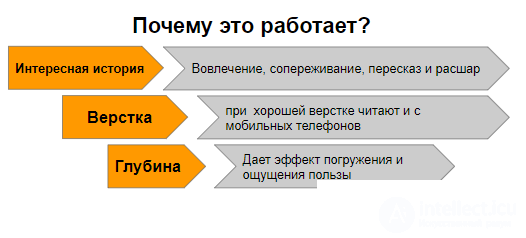
An experienced event is remembered better. And when we read, we involuntarily begin to identify ourselves with the lyrical hero of the narrative. And we experience all his emotions as our own. That is precisely why stories read in longreads get retold and shared on social networks as if they were one's own.
The depth and thoroughness of the material's presentation not only bring the reader new knowledge, but also a feeling of satisfaction – that they did not waste time, that they learned something new, engaged in self-development, and grew as a person.
People want to read. Thoughtfully, a lot, meaningfully. To immerse themselves in a story that makes them both experience emotion and learn something new at the same time. This is the most natural way for us to perceive information. Stories existed long before the invention of writing. One might even say that the story as a way of conveying information arose at the same time as humankind itself.
Multimediality and modern web-layout capabilities not only allow reading from any device, but also reinforce the text with other means of conveying information. You can read, watch video, listen to and watch animated graphics. This enriches the expressive possibilities of the text like never before.


Comments