
Lecture
Plot (from Fr. sujet, lit. “subject”) — in literature, drama, theatre, cinema, comics and games — a sequence of events (a succession of scenes, acts) taking place in a work of art (on a theatre stage) and arranged for the reader (viewer, player) according to certain rules of presentation. The plot is the basis of a work's form. The plot is the sequence and connection of the description of events in a literary or stage work; in a work of visual art — the subject depicted.
In journalism, plot is understood as “the movement of events, thoughts, experiences, in which human characters, destinies, contradictions and social conflicts are revealed. It is the plot that gives the writer the opportunity to reveal, in development, and to depict characters and circumstances from many sides, to bring out the connection between them”[14]. Unlike a literary plot, a journalistic one is “more ‘compressed’, not expanded; as a rule it lacks an exposition, the setup and development of the action are tied as closely together as possible, and the climax and denouement form almost the most developed part... A plot is not a mechanical imprint of an event or phenomenon, not a mirror-reflected construction of a subject. It is worked out as the result of a creative process, built in accordance with the social goal that the writer is pursuing”. And the aims and objectives in constructing a plot can be very diverse. In some cases a journalist needs to reflect the dynamics of the development of one event or another; in others – to show the formation of the character of the work's hero; in others – to reflect a real-life collision or conflict; in others – to illuminate a problem. In all these cases the journalist chooses those techniques and means of plot construction that are best suited, for the idea of the work, to bring out the object or subject being described.
It is no coincidence that E. P. Prokhorov classified the organisation of journalistic works into three types: 1) plot type, 2) type with a fabula basis, 3) type with a problem-analytical organisation of the work.
Television plot (news package) - a presentation by the author of information about events in the form of a story, accompanied by video footage.
Informational package - information about an event in the form of a story.
Thematic package - an analysis of the causes of some event, conflict, or state of affairs.
Problem package - a study of the causes and possible developments of some event or phenomenon.
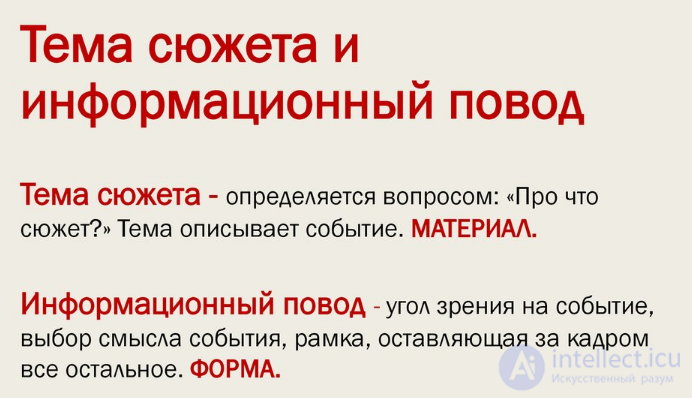
Fabula (from Lat. fabula — narration, story ) — the factual side of a narrative, that is, the events, facts, incidents and states in their causal, chronological sequence, which are assembled and formed by the author in the course of creative activity into the plot, on the basis of regularities that the author discerns in the development of the phenomena being depicted.
Script — a literary-dramatic work, written as the basis for the production of a film or television film, and of other productions in the theatre and elsewhere.
A script in cinema, as a rule, resembles a play and describes each scene and the characters' dialogue in detail, along with stage directions. Sometimes a script is an adaptation of a separate literary work for the cinema; sometimes in this case the author of the novel is also the author of the script (the screenwriter).
A screenwriter is a person who writes the script for a film. Sometimes several screenwriters take part in writing one and the same script before the director chooses the best version. It is not necessary for the author of a book to write the script when it is adapted for the screen. This work is usually given to a screenwriter, while the author of the work, when possible, is a co-author of the script or a consultant.
Literary script (historical and specialised, used in cinema) — a completed work of screen dramaturgy. It must contain a complete, consistent and specific description of the plot, consisting of developed scenes and episodes, dialogue, and must reveal the images of the characters.
Literary script — a full-fledged work of art that meets the specific and production requirements of filmmaking, in which, taking into account visual and sound images, a description of the film's episodes is given along with the actors' dialogue (B. N. Konoplyov, “Fundamentals of Filmmaking”, Moscow, “Iskusstvo”, 1969, p. 91)
Director's script (also — director's shooting script; production script; working director's script ) — a working script with dialogue and diagrams of the blocking, timing and storyboarding, alternation of shots and angles, and sound design, which is created after the literary script has been written , and represents an editing plan for the whole film, comprehensively determining the further shooting and the work of the actors and camera operators . It may also contain instructions for the directors, camera operators, art directors and make-up and costume artists . It is created by the director together with the playwright, the screenwriter and the art director .
There is currently no generally accepted form for a director's script.
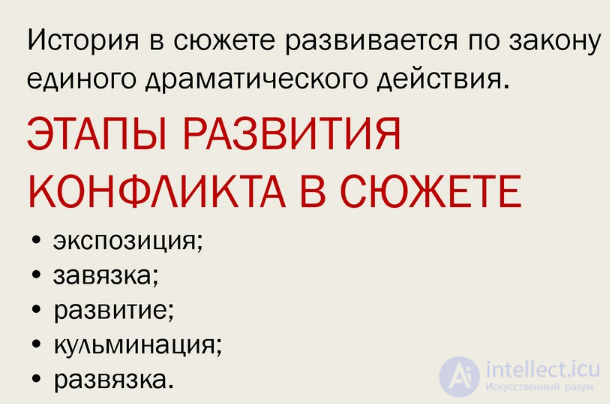
In the most general sense, a plot is a kind of basic scheme of a work, comprising the sequence of actions taking place in the work and the totality of the characters' relationships that exist within it. A plot usually includes the following elements: exposition, setup, development of the action, climax, denouement and post-position, as well as, in some works, a prologue and epilogue. The main precondition for the unfolding of a plot is time, both in the historical sense (the historical period of the work's action) and in the physical sense (the passage of time in the course of the work).
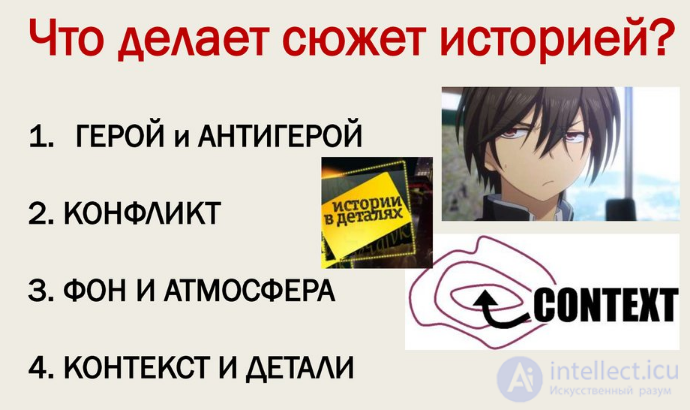
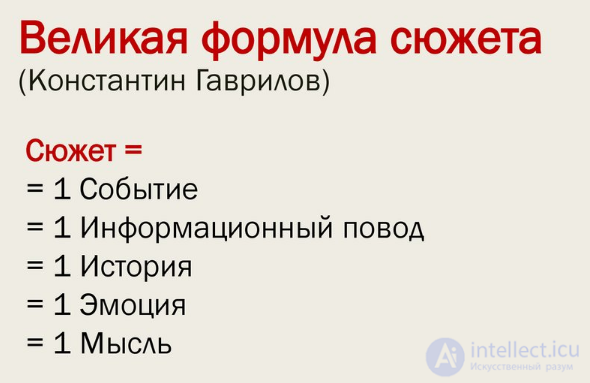
the great formula of plot
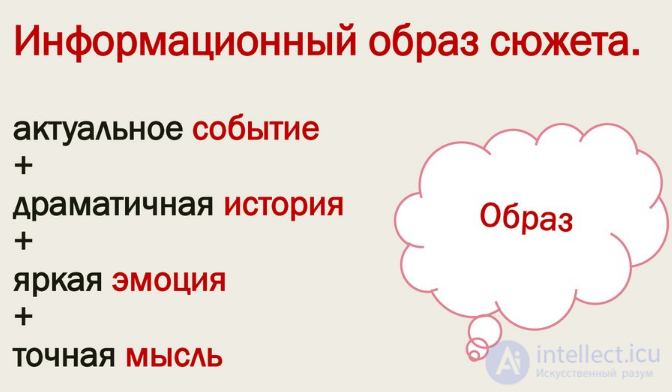
the informational image of a plot
Structural elements of a plot
1. Sync (synchronised sound bite);
2. B-roll (plus ambient sound);
3. Stand-up;
4. Voice-over text;
5. Life sound (natural sound);
6. Titles;
7. Special effects and animation.
The concept of plot is closely connected with the concept of a work's fabula. In contemporary Russian literary criticism (as well as in the practice of teaching literature in schools), the term “plot” is usually used for the actual course of events in a work, while “fabula” is understood as the main artistic conflict that develops in the course of those events. Historically, other views on the relationship between fabula and plot, different from the one given, have existed and continue to exist. For example:
Finally, there is also a viewpoint that the concept of “fabula” has no independent meaning, and that for the analysis of a work it is quite sufficient to operate with the concepts of “plot”, “plot scheme” (that is, fabula in the sense of the first two of the variants listed above), and “plot composition” (the way in which the author presents the events from the plot scheme).
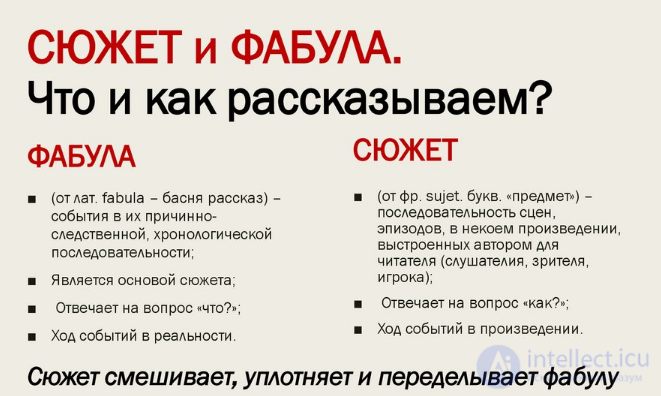
Originally the term “fabula” (Lat. fabula, Fr. fable, Eng. fable, Ger. Fabel) had the meaning of a fable, a little tale, a folk tale, that is, a work of a particular genre. Later, the term “fabula” came to denote what is preserved as the “basis”, the “core” of a narrative, while its presentation changes. Hence the meaning given at the outset, as applied to literary works in general.
Scholarly study of “fabula” was undertaken above all as facts of poetic tradition in world literature (mainly ancient and medieval) and especially — in oral folk literature. On this plane, a particular treatment of traditional “fabulas”, the process of their development and dissemination, formed the main content of the successively changing folkloristic theories — the mythological, the migrational, the anthropological. At the same time, in Russian scholarly literature the term “syuzhet” (plot), rather than fabula, was usually applied to this kind of traditional formation (see “Wandering plots”, “Folklore”). Later the question of fabula and plot was considered in terms of studying the structure of a poetic work (mainly by formalist literary scholars). Some researchers, identifying the concepts of plot and fabula, abolish the latter term altogether.
However, when studying the figurative reflection of the dynamics of life, one should distinguish: 1) the “factual” basis of a work, the events that are recounted in it, as a product of the artist's preliminary selection of phenomena of reality or of invention, which can be called the fabula, that is, the narrative theme subject to further working out in the plot; 2) and the working out of the narrative theme itself, which is connected with the resolution of some problem on the material of the given events (that is, the plot).
For the formalists, fabula is merely material that is worked over by special devices of plot construction for the purposes of “defamiliarisation”, of increasing the outward palpability of the narrative's dynamics. In connection with this, a division of works into “plot-driven” and “fabula-driven” was also established — depending on the greater or lesser sharpness of plot devices. This formalist treatment of fabula and plot must be rejected. First of all, fabula should not be considered “raw material” devoid of the quality of artistic imagery. Even when the artist simply takes some fact of life, he nevertheless carries out both a selection and a comprehension of the phenomena, clarifying their typical significance, that is — he creates a fabula. The creative character of fabula is all the more evident in those cases (the most usual ones) where the persons and events are invented by the author. Furthermore, the significance of the transformation of fabula into plot by no means lies in its “saturation with strangeness”. In working over the fabula, the artist reflects the dynamics of reality, revealing its regularities with one or another degree of depth and truthfulness, using the artistic method.
Depending on the nature of the understanding of reality and the nature of the object itself, fabulas may be of a mythological, fairy-tale, romantic, utopian, realistic order, and so on. The thematic diversity of fabulas is inexhaustible. Every historical period, every stage in the development of artistic creativity, every literary movement creates its own characteristic fabulas, which are the primary determinants of the concrete-historical features of plots.
The elements of fabula include:
Repeated attempts have been made to classify the plots of literary works, to divide them according to various criteria, and to identify the most typical ones. This analysis made it possible, in particular, to identify a large group of so-called “wandering plots” — plots that are repeated many times, in various forms, among different peoples and in different regions, for the most part — in folk art (fairy tales, myths, legends).
According to A. Ye. Nyamtsu, out of the whole variety of traditional plots four main genetic groups can be identified: mythological, folkloric, historical and literary .
As Prof. Ye. M. Meletinsky notes, “most traditional plots in the West go back to biblical and ancient myths” .
There are several known attempts to reduce the whole variety of plots to a small but exhaustive set of plot schemes. In the well-known short story “The Four Cycles”, Borges argues that all plots come down to just four variants:
The French researcher Georges Polti published in 1895 the book “The Thirty-Six Dramatic Situations”, in which he reduced the whole experience of world dramaturgy to the working-out of 36 standard plot collisions.
The first necessary stage on the path to realising the concept of a feature film is the creation of a script — its literary basis, in which the theme, plot, problematics and characters of the main heroes are determined. Over more than a century of the history of cinema, the script has gone through its own path of development, from “cuff-writers”, where the fabula of the future film was briefly described, to a special literary genre — screen dramaturgy. A literary script can be either original or an adaptation of an already existing literary work. Nowadays scripts have independent value; they are published in magazines and special collections intended for reading. But first and foremost, in creating his work, a screenwriter-dramatist assumes its embodiment on screen. In order to hold the viewer's attention, certain general rules that take viewer psychology into account must be observed in the script.
Types of script in film:
In narrating his story, the director creates a new reality, the reality of the film, in which the viewer must not only see but feel life on the screen, and then this life will convince him of its reality. To create this new reality, various expressive means are used, created already at the level of the script.
A plot can be compared to a dead tree, having a trunk and main branches. The recognisability of details (in the broad sense of the word) serves as thousands of small twigs with green leaves, that is, it gives the tree life. Details must work. The presence in a shot of a large number of inert (that is, non-working) details blurs the viewer's attention and ultimately causes boredom. A. P. Chekhov gave a clear characterisation of an active (that is, working) detail: “If a gun is hanging on the wall in the first act, it must go off in the last”. This is a constructive formula for activating all the components of the drama involved in the plot development of the overall idea.
There are five main aspects of detail:

Comments