
Lecture
The announcement and the abstract are two different journalistic genres used to give readers advance information about upcoming events or the content of publications. Their definitions and features are given below.
An announcement is a brief notice or message that gives advance information about an upcoming event, news article, program or project. It contains the main facts and details to draw readers’ attention and arouse their interest. Announcements are usually placed in print publications, on websites, on television or in radio broadcasts. The main purpose of an announcement is to give readers brief information sufficient for deciding whether to read or view the full version of the material. This news (informational) genre is made up of items that are preventive notices about all kinds of upcoming cultural events, exhibitions, concerts, etc. The name “announcement” is translated from English as “message”, “notification”, “notice”. They draw a wide public to all kinds of events, above all those taking place in the cultural life of society.
For all its closeness to an advertisement, the announcement is an independent kind of publication. The difference between an announcement and an advertisement lies above all in the fact that advertisements serve to notify not only that and where something will happen, but also that something is already happening or has happened. Moreover, advertisements pursue purely utilitarian goals and do not claim to lay out any details, the background of the “event”, its causes, or the conditions of its holding.
The announcement is also close to promotional text. However, unlike promotional text, an announcement does not set itself the goal of attracting as large a public as possible by extolling its merits. The main purpose of an announcement is to give brief but objective information about the time and the main aspects of the planned event, about the most important preconditions and stages.
The announcement, as a journalistic genre, has certain requirements to ensure it is informative and attractive to readers. Here are some of the main requirements for an announcement:
Brevity: An announcement must be concise and contain only key information. It must be short enough to interest readers and make them want more detailed information.
Clarity and precision: The text of the announcement must be clear and easy to understand. It must contain a clear and specific presentation of information so that readers can quickly and accurately grasp the essence of the event or news.
The main idea: The announcement must clearly express the main idea or essence of the event or news. It must grab readers’ attention and arouse their interest in the topic, so that they want to learn more.
Important details: The announcement must contain the main details, such as the date, time, place, participants or other relevant information about the event or news. It is important to give accurate and up-to-date data.
An attractive headline: The headline of the announcement must be attractive and arouse interest. It must be concise but informative, in order to draw readers’ attention and prompt them to read the announcement in full.
Style and language: The announcement must be written in a clear and easily readable style. The language must be simple, understandable and attractive to a broad audience. It is important to avoid excessive complexity or technicality.
Truthfulness and reliability: The announcement must be based on verified and reliable information. It is important to provide accurate and truthful data so as not to mislead readers.
Urgency: In the case of an announcement about an upcoming event, it is important to indicate the urgency of the information, for example if there is a limited number of places left, or if the time for registration or purchasing tickets is limited.
The requirements for an announcement may vary slightly depending on the specific media format or publication in which it is published. However, on the whole, an announcement must be informative, attractive and arouse readers’ interest, so as to prompt them to read further information or take the corresponding action.
Example of an announcement:
Headline: "New Contemporary Art Exhibition: Opening the World of Creativity"
Announcement: We invite all art lovers to the opening of a new contemporary art exhibition, which will run at the "Impulse" gallery from July 15 to August 30. The exhibition will present amazing works of art by famous artists from all over the world.
At the exhibition you will be able to enjoy unique works created in various techniques and styles. Paintings, sculptures, installations and much more will be on display. You will be able to immerse yourself in the world of creativity and appreciate its diversity and originality.
Discover new ideas, emotions and perspectives through art. The exhibition "Opening the World of Creativity" will become a source of inspiration and an unforgettable experience. Do not miss the opportunity to immerse yourself in the atmosphere of contemporary art and spend an unforgettable time with us.
Date: July 15 – August 30 Place: "Impulse" Gallery, 10 Central Street Free admission.
Come and discover the world of creativity for yourself!
This example of an announcement contains the main information about the contemporary art exhibition, including the dates, place, description of the exhibition and an invitation for visitors. The announcement provides brief but informative information that should interest readers and prompt them to visit the exhibition.
An abstract is a brief description of the content of a publication, scholarly article, book or other document. It gives readers an overview of the main themes, ideas, arguments and conclusions contained in the text. Abstracts are often used in scholarly journals, bibliographic databases and catalogues to help readers quickly assess the relevance and interest of a publication. Abstracts can be quite short, consisting of a few sentences, or more detailed, containing several paragraphs.
The name of the genre comes from the English “to annotate”. This kind of item belongs to the category of informational texts, the object of description in which is a certain information phenomenon that has already taken place (above all – books, articles). The purpose of publishing this type of text lies not so much in notifying the audience of the appearance or existence of some new publication, as in briefly describing its qualities. The abstract reports the main, “key” points of the phenomenon that has arisen (its title, author or authors, publisher or producer, topic, content, time of appearance, purpose of creation). Sometimes an abstract is called a mini-review. This cannot be agreed with, since any review, including a mini-review, has a different purpose than an announcement.
As journalistic genres, the announcement and the abstract serve to attract attention and orient readers. They provide brief information, helping readers decide whether to read or study the material further.
The abstract, as a journalistic or academic genre, has certain requirements to ensure it is informative and substantive. Here are some of the main requirements for an abstract:
Brevity: The abstract must be brief and contain the main ideas and information from the original text or article. It must provide a short overview of the content without detailed elaboration.
Structure: The abstract must have a structured form, including an introductory phrase or sentence, a main part and a conclusion. It may include keywords to help the reader quickly understand the main topics or directions of the research.
Substance: The abstract must contain the main arguments, results and conclusions of the original text or article. It must convey the main information and purpose of the work, as well as the main research questions and its significance.
Language and style: The abstract must be written clearly and concisely, using understandable language. It must be clear and comprehensible to a broad audience, including those who are not experts in the field.
Neutrality and objectivity: The abstract must be objective and must not contain the author’s subjective opinions or assessments. It must convey information factually and neutrally, based on the content of the original text.
Reliability and accuracy: The abstract must be based on accurate and reliable information from the original text or article. It is important to convey the main facts and conclusions with a high degree of accuracy.
Fidelity to the source text: The abstract must correctly reflect the main themes, ideas and conclusions of the original text or article. It is important to avoid distortions or a distorted presentation of the content.
The requirements for an abstract may vary slightly depending on the specific publication, for example an academic article or a scholarly journal. However, on the whole, an abstract must be informative, substantive and accurately convey the main ideas and results of the original text or article.
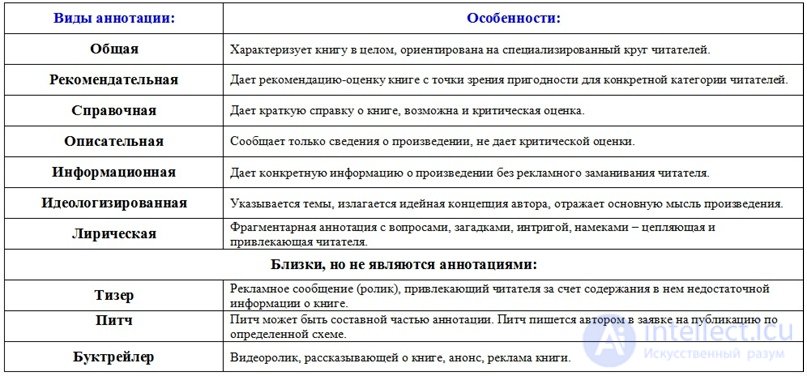
Types of abstracts – general, recommendatory, reference, informational, ideologized, lyrical
analogues of the abstract – teaser, pitch, book trailer
Example of an abstract:
Headline: "The Impact of Climate Change on Marine Ecosystems: Analysis and Prospects"
Abstract: This research article presents an analysis of the impact of climate change on marine ecosystems and discusses the prospects for their future development. The authors carried out a review of scientific research and data related to climate change and its consequences for marine biodiversity, ocean currents and the marine food chain.
The article presents the results of research showing that climate change has a significant impact on marine ecosystems. Changes in ocean temperature, water acidity and the distribution of sea ice affect the migration and reproduction of fish and other marine organisms. These changes also affect the distribution and diversity of marine species, as well as the life cycles and interactions between them.
The authors discuss the potential consequences of climate change for marine ecosystems and stress the need to take measures to mitigate these negative effects. They also discuss prospects and possible strategies for adapting marine ecosystems to climate change, including the protection and restoration of reef systems, rational management of fish resources and the reduction of greenhouse gas emissions.
The study concludes that understanding the relationships between climate change and marine ecosystems is important for developing effective strategies for sustainable management and the conservation of marine biodiversity. The study may be useful for scientists, ecologists, policymakers and all who are interested in preserving marine ecosystems amid climate change.
Keywords: climate change, marine ecosystems, biodiversity, adaptation, sustainable management, conservation.
The introduction and the abstract of an article are completely different concepts. To understand this, it is enough to understand what the abstract is for.
The introduction – is the first section of a research work. The requirements for an abstract state that the introduction must not contain data about results and methods. It gives a detailed description of the state of the subject under study, the hypothesis and problem of the question being researched, and its novelty.
The introduction must contain references to sources. It briefly characterizes the work, and has no conclusions or results. Usually, this component of a scholarly article occupies no more than four paragraphs. The style of presentation is businesslike and impersonal.

Comments