
Lecture
The sketch – one of the literary-journalistic genres, distinguished by its imagery. In other words, the sketch is a generalization of facts and a description of a setting. Judging by the name, one can guess that this kind of journalistic text lacks depth, completeness and analytical reflection, much like an artist’s sketch. The author of such material must be observant, since the sketch is meant to reflect reality objectively. On television, the term “sketch” often refers to scenic footage, a certain unity of interconnected shots (for example, “Spring in Moscow”, “Bridges of St. Petersburg”, “On the Boulevard” and so on).
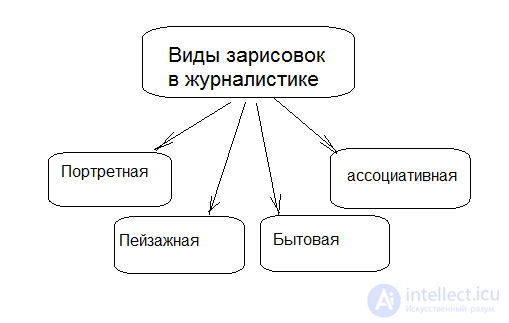
The main features include:
A classic example of a portrait sketch:
"Maria is a young woman, a student and a future psychologist. Small in stature, delicate but graceful, she never ceases to amaze with her energy and persistence. When she speaks, her voice sounds confident and calm, as if she knows exactly what she is saying. One can often notice Maria staring intently into her notebook, jotting down new thoughts and ideas. Her eyes shine with an inner passion for understanding the human psyche, and she is certain that this path is her calling."
And here is a sample of a landscape sketch, full of imagery and artistry:
In autumn the city takes on soft tones, as if muffled by raindrops. From the small hill where the city park is located, a panoramic view of the surroundings opens up. The green crowns of the trees give way to bright red and yellow, creating a colorful mosaic pattern against the blue sky. In the distance, the hazy outlines of mountains can be seen, like billows of mist, playfully caught between light and shadow. Calm and peace fill the soul as one gazes at this beautiful, tranquil landscape
Here is an everyday-life sketch :
In the morning in the village all the animals wake up differently. The hens bustle around the yard and cluck loudly, waking everyone with their noise. The cows lazily stretch out on the grass, while the sheep have long since begun grazing. The villagers, too, gradually wake up and prepare for a new day. The local women clean the house and make breakfast, while the men have already gone outside to attend to their chores. On the whole, the village wakes slowly and calmly, yet full of life and energy
Associative sketch :
A journalistic associative sketch can be written in the form of a chain of associations that carries the reader into a certain mood and links them with certain images and events. Here is an example:
"Summer heat, golden fields, an azure sky, the ringing of bells around a shepherd’s neck, the coolness of a stream beneath a tree – all of this creates an image of quiet, peaceful village life, where every day passes slowly and steadily, in harmony with nature."
Each type of journalistic sketch has its own peculiarities and can be used in different situations:
Portrait sketch – used to create an image of a person, to convey their character, appearance, manner of behavior. This type of sketch can be used in journalistic material devoted to interviews with famous people, in profiles of politicians, public figures, etc.
Landscape sketch – used to create an image of a locality, a city or the countryside. This type of sketch can be used in material about travel, excursions, geographical discoveries, etc.
Everyday-life sketch – used to create an image of the everyday life of people in a specific situation. This type of sketch can be used in material about daily life, stories about people, their habits, problems, events, etc.
Associative sketch – used to convey a mood, emotions and associations linked to a specific object. This type of sketch can be used in material about culture, art, music, nature, etc.
In each specific case, the journalist must choose the type of sketch best suited to convey the necessary information and create the desired effect.

Comments