
Lecture
“The Basic Principles of War Propaganda” (fr. Principes élémentaires de propagande de guerre) — a book published in 2001 by the historian Anne Morelli, a professor at the Free University of Brussels and a specialist in historical criticism as applied to contemporary media . The subtitle reads: “suitable for use in a cold, hot, or lukewarm war”.
In writing the work, Morelli examined the experience of the wars and colonial conflicts of the 20th century and their reflection in war propaganda. The ten “commandments” of propaganda that Anne Morelli sets out in this work represent, first and foremost, an analytical framework for pedagogical purposes and for media analysis . Morelli does not wish to take anyone's side or defend “dictators”, but shows the regularity with which the ten principles are used in the media and in society:
“I do not intend to assess the purity of either side's intentions. I am not trying to establish who is lying and who is telling the truth, who is acting in good faith and who is not. My sole aim is to illustrate the principles of propaganda that are applied by all sides, and to describe their mechanisms” .
Already on the first pages of her book, Anne Morelli expresses gratitude to the British diplomat and Labour politician Arthur Ponsonby — a pacifist who opposed Britain's entry into the First World War in 1914 and who made a significant contribution to formulating the principles of war propaganda. After publishing a series of pamphlets during the First World War, in 1928 he published the book “Falsehood in Wartime[eng.]”, in which he described the mechanisms of propaganda. Anne Morelli draws on this work, updates it and systematises it in the form of ten elementary principles.
Morelli identifies ten basic principles of war propaganda:
According to Morelli, the statesmen of every country have always solemnly assured the public that they do not want war. In society, wars are perceived negatively, except in extremely rare cases. With the advent of democracy, the consent of the population becomes mandatory, so war must be rejected by society. “If all leaders are animated by the same will for peace, the question arises as to why wars ultimately break out?”, the researcher asks, but answers this question in the second principle.
This principle stems from the fact that each side must be made to declare war in order to prevent the enemy from “destroying our values” and endangering our freedom or annihilating us completely. This is the paradox of a war waged to prevent wars, and it recalls George Orwell's phrase from his dystopia “1984”: “War is peace”. In this understanding, the United States was forced to wage war against Iraq because Iraq left it no other choice. They are merely reacting, defending themselves against the provocations of an enemy who bears full responsibility for starting the war. “Daladier assures in his „Address to the Nation“ of 3 September 1939 — while taking on France's responsibility for the consequences of the Treaty of Versailles —: „Germany has already refused to respond to the call of people of good will who have now raised their voices for peace throughout the world. […] We are waging war because we are forced into it“”.
Ribbentrop justified the war against Poland with the words:
The Führer does not want war. He is resolving on it with a heavy heart. But the decision of war and peace does not depend on him. On certain questions vital to the Reich, Poland must yield and fulfil demands without which we cannot manage. If Poland refuses, responsibility for the conflict will fall on her, not on Germany.
In the same vein, on 9 January 1991, in connection with the Gulf War, one could read in Le Soir: “The peace that the whole world desires above all else cannot be built on mere concessions to an act of piracy” . The same applied to the war in Iraq, when the day before it began, on 12 September 2002, Le Parisien came out with the headline: “How Saddam is preparing for war”.
The personification of the enemy's image in the eyes of citizens is the most important task. Morelli writes: “You cannot hate a group of people as a whole, even as your enemies. It is therefore more effective to direct hatred at the leading figure of the enemy country. In this way, the „enemy“ will have a face, and this face will naturally become the object of hatred”.
Morelli comments: “The victor will always portray himself as a pacifist, loving peaceful agreements and mutual understanding, but forced to start the war by the opposing camp — as Bush or Blair did.” “The enemy camp, without any doubt, is led by a madman, a monster (Milosevic, bin Laden, Saddam Hussein), (…) who is challenging us and from whom humanity must be freed” .
The first step in the process of demonisation, in Morelli's view, is to reduce an entire country to a single person — as if, in Iraq, apart from Saddam Hussein with his “terrifying” Republican Guard and his “fearsome” weapons of mass destruction, no one else lived there.
The personalisation of conflicts is characteristic of a certain view of history, according to which history is made by heroes, “great men”. Anne Morelli rejects this view and tirelessly writes about what official historiography conceals. Official history is idealistic and metaphysical, since it assumes that history is the result of great ideas and great individuals. Morelli counters this with a dialectical and materialist approach, which explains history on the basis of relations between people and social movements.
The enemy is endowed with every conceivable vice and evil — from his appearance to his sex life. Thus, on 8 April 1999, Le Vif/L’Express described “the horrifying Milosevic” — without quoting a single statement or document of his, yet emphasising his abnormal mood swings, his painful and violent outbursts of anger: “When he flies into a rage, his face becomes distorted. But suddenly he regains his composure”.
Of course, demonisation is also used for other purposes, like any propaganda tool. Pierre Bourdieu, for example, reports that in the United States, university professors who disliked Michel Foucault's popularity in colleges wrote books about his personal life. According to them, this “masochistic and insane homosexual” practised “unnatural, scandalous and impermissible sexual practices”. By discrediting Foucault as a person, they spared themselves the need to engage in the more difficult argument with his ideas or with the speeches of the political thinker, and “refuted” him on the basis of moral judgements.
Morelli analyses how the economic and geopolitical aims of a war must be disguised behind an ideal, moral and legal values. Thus, George H. W. Bush, speaking about the Gulf War, declared: “This is not a fight for oil, it is a fight against brutal aggression”. On 22 January 1991, Le Monde wrote:
The aims of this war are first and foremost the aims of the UN Security Council. We are taking part in this war for the reasons underlying the Security Council's resolutions, and our goal is, in essence, the liberation of Kuwait.
“In our modern societies, unlike in the times of Louis XIV, war can only be started with the consent of the people. Gramsci showed how necessary cultural hegemony and consent to government decisions are”[10]. This consent is easily obtained if the people believe that their freedom, life and honour depend on this war. “The aims of the First World War could be reduced to three points: — to destroy militarism, — to protect small states, — to prepare the world for democracy. These very noble aims have since been repeated almost verbatim on the eve of every conflict, although they have nothing to do with the true aims”. “It is necessary to convince public opinion that we, unlike our enemies, are going to war for infinitely noble motives”. “For the Yugoslav war, we see the same discrepancy between the official aims and the unacknowledged aims of the conflict”. NATO officially intervened to preserve the multi-ethnic character of Kosovo, to prevent abuses against minorities, to establish democracy and thereby put an end to dictatorship. This is the defence of sacred human rights. But by the end of the war it becomes clear that none of these aims was achieved — on the contrary, there was a significant retreat from the idea of a multi-ethnic society, and violence against minorities, now the Serbs and the Roma, became part of everyday life. However, it can be observed that the economic and geopolitical aims that were never spoken of aloud were achieved[11].
Morelli adds: “To this principle the following is added: the enemy is a bloodthirsty monster, representing a barbaric society”.
According to Morelli, accounts of enemy atrocities are an essential element of propaganda. Insisting that atrocities were committed only by the enemy makes tales of atrocities part of propaganda. In her words, war propaganda is not content with real incidents; it must invent inhuman atrocities so that the enemy appears as Hitler's alter ego.
Morelli sees almost no difference in the methods used to describe atrocities in different wars. Arthur Ponsonby described how, during the First World War, Entente propaganda described gang rapes, murders, cruel treatment and mutilation of children committed by German soldiers. Morelli shows how similar the reports of the wars in Iraq, Afghanistan and Kosovo are.
This principle is examined by Morelli as a supplement to the previous one. During the First World War, each of the warring sides accused the other of using poison gas. Although both opposing sides used gas and conducted research in this area, it became a symbolic expression of inhuman warfare. Therefore, according to Morelli, it was attributed to the enemy as an indecent and treacherous weapon.
Morelli explains this principle as follows:
With rare exceptions, people tend to side with the winning cause. In the case of war, the preference of public opinion largely depends on the apparent outcome of the conflict. If the results are not good, propaganda must disguise our losses and exaggerate the enemy's losses.
She gives the example that already in the First World War, losses in the first month reached 313,000 people. However, the High Command did not report even the death of a single horse and did not publish lists of the dead.
Morelli regards the war in Iraq as yet another example of the ban on publishing photographs of American soldiers' coffins. The enemy's losses, by contrast, were presented as gigantic, with their army allegedly offering no resistance whatsoever. “This kind of information raises morale in both camps and convinces public opinion of the effectiveness of the conflict”.
example
Bulletin of the Grande Armée (fr. Bulletin de la Grande Armée) — a periodical published during the years of the First Empire. The bulletins were issued by the official government body, “Le Moniteur universel”, also known simply as “Le Moniteur”. Copies of the bulletins were sent to local authorities and posted on the walls of public buildings. Julien Sorel, the hero of Stendhal's “The Red and the Black”, pored over the bulletins just as he did over the “Memorial of Saint Helena”[1].
In total, four series of publications were released, each with its own numbering and dedicated to one of Napoleon I's campaigns:
To this can be added the official communiqués, which formally replaced the bulletins in 1813—1814[2].
The bulletins described almost exclusively the military actions and plans of the Grande Armée and its opponents, current and potential. One could also find laudatory remarks about soldiers, officers and units for their various actions.
The bulletin was addressed not only to the soldiers of the Grande Armée (which gave them a better understanding of the scale of the events in which they were taking part), but also to the public, as well as to foreign courts. Being addressed to such a broad audience, the bulletin was used by Napoleon as an effective propaganda tool; because of this, the “grumblers”, who were better informed about the actual state of affairs, coined the saying “lies like a bulletin” (“fr. ment comme un Bulletin”), which entered not only the French language but others as well.
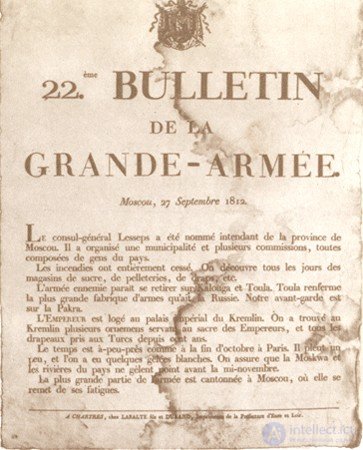
The 22nd bulletin of the Grande Armée (Moscow, 27 September 1812)
According to Morelli, after the First World War, intellectuals largely supported their own camp en masse. Each side of the war could count on the support of artists, writers and musicians who backed the interests of their countries through initiatives in their own fields of activity[13].
She refers to cartoonists, who, in her view, are used to justify the war and to depict the “butcher” and his atrocities, while others, camera in hand, produce heart-rending material about Albanian refugees, carefully choosing those closest to the viewer — for example, a cute blond Albanian child with longing in his eyes, meant to remind us of the Albanian victims.
Everywhere, Morelli writes, “manifestos” are published. The “Manifesto of the Hundred”, aimed at supporting France in the First World War, was signed by André Gide, Claude Monet, Claude Debussy and Paul Claudel. Closer to our own time — the “Manifesto of the 12” against the “new totalitarianism” of Islamism. These groups of intellectuals, artists and prominent figures justify the actions of their country's state power.
The researcher understands this principle in two ways: in the literal sense, war appears as a crusade, underpinned by a divine mission. God's will cannot be avoided — it must be fulfilled. Morelli asserts that this point of view acquired new significance with George Bush's rise to power. In this light, the war in Iraq is presented as a crusade against the “axis of evil”, as “the struggle of good against evil”. It is seen as a duty — to bring democracy to Iraq, as a value flowing directly from the will of God. Political decisions take on a biblical character, one that removes all social and economic problems. Reference to God is made in various ways (“In God We Trust”, “God Save the Queen”, “Gott mit uns” and the like) and serves to justify the sovereign's actions without the slightest chance of contradiction.
The last principle complements all the others, Morelli explains. Anyone who casts doubt on even one of the principles is necessarily a collaborator. There are only two areas: good and bad. You can only be for evil or against it. By this logic, opponents of the Kosovo War are accomplices of Milosevic. Entire groups are considered anti-American: Pierre Bourdieu, Régis Debray, Serge Halimi[eng.], Noam Chomsky or Harold Pinter. The “pacifist family” includes Gisèle Halimi[eng.], Renaud, Abbé Pierre and the media that print them, such as Le Monde diplomatique[eng.] and the French Communist Party (PCF).
Therefore, says Morelli, it becomes impossible to voice a different opinion without risking “media lynching”. Ordinary pluralism of opinion disappears, and all opposition is suppressed and discredited by means of false arguments.
According to Morelli, this procedure was applied again in the Iraq War, although world public opinion was far more divided than in the Kosovo conflict. To be against the war meant to be for Saddam Hussein. The same device was used in a completely different context, namely during the vote on the European Constitution: to be against the Constitution meant to be against Europe.
The German journalist Rudolf Walther, in a review for Die Zeit, writes that in this work Morelli adapts the typical forms of various kinds of propaganda to the news of her time. The researcher draws on the works “Falsehood in Wartime[eng.]” by Arthur Ponsonby and “The War of 1914: The Mobilisation of Consciences” (fr. La guerre de 1914: la mobilisation des consciences) by Georges Demartial on propaganda during the First World War, systematises them into ten principles and applies them to both world wars, the wars in Yugoslavia and the war in Afghanistan. Four of the ten principles, according to Walther, stem directly from a false dilemma that divides everything into black and white and offers no alternatives[14].
Jochen Stöckmann (ger. Jochen Stöckmann) approaches Morelli's study more critically. He finds it striking “that Morelli does not describe how the gears of the media mesh together, she does not investigate the mechanisms and details, but argues exclusively through quotations, basing her critique on the very products of propaganda”. In Stöckmann's view, for those who are so “enlightened”, yet in fact quite hardened against criticism, every report of a war must look like propaganda if it is not based on pacifist views[15].
In his review for H-Soz-Kult Lars Klein (ger. Lars Klein) of the University of Göttingen, while highly praising the relevance of the subject and the usefulness of its analysis, notes that Morelli lacks clarification as to whether the media themselves act independently, whether they pursue political or commercial interests, and whether they knowingly or unknowingly abuse the “good faith” of citizens[16].
The French journalist Serge Halimi writes[17]:
“Some of these maxims — „Our opponent bears full responsibility for this war“; „We are defending a noble cause, not our own special interests“; „The enemy deliberately commits atrocities; if we make mistakes, it happens unintentionally“; „Whoever casts doubt on our propaganda helps the enemy and is a traitor“ — alas, sound very relevant today.
Indeed, from the Allied fake of the First World War about „Germans cutting off the hands of Belgian children“ to the fabrication about „Kuwaiti infants allegedly pulled from incubators by Iraqi soldiers“, and right up to the brand of „Milosevic's accomplices“, which was used to label opponents of NATO during the war in Kosovo — the same intimidation tactics are applied again and again. And often — with the support of intellectuals incapable of thinking outside the framework of power”.
On the website “Appeal for a Democratic School” (Aped), Philippe Schmetz (fr. Philippe Schmetz) notes that the book “The Basic Principles of War Propaganda” is “a work of popularisation, genuinely easy to absorb, with a sharp style and not without humour”. He emphasises that the present day is full of examples confirming the relevance of Arthur Ponsonby's principles, as reinterpreted by Anne Morelli .
The historian Christian Hardinghaus[ger.], in his study on war propaganda and media manipulation (2023), assesses Morelli's principles as useful for identifying relevant propaganda. However, in his view, they should not be applied mechanically to all military conflicts. Principles 1 through 4, as well as principle 9, can be traced in all wars of modern history from 1914 to the present day. The remaining principles apply only partially[18].

Comments