
Practice
A news item (brief) is an informational genre of journalism involving a short report that states a fact or raises a specific question. There is no answer to the question here, and no evaluation of the event.
Unlike a news story, a brief contains fewer details, comments and additional information
Features of a brief:
Here is what the structure of a brief looks like:
Below I'll give some tips on how to write a brief. You should start with the headline. It can be anywhere from one to eight words. It is often phrased as a question. For example, “Why Savelyev Got Divorced”. And note that a question mark is never placed at the end of a headline.
You are not asking the reader a question!
And he himself doesn't want to be asked anything either. If a person has picked up your brief, then most likely he is looking for answers to his own questions. That's why a question mark would not be appropriate here.
Sometimes authors additionally use a subheading as well. It covers the topic more broadly.
For example, in the main headline you indicated a narrow direction — “Modern Culture”. Then in the subheading you can specify exactly what within modern culture will be discussed. Some event, a public figure, or a new painting.
Pay close attention to the lead. It informs more hurried readers, who may not read your whole brief. They look only at the first paragraph and understand whether it interests them or not.
Here, give concrete answers to the questions: what, where and when happened. This will serve as a kind of introduction.
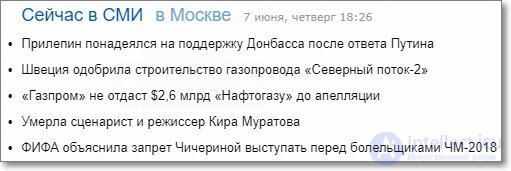
Yandex news briefs on the homepage
On the homepages of major portals (Yandex, for instance) there are news briefs. But even right in the headlines they sometimes give answers to the questions.
If you go to such a news story, you can see a page with all the sources of this information. Then you simply open the one that interested you.
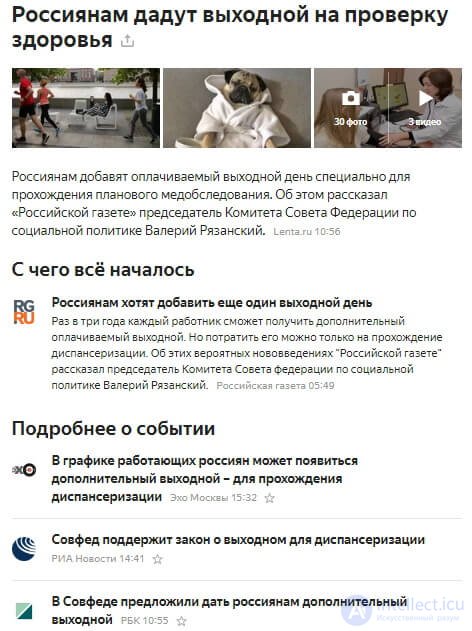 Yandex news feed
In the Yandex news feed you can see a lot of good examples of headlines and leads. Be sure to look at them.
The main text of a brief should answer the questions: what, who, where, when. In news briefs there are no answers to the questions: how, why, wherefore and so on.
Here we do not expand the reader's attention. We must simply briefly convey the information to a person who is rushing somewhere. After all, he has no time for long articles.
If, while reading your text, you can tell which part belongs to which block of the brief, then the work has succeeded.
Let's look at the main types of briefs:
Any given specific brief can be viewed as the result of the interaction of various genre-forming factors. In other words, it can reflect the most varied aspects of reality (different subjects), be the result of the realization of quite definite goals of its author, have its own type of informational content, which is very often connected with the type of publication in which it is published.
Below are the subgenres that can be used by different types of briefs. Here I will give a description and some examples for each.
Event briefs of this type make up, so to speak, the main stream of informational publications in the periodical press. The main content of such briefs is a factual description. Singling them out as an independent genre type is possible on the basis of the distinctiveness of the subject being depicted. As such, an event brief usually deals with various events, as well as the state of affairs in one sphere of activity or another.
In an event (news) brief the subject depicted is various events or states of affairs. Here there is a strict answer to what, where and when happened.
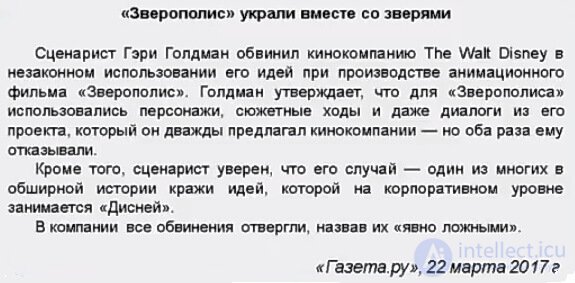
Example of a news brief in a newspaper
A news brief — is a kind of short informational report. The standard length is 4 — 5 sentences. As a rule, it is written in an official style.
The first sentence, the top line, should answer the question of what this is about. You should not overload the report with proper names and terminology. Do not use more than two figures in a sentence, and do not round them if it concerns victims.
At the end you can use information about past and upcoming events.
An announcement - forms simple briefs, which are preventive reports about various upcoming cultural events, exhibitions, concerts and so on. This informational genre is formed by briefs, which are preventive reports about various upcoming cultural events, exhibitions, concerts, etc. The name “announcement” is translated from the English “announce” as “message”, “notification”, “proclamation”. Without such timely reports it is hard to imagine the press, since it is precisely these that attract the wide public to all sorts of events, above all those taking place in the cultural life of society (but, of course, not only in that sphere).
Despite its closeness to a notice, an announcement is an independent type of publication. The difference (though slight) between an announcement and a notice (as they exist in the modern Russian press) lies above all in the fact that notices perform the function of informing not only about what and where something will happen, but also about what is already happening or has happened
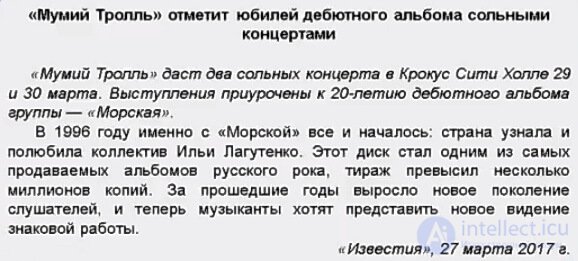 Example of an announcement of upcoming concerts
The time and place of the upcoming event are indicated. Then its essence is briefly laid out.
An abstract — is the main and initial source of information about an article or book. And the more skillfully and precisely you write the abstract, the greater the likelihood that someone will want to read the whole text of the article.
The name of this genre, “abstract”, is translated from the English “annotate” as “to note”. This type of brief belongs to the category of informational texts, the subject depicted in which is a certain informational phenomenon that has already taken place (above all – these are books, articles). The purpose of publishing this type is not so much to inform the audience of the appearance, the existence of some new publication, as to briefly describe its qualities. The abstract reports on the main, “key” points of the phenomenon that has arisen (its title, its author or authors, its publisher or producer, its topic, content, time of appearance, purpose of creation). The abstract is one of the main genres of specialized periodicals (“The Book World” and the like), but publications of this genre quite often also appear in periodicals of a different kind.
You may spend a lot of time conducting research and interpreting the results. But having stated 2 — 3 general sentences in the abstract, there is a risk that no one will ever read the article.
The subject depicted in this journalistic genre is a certain informational phenomenon that has already taken place. Above all, these are books and articles.
The purpose is not so much to inform the audience of the existence of some new publication, as to briefly describe its qualities.
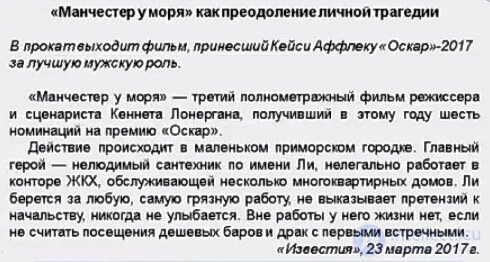
Example of a brief in the form of an abstract
An abstract includes a description of the main topic, the problem of the object, the purpose of the research, the main methods, the results of the research and the conclusions. Here it is indicated what new the material brings compared to others.
Therefore the information should be informative, original, substantive, structured and compact. The length, as a rule, is from 150 to 250 words.
It's important to know that the abstract is prepared after the main text of the article or book has been written.
It is most convenient to write a structured abstract for a structured article. In doing so, you need to select only the most important information from each section of the article. Together they should give a complete picture of the information set out in the article.
The abstract does not include references to sources from the full text. It is also undesirable to use abbreviations and acronyms. But if you absolutely must use some abbreviation, then don't forget to spell out its meaning in the abstract itself.
A mini-review is an evaluative, sometimes promotional, brief. Its subject is some informational phenomenon (a book, a film, a play and so on).
A mini-review represents an evaluative brief, the subject of which is some informational phenomenon (a book, a film, a play, etc.). The purpose of publishing this type is to convey to the reader the impression received by its author in the course of acquaintance with the depicted subject. At the same time, such an impression, being a kind of assessment of the merits of the work, is not substantiated in the mini-review by any proofs, but represents a simple statement of the author's emotions.
The purpose of publishing this type is to convey to the reader the impression received by its author in the course of acquaintance with the depicted subject. At the same time, the author's opinion is not substantiated by any proofs, but represents a simple statement of emotions.
Analysis is not important here. What matters here is only the author's attitude, his opinion and evaluation. The narration is usually in the first person.
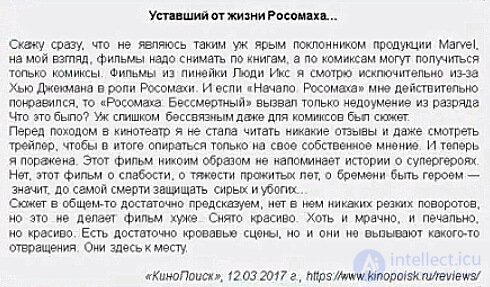
Example of a mini-review on Kinopoisk
This is a variety of brief where you can find short information about a person. It gives an initial impression of the personality.
A blitz portrait - is a genre that can be singled out from informational publications of other types as an independent one, on the basis of the distinctiveness of the subject being depicted. Publications of this type contain brief information about a person with the goal of giving the audience an initial impression of his personality. The name “blitz portrait”, to a certain extent, prepares one for acquaintance with a special subject of depiction, namely a person. The presence of such a name for the brief is important both for the journalist himself and for the audience. For the journalist, knowing that he needs to prepare an informational piece in the “blitz portrait” genre helps him understand exactly what he should write. For the audience, labeling the publication with the name “blitz portrait” suggests what, in fact, is being discussed in the publication placed under this heading.
Most often a blitz portrait is not some separate genre. It accompanies a larger piece, where it is set off as a separate, marked sidebar. For example, brief information about where a person was born, what he did, and so on.
Here some set of events is compared. The criterion for this comparison is some common feature.
For example, these events could have happened at the same time. Or they could have been devoted to one particular subject.
This type of material represents a factual brief. The possibility of classifying informational publications as an independent genre type of brief, the “mini-roundup”, lies in the distinctiveness of the subject depicted. Namely: in such cases the subject is not some single event, action, or phenomenon, but a set of them. Moreover, this set is defined by the author of the mini-roundup himself. The boundaries of this set may be, for example, a certain time period, during which the most notable events, from the author's point of view, occurred. But he may also combine certain phenomena on another basis, for example by their similarity (by topic). Other grounds may also be found for selecting the set of phenomena under review.
The author of a mini-roundup does not set himself the goal of thoroughly identifying the interrelations existing between the phenomena he has selected for coverage in the publication. He does not try, in such publications, relying on the interconnection of the phenomena covered, to determine some underlying pattern that generates them. His main goal – is to report on the existence of similar phenomena or to inform about events that occurred over a certain period of time.
At the heart of a mini-story lies a certain intrigue. Very often such short story-like briefs are published by women's magazines. In them they tell of professional, romantic or family adventures. This type of brief is currently widespread in publications intended for family reading and prepared according to the “European standard” (the reader is offered the chance to get the main information with minimal expenditure of time and effort). In other words, briefs of this type are oriented toward a small volume of information, usually accompanied by color photographs.
The main basis for singling out the mini-story as an independent genre is the subject depicted, which is some family, romantic, professional or other life intrigue built on relationships between people.
The main content of mini-advice is programmatic information. This is how something needs to be done. A kind of algorithm of actions for achieving a result. Informational publications of this type represent a brief, the main content of which is programmatic information.
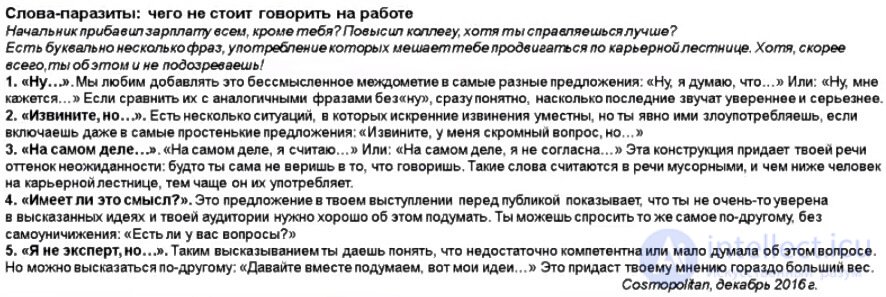
Example of mini-advice
Let's use a specific example from a newspaper to see how an event brief is written and what its structure is.
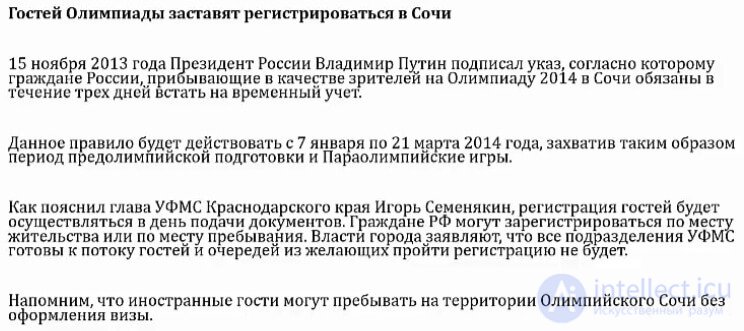 An event brief in a newspaper
In the headline we see that the main news has already been reported. In the lead (the first paragraph) comes the explanation with the answer to the questions: what, where and when.
What happened? Putin signed a decree according to which viewers must register. When did this happen? On November 15, 2013. Where did this happen? In this case it is not a relevant question, since it is already clear that it was in the Kremlin. So there is no clarification here.
You see, if a person only skims the headline and the lead, he already gets enough information. And if he wants details, he continues reading the text further.
In the main text of the brief the author does not give any evaluations of the given event. He does not comment on it in any way. The person simply gives us information. This means it is an informational type, done in the news subgenre.
The only place where there is a manifestation of the author's personality and evaluation is the very last paragraph. But this is done unobtrusively. The author simply informs us. There are no evaluations here. Only facts.
Let's look at a second, simple example of an event brief. Here we have all the typical mistakes inherent to this genre.
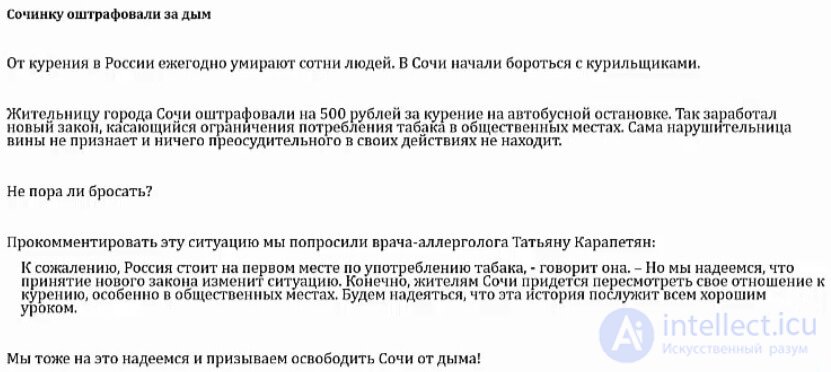 Gross errors in a brief
The headline here carries no valuable information. The phrase “fined for smoke” is not immediately clear. You could be fined for a forest fire, for smoke in the kitchen, or for smoking. That is, this is not an informative headline.
Next comes the introduction (the lead).
Here too it is not clear what, where and when happened. First, the first phrase is absolutely banal. That hundreds of people die every year is not statistics. It's all abstract. What's needed is more precise figures. For example, 2,765 people.
Second, how this connects to the headline and our news story is also not clear. Only the second sentence of the lead somehow tries to introduce us to the essence of the matter. But it does this poorly. As a result it fails to convey the main message. The introduction is not specific enough.
Next, in the third paragraph comes the explanation. The event itself is covered only in this paragraph. But again it is not clear what law this is, when it was adopted, and so on.
Next comes a subheading of a philosophical character — “Isn't it time to quit?”
A little below it comes an utterly out-of-place expert comment. This happens quite often, when they bring in someone irrelevant just so a person could comment.
First, what does an allergist doctor have to do with this situation? Probably nothing.
Second, even if he is a doctor by profession, who is he. In the first example brief this was the head of the Federal Migration Service. That is, the person who will be responsible for the enforcement of the law on the territory of Sochi.
If in the second example there had at least been the head of the Krasnodar Territory Health Ministry, that would be another matter. But as it stands this is just a private individual who happens to have a medical diploma. He was dragged into this brief by the ears, quite literally.
The comment itself does not shed any light on the essence of the event. It carries no new information. There are no facts at all.
The end of the brief is very pompous, unspecific and uninformative.
In general, this is an example of how a brief should not be written. Remember, the author does not express his opinion. He does not try to show himself off. Here we only inform.
We always remain behind the scenes. Yes, this is a shame. You still want to show off your talents and present yourself. But let it comfort you that briefs are a very popular genre, one that very often finds its application on the internet. For example, news on websites, posts on social networks, news feeds, and so on.
How can you turn a large news story or some information into a compact brief? To begin with, this is removing introductory words and constructions.
You also need to remove evaluative expressions. For example, authoritative, newest, super high-quality, and so on. Remember that the author's evaluation is of no interest to anyone in this genre.
Also remove everyday clichés. For example, at every turn, by magic, in the end. This too carries no meaning or informational value.
Also remove bureaucratic clichés. Such words are very hard to take in. They will not make your brief any easier to read.
For example, if you say: “Work is being carried out aimed at specialization…”, this will be hard to take in. But you could put it this way instead: “Utility workers will be collecting taxes under a unified system.”
Formalism is not just the enemy of comprehension and ease of a text. It violates care for the reader. For example, when the water is shut off, notices are posted in stairwells.
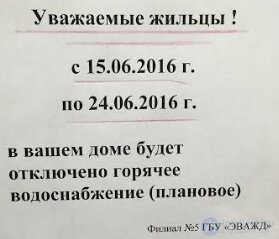
What use is there in such a message?
None at all! Such a principle would also be bad for a brief. So it's better to write it differently. Thinking about the benefit for the reader, we need to understand what problem he has run into.
In our example, this is the shutoff of hot water. People have a hard time without it. But we can tell the reader, in this very same brief, that the utility company, on the contrary, cares about us.
First, they chose the most convenient period, when it is easier for a person to live without hot water. Second, if the repairs are not carried out in summer, then in winter there could be a breakdown. Then things would be much worse.
And having read this, a person already understands that it is even a good thing that he will have to live without hot water for two weeks right now. In this way, we have created benefit and formed understanding.
The genre definition “brief” corresponds to a type of material distinguished by its small size (from the point of view of the corresponding notions of publication length established in journalism), in which the results of a certain study of the subject of the presentation (acquaintance with this subject) are set out. In such material, if the source from which the information was drawn is mentioned at all, it is done very briefly; usually there is no account of the depth of this study, or of what methods were used to obtain the information about the subject. The course of this study, and the author's emotions that accompanied it, and so on, are not set out. The main thing for a brief – is precisely a brief account of the result of the study, a “signal” about the existence (or absence), the main features of some phenomenon, event, person, or problem. Moreover, these events, phenomena, problems, and aspects of a person's character must appear to the audience as “news”, that is, potential information exceeding what readers already know. The greater this “excess” (naturally, within the bounds of what can be comprehended), the more significant the news will be.
Types of informational content of a brief
As already stated above, a person, in order to orient himself in the world and carry out activity to satisfy his diverse needs, requires comprehensive information, which would help him establish the fact of the existence of certain phenomena, their significance, value and directions of development, the future state of these, determine the corresponding norms (limits) of their “use”, and the possible options for his own actions (including, possibly, on the part of other members of the audience) connected with such phenomena.
The comprehensiveness of information arises as a result of combining (whether purposefully or spontaneously) certain initial types of this information. Namely: facts (factual, descriptive information), evaluations (evaluative, valuative information), norms (normative, prescriptive information), programs (programmatic, recommendatory information), assumptions (prognostic, probabilistic, preventive information). In a specific brief, one or another of the listed types of information may predominate, and it may even contain only one type of information. As a result, a relatively wide substantive variety of briefs arises.
That's all!
Now you know how to properly put together a brief. Remember that you can use its various types (simple and more extended ones). Also try to pay more attention to sample examples of writing. This later helps a lot in practice.
Informational genres
Analytical genres

Comments