
Lecture
Here I've put together in one table a list of all the factors that influence your site's ranking in Google, Yandex, Bing, Yahoo! , Baidu , MailRu, SputnikRu and other search engines. The list contains positive, negative and neutral factors , affecting ranking.
Even though ranking algorithms and signals keep changing and new signals keep appearing, the existing signals mostly stay in the set of signals taken into account for ranking, with only small changes. Signals related to a site's internal content are the main and classic ones, because the most important thing on any site is its content, and the fact that the site is made for people (MFP), and not made as yet another junk site (a garbage site made only for search engines).
Don't forget the single most important thing: you're making the site for PEOPLE, not for search engines, so first and foremost the content or service on the site must be unique, and only secondly should the site follow SEO rules.
The tag shows up in search results as the page title. The title tag should be short (6 or 7 words maximum) and the keyword should be placed right at the beginning. for key pages it matched its name (with the page title, highlighted, for example, by a tag this page's title should read: “Site name” — “Contacts” or simply “Contacts”;
but it is better to use link rel="alternate"and
Cutts recommends that webmasters place language versions of sites on separate domains (for example, domainname.com, domainname.ru, domainname.fr, etc.). First, Matt Cutts states that it is easier for a search engine to adequately evaluate content that sits on a separate domain with a regional binding. Second, users in each individual country trust sites in their own domain zone more, since they perceive a company with such a site as a local business rather than something distant and inaccessible. If your budget doesn't allow you to buy separate domains in different domain zones, Cutts advises at least making subdomains for each language version of the site.
Also, if a site on an international domain zone (for example, .com) is made for the audience of a specific country, that regional binding should be specified in Google Webmasters.
8. Site performance and optimisation |
|||
| 8.1 | Low page generation speed (long time) | directly affects the site's ranking. the shorter the page generation time and the server response time, the better, and vice versa | -2 |
| 8.2 | No site optimisation for mobile devices, no minification and no concatenation of css and js, no use of image sprites or vector svg images | -1 | |
| 8.3 | not using deflate or gzip compression | Using deflate or gzip compression mechanisms for HTML JSON content | -1 |
| 8.4 | not using max-age and e-tag caching | Not using the client-side caching mechanism for static content with max-age and e-tag | -1 |
| 8.5 |
not using caching Last-Modified If-Modified-Since |
Not using the full client-side caching mechanism for dynamic or static content with code 304 Last-Modified and a correct response to a request with the If-Modified-Since header (an empty response with code 304 ) |
-1 |
| 8.6 |
Performance / Site loading |
the FTTB time should be minimal | |
| 8.7 | JS execution time | should be minimal |
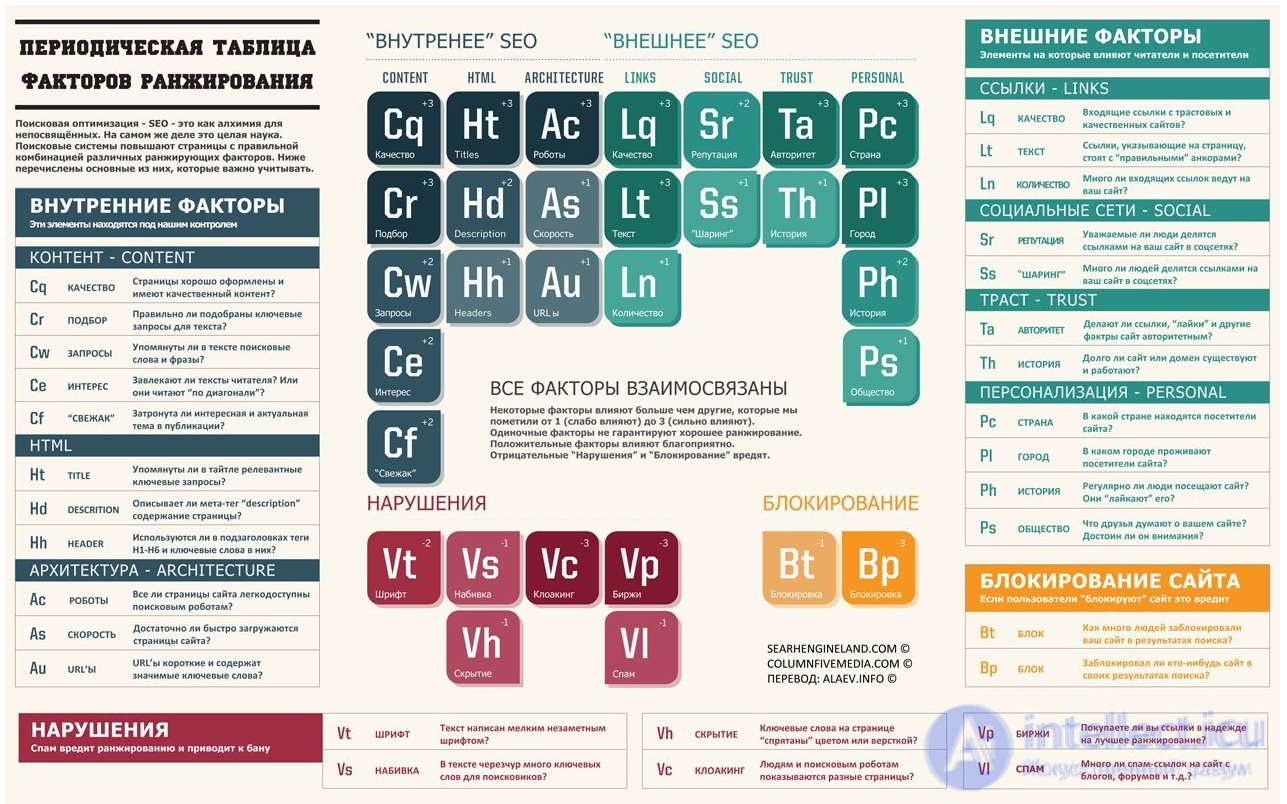
You probably already know that Google uses around 200 ranking factors in its algorithms. But which ones? Fortunately for you, today we are publishing the full list.
20. Page load speed in HTML. Both Google and Bing use page load speed information as a ranking factor. Spiders can fairly accurately calculate load speed based on the webpage's code and file size.
23. Page load speed in Chrome. Google may use Chrome user data to better understand a page's load speed. Information such as server speed, CDN use and other metrics unrelated to HTML matters here.
24. Image optimisation. In the image files placed on a webpage, search engines look for additional important relevance signals. The file name, the values of the img tag's alt and title attributes, and the photo's description and caption are all read.
75. Optimisation for mobile devices. Google's official position on mobile optimisation is to build a responsive site design. It's quite likely that sites with a responsive design rank better in search from a mobile device. In fact, in the results such sites are marked with a “For Mobile” label (“Mobile friendly” in English-language results), which means the site is optimised for viewing on mobile devices. In addition, in mobile search results Google has started demoting sites that aren't built for mobile.

Comments