
Lecture
In today's world, mobile apps have become an integral part of business and everyday life. But simply building an app isn't enough — users also need to be able to find and download it. This is where ASO (App Store Optimization) comes in — optimising an app for the Google Play and App Store, which boosts its visibility and increases the number of installs.
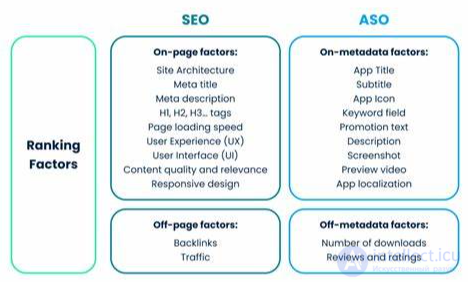
ASO (App Store Optimization) is the process of optimising a mobile app to improve its search rankings and visibility in the app store. It's the mobile equivalent of SEO, but with its own quirks tied to the iOS and Android platforms.
The goals of ASO:
Increasing organic installs.
Improving search and category rankings.
Boosting the conversion rate from page view to install.
The main goal of ASO is to attract organic traffic, increase the number of installs and improve the app page's conversion into downloads.
The ASO process involves working with both internal and external factors. Internal (on-metadata) factors include elements that can be edited directly: the app title, subtitle, keywords, description, icon, screenshots, promo video and the choice of the right category. The title and subtitle should contain keywords, since they have a significant influence on app store algorithms. The description matters for Google Play, as it's analysed by search algorithms, whereas in the App Store it plays more of a role in persuading users. Screenshots and the preview video should be appealing and showcase the app's key benefits, since visual content directly affects the install conversion rate.
External (off-metadata) factors include ratings, install numbers, user reviews and external mentions. The higher the average rating and the more positive reviews there are, the better the app ranks. Regular engagement with the audience, replying to comments and encouraging users to leave ratings all help improve ASO performance. It's also important to build up external traffic by attracting users from social media, blogs and ad campaigns.
An effective ASO strategy includes keyword analysis, A/B testing of visual content, working on ratings and reviews, and monitoring positions in the stores' search results. Using specialised tools such as AppFollow, Sensor Tower, Mobile Action or ASOdesk lets you analyse competitors and find the best ways to promote your app.
Today, store algorithms increasingly take into account user behaviour, engagement, retention and app quality. That's why ASO isn't a one-off action but a continuous process of improvement and adapting your strategy to market changes.
These elements can be edited directly in the app's settings:
These elements depend on users and external sources:
The key ASO (App Store Optimization) factors are divided into internal (on-metadata) and external (off-metadata), and both types affect the app's visibility and conversion rate in the store.
Internal factors are the elements the developer can change independently. First and foremost is the app title, which should be short, memorable and contain keywords, since it has a strong influence on ranking. The App Store limit is 30 characters, while Google Play allows 50. The next important element is the subtitle (App Store) or short description (Google Play), where relevant keywords should also be used to improve indexing. The full description is especially important for Google Play, since its text is analysed by search algorithms, whereas in the App Store the description plays more of a marketing role, influencing user conversion. The App Store also has a dedicated keywords field (up to 100 characters), which isn't visible to users but is actively used by the algorithms for ranking. Another factor is the app's category, which should be chosen carefully in order to compete against relevant apps and improve the chances of reaching the top spots. Visual elements such as the icon, screenshots and promo video have a huge effect on conversion. The icon should be simple, appealing and stand out from competitors. Screenshots should showcase the app's key features and the benefits of using it. Promo videos are especially relevant for games and complex services, since they can quickly show users the core functionality and increase the likelihood of a download.
External ASO factors are parameters the developer can't change directly but can influence. One of the main ones is the app's rating, which has a strong effect on ranking and conversion. The higher the average rating, the more likely the app is to be installed. The presence of user reviews also matters: positive comments improve reputation, while negative ones can hurt rankings, especially if the developer doesn't respond to them or fix the issues raised. The number of installs and uninstalls is another important metric, since store algorithms take the app's popularity into account. If users frequently download the app but quickly delete it, this can hurt ASO. External mentions and links to the app — for example, in blogs, social media or the press — can also boost its popularity and improve its position in the store's search results.
Effective ASO optimisation requires constant analysis and improvement of all these factors. Regularly updating keywords, testing visual content, working with user reviews and attracting external traffic will all help boost the app's position in the store and increase the number of installs.
Effective ASO optimisation requires a comprehensive approach that includes keyword analysis, optimising visual content, working with reviews and ratings, A/B testing, and external promotion.
The first step is selecting keywords and building a keyword set. This requires researching popular user queries using specialised tools such as Sensor Tower, AppFollow, Mobile Action or ASOdesk. Keywords should include both high-frequency (HF) terms, which drive high traffic, and mid-frequency (MF) and low-frequency (LF) terms, which help you compete in narrower niches. Once the keyword list has been drawn up, the keywords need to be placed thoughtfully in the title, subtitle, description and, for the App Store, in the dedicated keywords field. It's important to keep an eye on shifting trends and regularly update the keyword set, testing different combinations to improve the app's rankings.
The next aspect is optimising visual content. The app icon should be simple, recognisable and stand out from competitors. It plays an important role in a user's decision, especially when quickly scrolling through a list of apps. Screenshots should showcase the app's key features and benefits, and it's worth remembering that the first screenshot is visible even before the user opens the app page. An effective tool for boosting conversion is the promo video, especially for games and complex services, where it's important to convey the product's value quickly. The video should grab attention in the first 5 seconds, since users rarely watch it all the way through.
Working with reviews and ratings is a key factor in successful ASO. The higher the app's average rating, the higher its position in the search results. Developers should actively engage with users, respond to reviews — especially negative ones — and promptly fix the issues users report. It's also important to encourage users to leave ratings using built-in mechanisms, such as pop-ups inviting them to rate the app.
Another important ASO tool is A/B testing. It lets you experiment with different versions of the title, icon, description, screenshots and video, analysing which changes deliver the biggest boost in conversion. Google Play has a built-in tool, Google Play Experiments, which helps test different versions of the app page, while for the App Store you can use alternative services to analyse user behaviour.
Besides working on internal factors, external promotion (off-metadata factors) also plays an important role. This includes advertising on social media, collaborations with bloggers, promotion through influencers, and coverage in industry media and niche communities. Attracting external traffic has a positive effect on the app's rankings, since the store algorithms take its popularity into account. It's important to use a range of promotion channels, such as targeted advertising, content marketing, SMM and PR campaigns.
An effective ASO strategy isn't a one-off action but an ongoing process that requires regular analysis, testing and improvements. Taking a comprehensive approach that includes optimising keywords, visual content and ratings, as well as working with external traffic channels, will help you achieve high rankings in the app store and increase the number of installs.
A/B testing in ASO (App Store Optimization) is the process of comparing two or more versions of elements on an app's store page (App Store or Google Play) to determine which one delivers a better install conversion rate. It helps developers and marketers find the most effective titles, icons, screenshots, descriptions and videos for attracting more users.
The basic idea is that the audience is randomly split into groups, each of which sees a different version of the element being tested. The metrics are then analysed — such as CTR (click-through rate — the percentage of users who went to the page) and CVR (conversion rate — the percentage of installs after viewing the page) — and other indicators, in order to pick the most successful variant.
Suppose a mobile app developer has a hypothesis that a brighter icon will attract more users and boost install conversion.
Choosing the element to test:
Testing platform:
Running the test and analysing the data:
Conclusion:
A/B testing in ASO lets you make decisions based on data rather than assumptions, which helps improve the app's position in the store and boost install conversion.
Artificial intelligence: store algorithms are getting smarter, taking user behaviour into account.
Video content: Google Play has started actively promoting apps with video presentations.
Voice search: voice queries are growing in popularity, so it's important to adapt keywords accordingly.
Engagement rating: not just the number of installs is taken into account, but also user engagement.
In the 2020s, ASO (App Store Optimization) underwent significant changes driven by the evolution of app store algorithms, tighter moderation rules and shifting user behaviour. The main trends include a greater role for behavioural factors, growing influence of external traffic, expanded A/B testing tools, new formats of visual content, and changes to keyword and metadata requirements.
One of the key changes was the growing role of behavioural factors. Whereas ranking algorithms in the App Store and Google Play used to focus mainly on keywords and install counts, the stores now take into account the depth of user engagement, retention levels, app launch frequency and uninstall rates. This means ASO is no longer just about optimising metadata, but requires a comprehensive approach that includes UX/UI improvements, working with reviews and maintaining high product quality.
Another important trend was the growing importance of external traffic. Google Play and the App Store increasingly favour apps that get organic installs not just through in-store search, but also through advertising, social media, PR and bloggers. This means apps that attract users from external sources gain a ranking advantage. As a result, developers have started making more active use of ad campaigns on Facebook Ads, TikTok Ads and Google Ads, as well as working with influencers to boost their store rankings.
Significant changes have also affected A/B testing tools. Google Play has expanded the capabilities of Google Play Store Listing Experiments, allowing developers to test not just metadata but also visual elements, including icons, screenshots and video. The App Store introduced a new tool, Product Page Optimization, which allows developers to test alternative versions of the app page. This has given developers more opportunities to analyse user behaviour and adapt their pages to their target audience.
Another major change is the growing influence of visual content. In the 2020s, users started paying less attention to text descriptions and focusing more on the icon, screenshots and promo video. In response, developers have started experimenting with vertical and horizontal screenshots, infographics, animation and more emotionally engaging visual elements. The use of video in promo materials has also increased, especially for gaming apps, where showcasing gameplay has become a decisive factor in driving installs.
Changes have also affected keywords and how semantics are handled. In the App Store, Apple continues to strictly moderate keywords, banning excessive use of brand names and irrelevant queries. In Google Play, updated algorithms now analyse not only the occurrence of keywords in the description, but also their naturalness, text structure and how users behave in response to particular phrasing. This forces ASO specialists to take a more thoughtful approach to selecting keywords and to adapt their copy to users' real search queries.
The 2020s also saw app stores tighten their control over content quality. Apple and Google have started fighting fraud, install manipulation and fake reviews more actively. As a result, developers now need to pay more attention to organic growth, honest reviews and a long-term audience retention strategy.
In short, ASO in the 2020s has become a more comprehensive process, requiring not just work on keywords and visuals but also in-depth analysis of user behaviour, integration of external traffic channels, and constant adaptation to new store algorithms.
| Parameter | SMM (Social Media Marketing) | SEO (Search Engine Optimization) | ASO (App Store Optimization) |
|---|---|---|---|
| Goal | Attracting users through social media | Increasing website traffic through search engines | Boosting visibility and downloads in the App Store and Google Play |
| Where it's used | Social media (Facebook, Instagram, TikTok, Twitter, etc.) | Search engines (Google, Bing, Yandex, etc.) | App stores (Google Play, App Store) |
| Main tools | Content marketing, targeted advertising, collaborations with bloggers, contests, audience engagement | Keywords, meta tags, site structure, internal and external links, page load speed | App title, description, keywords, icon, screenshots, video, reviews and rating |
| Type of traffic | Paid (targeting, advertising) and organic (viral reach) | Organic (search) | Organic (in-store search) and paid (advertising in the store) |
| Influence of reviews | Important for audience trust, but doesn't affect ranking | Affects trust, but doesn't directly affect search rankings | Very important – reviews and rating affect ranking in the store |
| Speed of results | Fast results from ad campaigns, but requires constantly refreshed content | Long-term process, visible results after 3–6 months | Medium-term process (1–3 months), but requires regular optimisation |
| Analytics methods | Reach, engagement, clicks, conversions (Facebook Analytics, Instagram Insights, Google Analytics) | Search rankings, traffic, conversions (Google Search Console, Ahrefs, Semrush) | Number of installs, conversion, rating, keywords (App Store Connect, Google Play Console, AppFollow) |
| Monetisation | Sales via social media, affiliate programmes, advertising | Contextual advertising, affiliate programmes, lead generation | In-app purchases, subscriptions, advertising |
| Platform dependency | Subject to social media algorithms (changes in reach, shadow bans) | Subject to search engine algorithms (changes in ranking) | Subject to App Store and Google Play algorithms (changes in ranking) |
| Promotion cost | High (targeting + content) | Medium (depends on competition) | Medium (ASO + in-store advertising) |
Conclusion:
All three methods can be used together for maximum effect.
ASO is a long-term process that requires regular analysis and optimisation. To successfully promote a mobile app, you need to work on keywords, visual content, reviews and external traffic. Using effective ASO strategies can significantly increase organic installs and help you achieve high rankings in Google Play and the App Store.

Comments