
Lecture
Here I've brought together in one table the list of all the factors that affect your site's ranking in Google, Yandex, Bing, Yahoo!, Baidu, MailRu, SputnikRu and other search engines. The list contains positive, negative and neutral factors affecting ranking.
Even though ranking algorithms and signals keep changing and new ones keep appearing, the existing signals mostly stay part of the ranking factor set with only minor changes. Signals related to a site's internal content are the main, classic ones, because the most important thing on any site is its content, and the fact that the site is made for people (MFP), not just another piece of junk (a so-called "junk site").
Don't forget the most important thing: you build a site for PEOPLE, not for search machines, so first and foremost the content or service on the site must be unique, and only secondly should the site follow SEO rules.
The tag shows in the search results as the page title. The title tag should be short (6 or 7 words maximum) and the keyword should be placed right at the beginning. for key pages it matched its name (with the page title, highlighted, for example, by the tag, this page should have stated: “Site name” — “Contacts” or simply “Contacts”;
but it's better to use link rel="alternate"and
Cutts recommends that webmasters place language versions of sites on separate domains (for example, domainname.com, domainname.ru, domainname.fr, etc.). First, Matt Cutts states that it's easier for a search engine to properly evaluate content that sits on a separate domain with a regional tie. Second, users in each individual country trust sites in their own TLD more, since they perceive a company with such a site as a local business rather than something distant and unreachable. If your budget doesn't allow you to buy separate domains in different TLDs, Cutts advises at least making subdomains for each language version of the site.
Also, if a site on an international TLD (for example, .com) is made for the audience of a specific country, you should specify this regional targeting in Google Webmasters.
|
|
6. Domains, URLs |
||
|
6.1 |
Keyword in the URL and in file names |
This is a very important factor. Moreover, first and foremost in the original language, second a translation into English, and last, all else being equal, transliteration |
+3 |
|
6.2 |
Site accessibility |
Another fundamental issue that's often neglected. If a website (or individual pages) is inaccessible because of broken links, 404 errors, password-protected sections and other similar reasons, then the site simply can't be indexed. |
+3 |
|
6.3 |
Sitemap |
It's great to have a complete and up-to-date sitemap; spiders love it, regardless of whether it's a plain old HTML sitemap or Google's special sitemap format. |
+2 |
|
6.4 |
Site size (number of pages) |
Search engines love large sites, so in general, the more the better. Still, large sites become user-unfriendly and hard to navigate, so sometimes it makes sense to split a large section into several smaller ones. On the other hand, such sites are hardly ever penalized simply for having more than 10 thousand pages. |
+2 |
|
6.5 |
Site age |
Like wine, older sites are valued more. The idea is that an old, established website is more trustworthy than a new site that has just appeared and might soon disappear. |
+2 |
|
6.6 |
site topic |
It's not just about keywords in the URL and a page matching them. A site's topical focus matters even more for good ranking, because when a site fits into a single topic, it boosts the rankings of all its pages that relate to that topic. |
+2 |
|
6.7 |
File location on the site |
File location matters, and files that sit in or near the root directory generally rank higher than files buried 5 or more levels deep. |
+1 |
|
6.8 |
Domains vs. subdomains, separate domains |
Having a separate domain is better - that is, instead of mysite.domain.com, register a separate domain, domain.com |
+1 |
|
6.9 |
Top-level domains (TLDs) |
Not all TLDs are equal. Some top-level domains are better than others. For example, the most popular TLD - .com - is much better than .ws, .biz, .info or similar domains, but (still) .edu or .org domains carry much more weight. |
+1 |
|
6.10 |
Hyphen in the URL |
A hyphen between words increases URL readability and helps with SEO ranking. This applies both to hyphens in domain names and in the rest of the URL. |
+1 |
|
6.11 |
Hyphen in the domain name |
used to boost ranking (because it clearly separated the words of the domain, if the domain name consisted of several words); now it lowers ranking instead |
-1 |
|
6.12 |
URL length |
As a rule, it doesn't matter, but if the URL is very long, it starts to look like spam, so avoid more than 10 words in the URL (3 or 4 for the domain name itself and 6 or 7 for the rest of the address is acceptable). |
0 |
|
6.13 |
IP address of the server hosting your site |
This can only matter for shared hosting or when a site is placed on a free hosting provider, when the IP or an entire C-class range of IP addresses is blacklisted because of spam distribution or other illegal activity. |
0 |
|
6.14 |
Adsense will boost your ranking |
Adsense has no connection whatsoever to SEO ranking. Google certainly won't give you a ranking bonus for hosting AdSense ads. Adsense can increase your revenue, but it has nothing to do with search ranking. |
0 |
|
6.15 |
Adwords will boost your ranking |
Similarly to Adsense, Adwords has nothing to do with search ranking. Adwords will bring more traffic to your site, but it won't affect your ranking at all. |
0 |
|
6.16 |
Hosting downtime |
Hosting downtime is directly related to accessibility, because if a site is frequently down, it can't be indexed. But in practice this is only a factor if your hosting provider is genuinely unreliable and has less than 97-98% uptime. Try using a proven hosting provider, such as Hostgator, for hosting. |
-1 |
|
6.17 |
Dynamic URLs |
Spiders prefer static URLs, though you'll see plenty of dynamic pages in top positions. Long dynamic URLs (more than 100 characters) are genuinely bad, and in any case it's better to use a tool to rewrite dynamic URLs into something more SEO- and human-friendly. |
-1 |
|
6.18 |
Session ID |
This is even worse than dynamic URLs. You shouldn't use session identifiers for information that you want spiders to index. |
-2 |
|
6.19 |
Disallows in robots.txt |
If indexing of a significant part of the site is disallowed, this can affect the non-banned part too, because spiders will come less often to a "NoIndex" site. |
-2 |
|
6.20 |
Excessive automatic redirection (redirects). Redirection (301 and 302) |
When not implemented properly, redirection can cause serious harm - the target page may not be reached, or worse - the redirect can be viewed as a black-hat SEO technique, where a visitor is immediately delivered to a different page. A page with a redirect will most likely not be indexed, which is especially risky if the redirect is on the homepage, for example redirecting to a language version. Bing even refuses to index sites that have a redirect on the homepage. Avoid using redirects whenever possible. A redirect can only be useful if page addresses change for technical reasons and the user needs to be sent to the new page address. . Note that servers use a 302 redirect by default, which doesn't guarantee that the redirect's target will be shown in the search results (unlike a 301 redirect). |
-3
|
|
6.21 |
Using the HTTPS protocol |
increases trust in the site, the site address is displayed with a green highlight, and the site also gets a slight boost in rankings |
+1 |
|
6.22 |
whois DNS, correctness of the domain's registration data |
Incorrect domain registration data, Hidden owner data in DNS, or the same owner for sites that actively link to each other, lower the overall ranking |
-1 |
|
6.23 |
Free domains, .tk and so on |
as a rule, aren't trusted by search engines and have less chance of ranking well than paid second-level domains. | |
| 6.24 |
History of penalties against the domain owner |
if penalties were imposed in the past, this brings a ranking drop for all other domains owned by the same owner | |
| 6.25 | domain history (before ownership by another owner) | even after a change of ownership, a positive or negative history may be retained by the search engine |
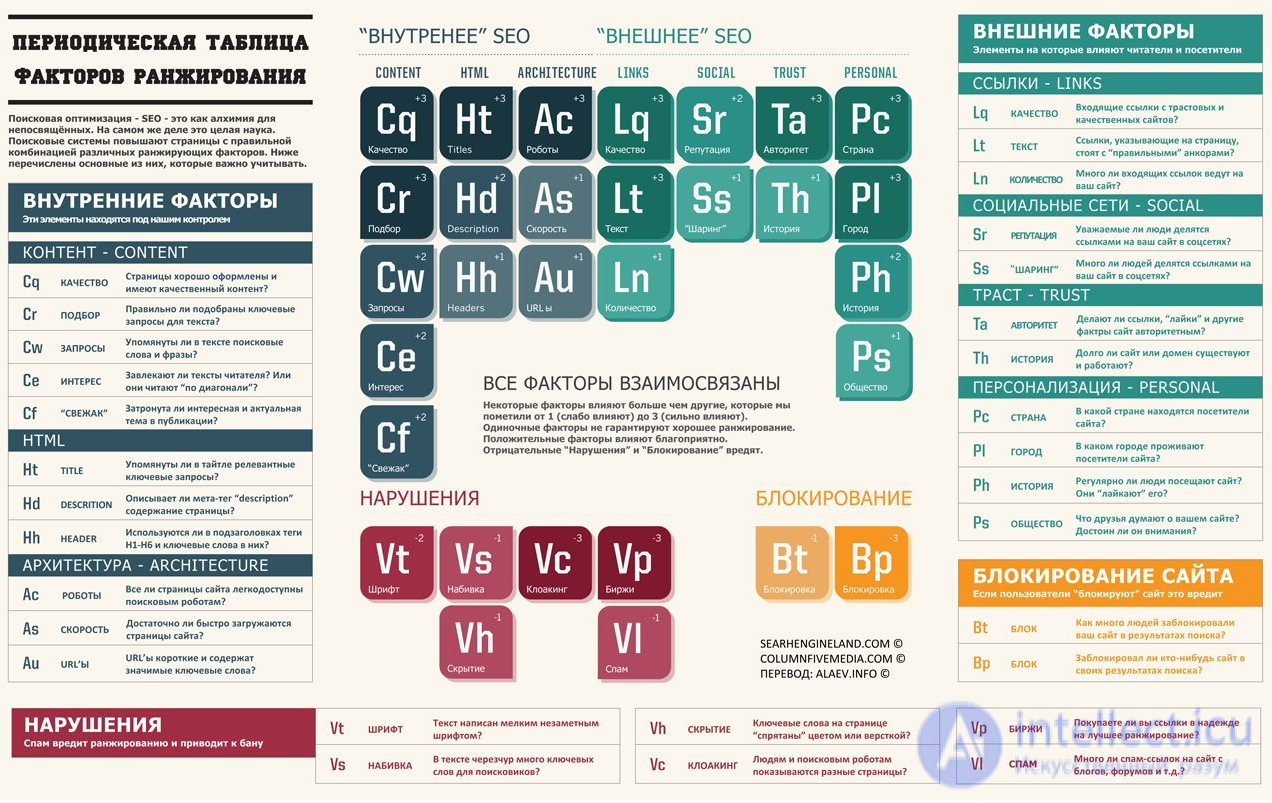
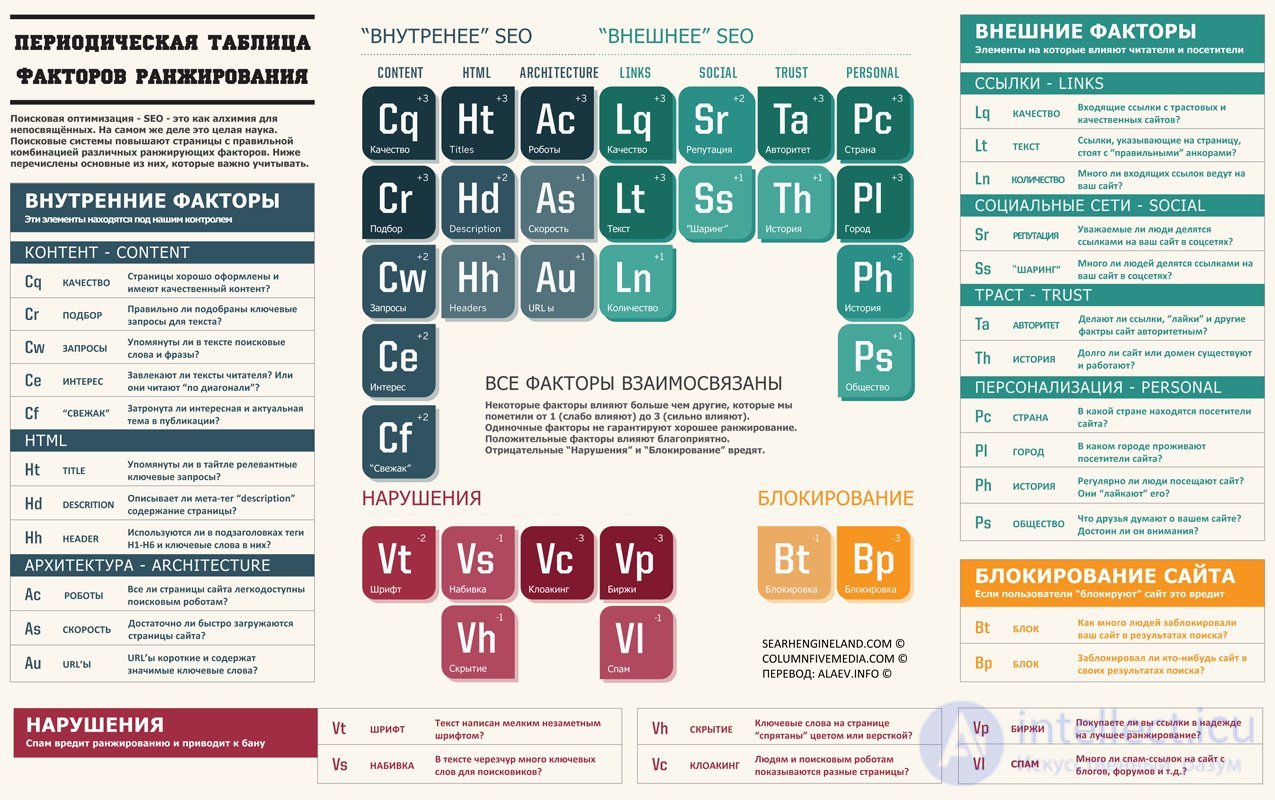
You probably already know that Google uses around 200 ranking factors in its algorithms. But which ones? Fortunately for you, today we're publishing the full list. Some of these factors are proven, others are the subject of endless debate, and some may just be someone's half-baked invention. But they're all here.
1. Domain age. In one of his videos, Matt Cutts states that:
“There isn't much difference between a domain that's six months old and one that's a year old.”
In other words, domain age is taken into account, but it isn't that important.
2. Keyword in the domain name. It's impossible to say for certain whether this carries a lot of weight, but a keyword in the domain name does still point to the resource's relevance. After all, the keyword in the domain is shown in bold in the search results.
3. Keyword at the start of the domain. A site whose name starts with a relevant keyword benefits more than a site whose name has no keywords, or has them in the middle or at the end of the domain.
4. Domain registration length. Google's patent “Information Retrieval Based on Historical Data” states:
“Useful domains with serious intent are usually paid for several years in advance, whereas doorway pages are rarely used for more than 1 year. So the domain's registration expiration date can be used as another factor to help determine a site's value.”
5. Keyword in the subdomain. Moz's observations also confirm that a keyword placed in the subdomain name can positively affect ranking:

6. Domain history. Dropped domains and sites that have had changing owners risk having Google “reset” the site's history and discount the links pointing to the domain.
7. Exact-match domains. An exact-match domain (EMD) can only work in your favour if the site itself is high-quality. Otherwise the domain risks being hit by the EMD algorithm:
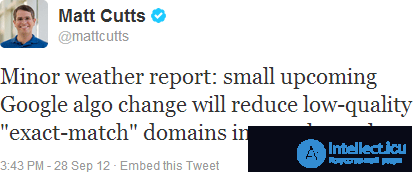
Matt Cutts: “A small prediction: a Google algorithm update will reduce the number of low-quality EMDs in the search results.”
8. Public vs. private WHOIS. Private WHOIS information can signal that something is being hidden. At Pubcon 2006, Matt Cutts noted:
“…When I checked their WHOIS, it was private for all of them. That's quite unusual. …If the WHOIS is private, that doesn't mean everything is necessarily bad, but combined with other negative factors it usually points to a not entirely trustworthy webmaster.”
9. A violator in WHOIS. If Google identifies a person as a spammer, it's logical that their other sites will also come under close scrutiny.
10. Country-code top-level domain (ccTLD) specifics. A top-level domain assigned to a specific country (.ua, .de, .cn, .pt, etc.) can rank well within its own country, but has limited ranking potential on a global scale.
46. URL length. Search Engine Journal notes that an excessively long URL can negatively affect a page's visibility in search.
47. URL depth. A page located closer to the homepage may get a slight boost in authority.
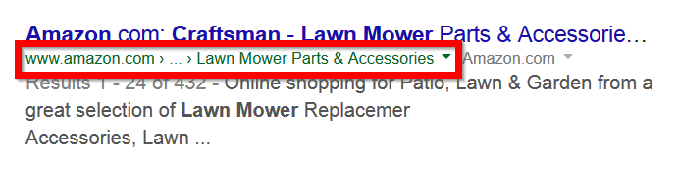
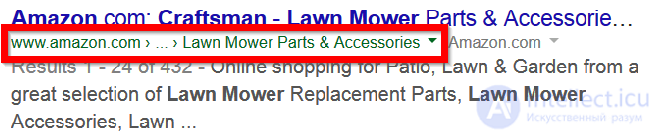
52. URL string. Categories in the URL are read by Google and can help it recognise what the page is about:

Comments