
Lecture
There are events for which it matters more "how it happened" than "what happened". News about such events is called "soft" news, as opposed to "hard" news, in which the essence matters rather than the process. Usually this is news about tragedies and oddities. Describing how an event unfolded lets the reader experience it, rather than merely learn that something tragic or curious happened somewhere.
A distinction is made between "hard" and "soft" reporting.
A pleasant surprise is that we are already familiar with "hard" news (hard news). It is precisely the clear answers to the classic questions – WHO? WHAT? WHERE? WHEN? HOW? WHY? – together with a text built as an "inverted pyramid". Here the journalist puts the most important information in the lead, and places the remaining details in the body.
It is important not to clutter the "hard" lead (headline) with secondary details and excessive particulars that distract attention from the main content.
Here is a text written by a beginning journalist at a provincial American newspaper: The Hotel-Kyelkyel was completely destroyed yesterday by a fire that started after seven in the evening in the restaurant's storeroom. None of those who lived in its 10 rooms was hurt. It was a monolithic three-story building in the central part of the city. A co-owner believes its current value was about (...) dollars.
Everything in this lead seems correct, but it is chaotic and boring to read. Some details could painlessly be moved further from the beginning. Such introductions are called "coat-rack" leads: having practically exhausted all the news material in the first paragraph, the author "hangs" answers to all the questions on it at once, piling them up.
At the editor's demand and with his help, the journalist rewrote the lead (headline), and a much better version went to print: A fire yesterday destroyed the 10-room Hotel-Kyelkyel in the city center. The owner estimates the losses at about (...) dollars. Fortunately, there were no casualties.
Unlike hard news as a report of heightened immediacy, "soft" news is less timely, or rather, timeliness is not particularly important for it. Touches and details focus attention on the unusual and entertaining aspects, and an element of intrigue is introduced. The form of soft news allows the writer to "approach the fact", making the reader's acquaintance with it gradual.
Since attention has to be shifted from the outcome to the circumstances, and entertaining details have to be highlighted, the structure of the news changes. A composition based on the "inverted pyramid" principle is not suitable here. The lead is built with the reader's interest in mind, but it does not report – it postpones the report of the most interesting thing to the second (even third) paragraph. The story builds up to a climax, and then follows the principle of diminishing interest.
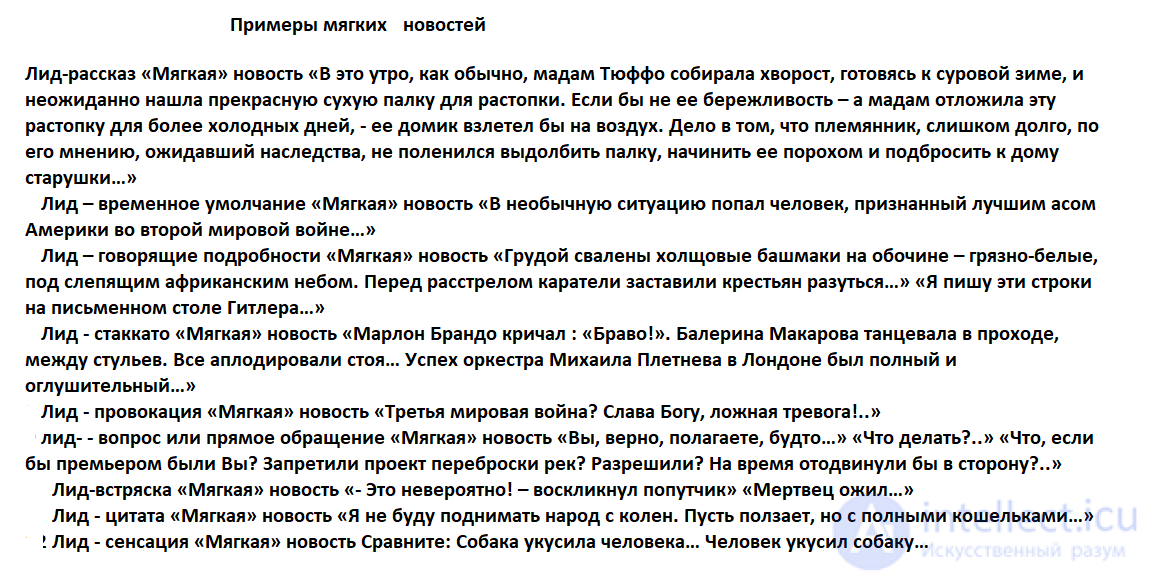
For the intriguing openings of soft news, so-called "special leads" are used, which, unlike the "inverted pyramid" lead, do not set out the content in brief but lead up to it.
In the collective treasury of reporters' experience there are many such openings. Some of them are given as examples below. But for comparison, let us first present the sample news item in a "hard" key: Yesterday the municipal council approved the city budget of 120 million dollars by a narrow margin of votes. The budget exceeds last year's by 30 million. Thus the average tax paid by homeowners will increase by 172 dollars.
(For understanding: the draft budget is submitted by the mayor, i.e. the head of the city's executive power, and approved by the council – the local legislative power. The budget is formed from taxes paid by all residents of the territory.)
When writing soft news, the "hourglass" compositional scheme is used – a combination of an "inverted" and an "ordinary" pyramid. Recall that the inverted pyramid is an account of an event from the more important aspect to the less important one, violating chronology, or an "anti-story". The ordinary pyramid, by contrast, is an account of an event in chronological order, or a "story".

The upper part of the "hourglass" is the inverted pyramid. There the essence of the event is set out in condensed form. This part of the item is necessary for readers who are not very interested in the event and for whom it is enough to be kept up to date. This part is small – usually 15–20% of the item's length.
The junction of the apexes of the inverted and the straight pyramids is the transition point. Here the account of the event from beginning to end starts. The transition point can be marked by phrases such as "according to eyewitnesses, it all happened like this". One can also do without an introductory phrase and begin the account of the event right after stating its essence.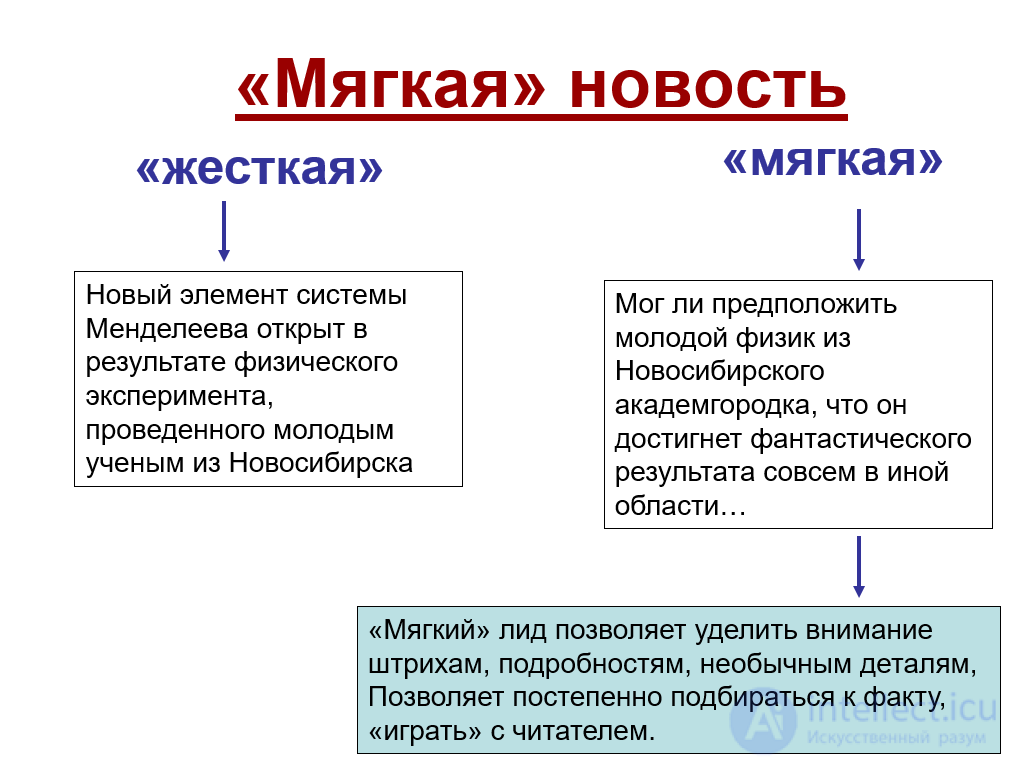
In Maision yesterday a many-hour operation was completed to eliminate a group of militants who had carried out an armed attack on a local police station. As a result, three militants were killed. In the process, a house in which a married couple lived, and which the militants had chosen as their hideout, was destroyed (the essence of the event ends and the chronological account begins).
At about ten o'clock on Thursday evening, the local police station in the Ramaisky district of the suburb of Maision (one of the most densely populated districts of the city) was shot at by unknown persons. It remains unclear whether this was a deliberate act of intimidation or the senseless bravado of recruits of the extremist underground – even from outward signs it became clear that there was nobody in the station's premises: the doors were closed and the lights were off. The shooting resulted in broken windows and many bullet marks in the walls of the building. Nevertheless, immediately after the attack the personnel of the district internal affairs department were put on alert, and mobile patrol units of the police received a description of a red "Devyatka" car in which the shooters were moving. Soon one of the patrol units spotted the offenders and organized a chase. Two militants, firing back, abandoned the car near a landing strip located on Zigizmund Avenue and disappeared into a wooded thicket. Some time later, realizing that they might be surrounded by the security forces, they ran over to a residential area and dashed into a private property (2 Bantalyena St.). In this house, where the Mallenson couple lives, only the owner was at home at that moment. For almost an hour he remained a hostage of the militants, who were preparing to defend themselves, and only then managed to slip away, taking advantage of their inattention.
From midnight, a counter-terrorist operation regime began to operate in the area of the operation. A whole block with multi-story buildings fell within the operation zone. Residents of the nearby houses were evacuated for the duration of the counter-terrorist operation.
The militants answered the offer to surrender with fire, after which a many-hour assault began. Special forces officers had to break the window bars of the neighboring house in order to get through it into the utility room directly adjoining the surrounded house. Until almost half past two in the morning, bursts of automatic fire and grenade-launcher shots could be heard. The militants' hideout was soon engulfed in flames, but emergency services officers managed to prevent the fire from spreading to nearby structures. After some time the roof of the private house collapsed, and the building itself burned down completely. By then the shooting had stopped as well.
Toward morning, officers of the operational investigative team found two bodies at the site of the fire. Until Tuesday evening the investigation had not released data on the results of identifying the dead. In the opinion of the security forces, those who attacked the police station were members of a Maision gang that regularly attacks law enforcement officers
Informational genres
Analytical genres

Comments