
Lecture
Functional analysis, a branch of modern mathematics whose main task is the study of infinite-dimensional spaces and their mappings. Linear spaces and linear mappings are the most thoroughly studied. Functional analysis is characterized by a combination of methods from classical analysis, topology, and algebra. Abstracting from specific situations makes it possible to single out axioms and, on their basis, to build theories that include classical problems as a special case and make it possible to solve new problems. The very process of abstraction has independent significance, clarifying the situation, discarding what is superfluous, and revealing unexpected connections. As a result, it becomes possible to penetrate more deeply into the essence of mathematical concepts and to open up new paths of research.
The development of functional analysis proceeded in parallel with the development of modern theoretical physics, and it turned out that the language of functional analysis most adequately reflects the laws of quantum mechanics, quantum field theory, and so on. These physical theories, in turn, had a substantial influence on the problems and methods of functional analysis.
The beginning of the 20th century was a great epoch in the history of mathematics. Many of the modern branches of mathematics were born or took shape precisely during this time.
One of the most important events in the development of mathematics that took place in the period from the beginning of the century to the First World War was the birth of functional analysis, in which many concepts of classical analysis, linear algebra, and geometry were combined.
In parallel, branches of mathematics arose and developed intensively that played an important role in the formation of functional analysis: topology, measure theory, and the theory of the Lebesgue integral.
Functional analysis – is a type of analysis that involves considering an object as a complex of the functions it performs, rather than as a material-physical structure. For example, an incandescent electric lamp is regarded as the carrier of the function "emit light", and not merely as a set of structural elements (bulb, base, filament, etc.).
Functional analysis proceeds from the premise that in the object being analyzed, useful functions are always accompanied by harmful and neutral functions. For example, the blade of a meat grinder simultaneously performs several functions while operating: the useful function – "grind the product", the harmful function – "crush the product", the neutral function – "heat the product". It should be taken into account that the useful functions of one object may be harmful or neutral for another (and vice versa).
Functional analysis makes it possible to abstract from the specific implementation of an object and to focus attention on its functions. The search for alternative ways of implementing functions is carried out with the aim of reducing costs and raising the level of function performance. Functional analysis can be applied with equal success to improving both technical and non-technical objects and processes.
Functional analysis — a branch of analysis that studies infinite-dimensional topological vector spaces and their mappings. The most important examples of such spaces are spaces of functions (hence the name “functional analysis”).
In various sources, the branches of functional analysis are considered to include measure and integration theory, function theory, operator theory, and differential calculus on infinite-dimensional spaces. In the second half of the 20th century, functional analysis was enriched by a whole series of more specialized branches built on the basis of the classical ones.
Functional analysis finds application in many exact sciences; many of the most important theoretical constructions are described in the language of functional analysis. In particular, at the beginning of the 21st century functional analysis is widely applied in the theory of differential equations, mathematical physics, theoretical physics (including quantum mechanics, string theory), control and optimization theory, probability theory, mathematical statistics, the theory of random processes, and other fields. Fourier transform theory, used in many fields of science and technology (for example, in image-processing theory), can also be regarded as part of functional analysis.
The word “topology” is now applied to two branches of mathematics. And originally each of them had its own definition attached to the word “topology”. One topology, whose founder was Poincaré, was for a long time called combinatorial, while the other (at the origins of which were Cantor's investigations) came to be known as general, or set-theoretic, topology.
General topology is adjacent to set theory and lies at the foundation of mathematics (in accordance with the layout of this science, which was outlined by Cantor's followers – D.Hilbert, H.Weyl, and others). It is an axiomatic theory intended to investigate such concepts as “limit”, “convergence”, “continuity”, and so on. The foundations of general topology in the 20th century were laid by the German mathematician Hausdorff, the Polish mathematician Kuratowski, the famous representative of the Moscow school P.S.Aleksandrov, and others.
At the beginning of the 20th century Lebesgue completed the construction of measure and integration theory. In the 19th century, following Cauchy and Riemann, the integral was understood as the limit of Riemann sums. Lebesgue, however, proposed a different approach. The basic idea behind the construction of the Lebesgue integral is that, unlike the Riemann integral, the points x are grouped not according to their proximity on the x-axis, but according to the proximity of the values of the function at these points. But the sets on the abscissa axis for which the values of the function fall within a certain interval can, for sufficiently complicated functions, be arranged in a highly intricate way, and in order to construct a theory of integration it was necessary, first of all, to construct a theory of measure, that is,
to learn how to “measure” such sets. This was done by Borel and Lebesgue.
Lebesgue described the advantage of his method very expressively. “In Cauchy's method, – wrote Lebesgue, – one operates the way an inexperienced clerk does, who counts coins and banknotes in whatever order they come to hand. Whereas we operate like an experienced and methodical clerk, who says: I have n1 coins of one franc, worth 1×n1, I have n2 coins of two francs, worth 2×n2, I have n5 coins of five francs, worth 5×n5 … In total, I have 1×n1+ 2×n2 + 5×n5 +... francs. Of course, both clerks will arrive at the same result. But in the case of sums of indivisibles, whose number is infinite, the difference between the two methods is fundamental.” On the basis of the new theory of measure a new direction arose in function theory – the metric theory of functions.
In the nineteen-twenties the leading role in function theory passed to the Russian school, represented by Nikolai Nikolaevich Luzin and his students P.S.Aleksandrov, N.K.Bari, A.N.Kolmogorov, D.E.Menshov, M.Ya.Suslin, A.Ya.Khinchin, and others. They laid the foundations of the Moscow mathematical school. Having taken their first steps in function theory, Luzin's students subsequently each went their own way. Kolmogorov and Khinchin transformed probability theory, Aleksandrov and Urysohn – topology, Lyusternik and Schnirelmann - nonlinear analysis, Novikov made an outstanding contribution to mathematical logic, Lavrentiev made the greatest discoveries in complex analysis and mechanics. Only Menshov and Bari carried on their teacher's work. In the nineteen-thirties, no mathematical school in the world possessed such a constellation of outstanding scientists.
Functional analysis arose at the turn of the 19th and 20th centuries in the works of Hilbert, Fréchet, Fredholm, Lebesgue, and others. After the publication of S. Banach's famous treatise, it became an independent discipline.
Even at the end of the previous century, analogies were discovered between the theory of systems of linear equations in a finite number of variables and their infinite-dimensional analogues – linear integral equations.
The decisive shift in the theory was made by Fredholm in 1900. Fredholm replaced the integral equation with a system of linear equations, considering integral sums instead of the integral.
Methods for solving systems of linear equations had already been developed in the 18th century. Applying these methods together with the passage to the limit, Fredholm found the conditions for solvability and algorithms for finding solutions of the equations. This served as a stimulus for the development of a theory combining elements of algebra and geometry, but in infinite-dimensional spaces.
The basic concepts and methods of functional analysis gradually took shape within the depths of older branches of mathematical analysis.
The essence of functional analysis consists in the fact that a number of concepts and methods from the elementary chapters of mathematical analysis and the adjacent fields of algebra and geometry (such as functional dependence, passage to the limit, proximity, distances, which are used explicitly or implicitly and in various forms in these theories) are carried over to objects of a more general and more complex nature, with geometric and algebraic methods being widely used. Such a transfer, associated with the generalization of the basic concepts of analysis, makes it possible to approach, from a unified point of view, questions that were previously considered in isolation within special mathematical disciplines, to establish connections between seemingly distant mathematical theories, and thereby to contribute to the discovery of new mathematical facts (it is enough to point to a number of existence theorems for solutions of differential, integral, and other equations obtained by the methods of functional analysis).
What is characteristic of functional analysis is not only generalization but also the geometrization of the basic concepts and methods of classical analysis. Functions of one class or another are regarded as points or vectors of “functional spaces”. Such a treatment required a generalization of geometric concepts – infinite-dimensional Euclidean, vector, and other spaces. This led, in the end, to the creation of the general concepts of metric, linear normed, and topological spaces, encompassing both the geometric objects previously considered and various functional spaces.
Having developed into a large independent mathematical discipline, functional analysis continues to this day to assimilate and generalize the methods of other, already newer, mathematical disciplines.
functional analysis as an independent branch of mathematics took shape at the turn of the 19th and 20th centuries. A great role in the formation of the general concepts of functional analysis was played by set theory, created by G. Cantor. The development of this theory, together with axiomatic geometry, led to the emergence, in the works of M. Fréchet and F. Hausdorff, of metric and the more general so-called set-theoretic topology, which studies abstract spaces, that is, sets of arbitrary elements for which the concept of proximity has been established in one way or another.
Among the abstract spaces, functional spaces turned out to be important for mathematical analysis and functional analysis (that is, spaces whose elements are functions — hence the name “functional analysis”). In the works of D. Hilbert on deepening the theory of integral equations, the spaces l2 and L2(a, b) arose (see below). Generalizing these spaces, F. Riesz studied the spaces lp and Lp (a, b), and S. Banach in 1922 singled out complete linear normed spaces (Banach spaces). In the 1930—40s, in the works of T. Carleman, F. Riesz, the American mathematicians M. Stone and J. Neumann, an abstract theory of self-adjoint operators in Hilbert space was constructed.
In the USSR, the first research on functional analysis appeared in the 1930s: the works of
A. N. Kolmogorov (1934) on the theory of linear topological spaces;
N. N. Bogolyubov (1936) on invariant measures in dynamical systems;
L. V. Kantorovich (1937) and his students on the theory of partially ordered spaces, applications of functional analysis to computational mathematics, and others; M. G. Krein and his students (1938) on the in-depth study of the geometry of Banach spaces, convex sets and cones in them, operator theory, and connections with various problems of classical mathematical analysis, and others; I. M. Gelfand and his students (1940) on the theory of normed rings (Banach algebras), and others.
The development of functional analysis is connected with the study of the Fourier transform, differential and integral equations. A great contribution to the development and establishment of functional analysis was made by the Polish mathematician Stefan Banach.
The study of the representation of functions by means of the Fourier transform was attractive, for example, because for certain classes of functions a continuum of points (function values) can be characterized by a countable set of values (a set of coefficients).
The methods of functional analysis quickly gained popularity in various fields of mathematics and physics as a powerful tool. The theory of linear operators played a significant role in this:
Functional analysis has grown so much and has penetrated so widely and deeply into almost every area of mathematics over the past two decades that it is now even difficult to define the very subject of this discipline. However, functional analysis has several major “traditional” directions which even now largely determine its character. Among these belongs the theory of linear operators, which is sometimes called the backbone of functional analysis. It was precisely through operator theory that functional analysis came into contact with quantum mechanics, differential equations, probability theory, and a number of applied disciplines. Kostyuchenko A. G., preface by the editor of the 1962 translation
At the end of the 1990s, the topic of wavelet transforms was added to the treasury of functional analysis. This topic came from practice as an attempt to construct new bases of functional spaces possessing additional properties, for example, a good rate of convergence of approximations. I. Daubechies made a contribution to this development.
The present stage in the development of functional analysis is characterized by a strengthening of ties with theoretical physics, as well as with various branches of classical analysis and algebra, for example, the theory of functions of many complex variables, the theory of partial differential equations, and so on.
For example — spaces of continuous functions, spaces of integrable functions. Important roles are played by such concepts as measure, metric, norm, and inner product. To consider mappings of spaces, such terms as “operator” and “functional” are introduced.
The most general spaces occurring in functional analysis are linear (vector) topological spaces, that is, linear spaces X over the field of complex numbers  (or real numbers
  ), which are simultaneously topological, with the linear operations being continuous in the topology under consideration. A more particular, but very important, situation arises when in the linear space X it is possible to introduce a norm (length) of vectors, whose properties are a generalization of the properties of the length of vectors in ordinary Euclidean space. Namely, the norm of an element x ∈ X is called the real number ||x|| such that always ||x|| ≥ 0 and ||x|| = 0 if and only if x = 0;
||lx || = |l| ||x||, l ∈  x, if ||xn — x||
  0.
0.
In a large number of problems an even more particular situation arises, when in the linear space X it is possible to introduce an inner product — a generalization of the ordinary inner product in Euclidean space. Namely, the inner product of the elements x, y ∈ X is called the complex number (x, y) such that always (x, x) ≥ 0 and (x, x) = 0 if and only if x = 0;

 , l, m ∈
  is the norm of the element x. Such a space is called pre-Hilbert. For the constructions of functional analysis it is important that the spaces under consideration be complete (that is, from the fact that
 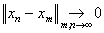 for xm, xn ∈ X, there follows the existence of a limit
  , which is also an element of X). A complete linear normed space and a complete pre-Hilbert space are called, respectively, Banach and Hilbert. Here the well-known procedure of completing a metric space (analogous to the passage from the rational numbers to the real numbers) in the case of a normed linear (pre-Hilbert) space leads to a Banach (Hilbert) space.
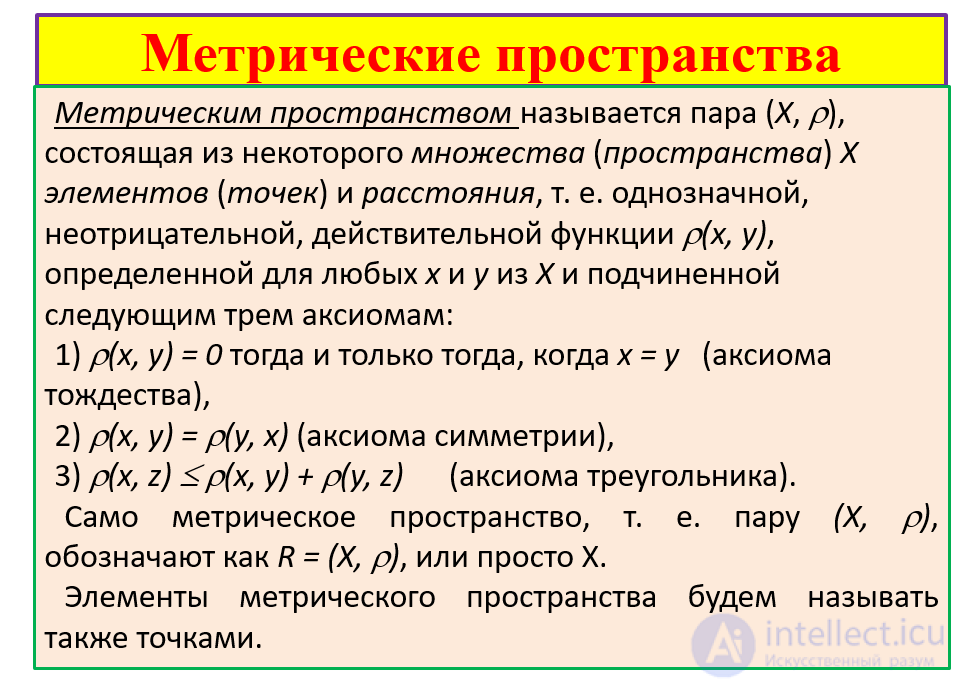
The ordinary Euclidean space is one of the simplest examples of a (real) Hilbert space. However, in functional analysis the main role is played by infinite-dimensional spaces, that is, ones in which there exists an infinite number of linearly independent vectors. Here are examples of such spaces, whose elements are classes of complex-valued (that is, with values in  , norm ||x|| =
  ; the Banach space Lp (T) of all functions summable to the p-th (p ≥ 1) power on T, norm
 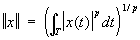 ; the Banach space lp of all sequences such that
  , here
 (the set of integers), norm ||x|| =(∑
 |xj|p)1/p; in the case p = 2 the spaces l2 and L2 (T) are Hilbert spaces, and here, for example, in L2(T) the inner product
 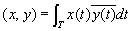 ; the linear topological space D (
 ), consisting of infinitely differentiable functions on
  , each of which has compact support [that is, is equal to zero outside some interval (a, b)]; here xn
  x, if xn (t) have uniformly bounded supports [that is, (a, b) does not depend on n] and converge uniformly together with all their derivatives to the corresponding derivatives of x (t).
All these spaces are infinite-dimensional; this is easiest to see for l2: the vectors ej = {0,..., 0, 1, 0,...} are linearly independent.
From a geometric point of view, the simplest spaces are the Hilbert spaces H, whose properties most closely resemble the properties of finite-dimensional Euclidean spaces. In particular, two vectors x, y ∈ H are called orthogonal (x ^ y) if (x, y) = 0. For any x ∈ H there exists its projection onto an arbitrary subspace F — a closed linear subset of H, that is, such a vector xF, that x—xF^f for any f ∈ F. Thanks to this fact, a large number of geometric constructions that hold in Euclidean space carry over to H, where they often acquire an analytic character. Thus, for example, the usual orthogonalization procedure leads to the existence in H of an orthonormal basis — a sequence of vectors ej, j ∈  , from H such that ||ej|| = 1, ej ^ ek for j ≠ k, and for any x ∈ H there holds a “coordinate-wise” expansion
x = ∑ xjej (1)
where xj = (x, ej), ||x|| = ∑ |xj|2 (for simplicity H is assumed to be separable, that is, it contains a countable everywhere dense set). If we take H to be L2(0, 2p) and set
  , j =...,—1, 0, 1..., then (1) gives the expansion of the function x (t) ∈ L2(0, 2p) into a Fourier series, convergent in the mean square. Furthermore, relation (1) shows that the correspondence between H and l2 ' {xj}, j ∈
  of Hilbert spaces Hj — a construction similar to the formation of H by one-dimensional subspaces, described by formula (1); factorization and completion: on the original linear space X a quasi-inner product is given [that is, the equality (x, x) = 0 for x ≠ 0 is possible], often of a rather exotic character, and H is constructed by the procedure of completing X with respect to (.,.) after a preliminary identification with 0 of the vectors x, for which (x, x) = 0; the tensor product
  — its formation is analogous to the passage from functions of one variable f (x1) to functions of many variables f (x1,..., xq); the projective limit
  of Banach spaces — here
  (roughly speaking) if
 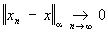 for each a; the inductive limit
  of Banach spaces X1 ⊂ X2 ⊂..., here
  , if all the xj, starting from some j0, lie in one Xj0, and in it
 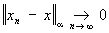 . The last two procedures are usually used for constructing linear topological spaces. Such, for example, are nuclear spaces — the projective limit of Hilbert spaces Ha, possessing the property that for each a there exists b such that hb ⊂ Ha, and this — is the so-called Hilbert—Schmidt embedding [D (
 ) — an example of a nuclear space].
An important branch of F.a. has been developed, in which spaces with a conical structure “x  0” (partial ordering) are studied. An example of such a space — the real C (T); in it x
  0 is taken to hold if x (t ≥)0 for all t ∈T.
Let X, Y — be linear spaces; a mapping A: X → Y is called linear if for x, y ∈ X, l, m ∈ 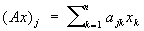 ,
,
where x1,..., xn and (Ax)1,..., (Ax) n — are the coordinates of the vectors x and Ax respectively. In passing to infinite-dimensional linear topological spaces, the situation becomes considerably more complicated. Here, first of all, it is necessary to distinguish between continuous and discontinuous linear operators (for finite-dimensional spaces they are always continuous). Thus, the operator acting from the space L2 (a, b) into itself
 (2)
(2)
(where K (t, s) — is a bounded function — the kernel of A) — is continuous, whereas the differentiation operator defined on the subspace C1(a, b) ⊂ L2(a, b)
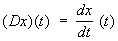 (3)
(3)
is discontinuous (in general, a characteristic feature of discontinuous operators is that they are not defined on the whole space).
A continuous operator A: X → Y, where X, Y — are Banach spaces, is characterized by the fact that
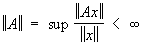 ,
,
therefore it is also called bounded. The set of all bounded operators  (X, Y) with respect to the usual algebraic operations forms a Banach space with the norm ||A||. The properties
  , if
, if  for every x ∈ X], with respect to which the ball, that is, the set of points x ∈ X such that ||x|| ≤ r, will already be compact (such an effect will never occur in an infinite-dimensional space with respect to the topology generated by the norm). This makes it possible to study in more detail a number of geometric questions for sets from X', for example, to establish the structure of an arbitrary compact convex set as the closed hull of its extreme points (the Krein—Milman theorem).
An important task of functional analysis is to find the general form of functionals for specific spaces. In a number of cases (besides the Hilbert space) this can be done; for example, (lp)′, p > 1, consists of functions of the form ∑ xjej, where
  ,
,  . However, for most Banach (and especially linear topological) spaces, the functionals turn out to be elements of a new nature that cannot be constructed simply by means of classical analysis. Thus, for example, for fixed t0 and m, on the space D (
 ) a functional
 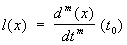 is defined. In the case m = 0 it can still be written in the “classical” way, by means of an integral, but for m ≥ 1 this is no longer possible. Elements of (D (
 ))′ are called generalized functions (distributions). Generalized functions, as elements of the conjugate space, can also be constructed when D (
 ) is replaced by another space Φ, consisting of functions that are either infinitely differentiable or differentiable a finite number of times; here an essential role is played by triples of spaces Φ′ ⊃ H ⊃ Φ, where H is the original Hilbert space, and Φ is a linear topological (in particular, Hilbert, with a different inner product) space, for example
Φ = Wl2(T).
The differential operator D, appearing in (3), will be continuous if understood as acting in L2[a, b] from the space C1[a, b] equipped with the norm 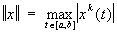 ,
,  However, for many problems, and above all for spectral theory, such differential operators must be interpreted as acting within one and the same space. These and other related problems led to the construction of a general theory of unbounded operators, in particular unbounded self-adjoint and Hermitian operators.
Many problems lead to the need to study the solvability of an equation of the form Cx = y, where C is some operator, y ∈ Y is given, and x ∈ X is the sought vector. For example, if X = Y = L2 (a, b), C = E − A, where A is the operator from (2), and E is the identity operator, then one obtains a Fredholm integral equation of the second kind; if C is a differential operator, then one obtains a differential equation, and so on. However, here one cannot count on a sufficiently complete analogy with linear algebra without restricting the class of operators considered. One of the most important classes of operators, closest to the finite-dimensional case, are the compact (completely continuous) operators, characterized by the fact that they carry every bounded set from X into a set in Y whose closure is compact [such is, for example, the operator A from (2)]. For compact operators a theory of solvability of the equation x − Ax = y has been constructed, fully analogous to the finite-dimensional case (and containing, in particular, the theory of the aforementioned integral equations) (F. Riesz).
In various problems of mathematical physics there arises the so-called eigenvalue problem: for a certain operator A: X → X one must determine whether it is possible to find a solution j ≠ 0 (an eigenvector) of the equation Aj = lj for some l ∈  ljxjej, (4)
where lj, is the eigenvalue corresponding to ej. For finite-dimensional X the question of such a representation is fully resolved, and in the case of multiple eigenvalues, in order to obtain a basis in X one must, generally speaking, add to the eigenvectors the so-called associated (generalized) vectors. The set SpA of eigenvalues in this case is called the spectrum of A.
The first transfer of this picture to the infinite-dimensional case was given for integral operators of the type A from (2) with a symmetric kernel [i.e., K (t, s) = K (s, t) and real] (D. Hilbert). Later a similar theory was developed for general compact self-adjoint operators in a Hilbert space. However, upon passing to the simplest non-compact operators, difficulties arose connected with the very definition of the spectrum. Thus, the bounded operator in L2[a, b]
(Tx)(t) = tx (t) (5)
has no eigenvalues. Therefore the definition of the spectrum was revised, generalized, and now looks as follows.
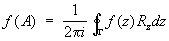
Let X be a Banach space; A ∈  — a polynomial, then f (A) =
  (the power of the operator is understood as its successive application). However, if f (z) is an analytic function, then f (A) can no longer always be understood so directly; in this case f (A) is defined by the following formula, if f (z) is analytic in a neighbourhood of SpA, and Γ is a contour enclosing SpA and lying in the domain of analyticity of f (z):
 . (6)
. (6)
In this process, algebraic operations on functions carry over into analogous operations on operators [i.e., the mapping f (z) → f (A) is a homomorphism]. These constructions do not make it possible to clarify, for example, questions of completeness of eigenvectors and associated vectors for general operators; however, for self-adjoint operators, which are of primary interest, for example, for quantum mechanics, such a theory has been fully developed.
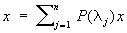
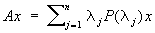
Let H be a Hilbert space. A bounded operator A: H → H is called self-adjoint if (Ax, y) = (x, Ay) (in the case of unbounded A the definition is more complicated). If H is n-dimensional, then there exists in it an orthonormal basis of eigenvectors of the self-adjoint operator A; in other words, the following expansions hold:
 ,
,  , (7)
, (7)
where P (lj) is the projection operator (projector) onto the subspace spanned by all eigenvectors of the operator A, corresponding to one and the same eigenvalue lj.
It turns out that these formulas can be generalized to an arbitrary self-adjoint operator on H, except that the projectors themselves P (lj) may fail to exist, since eigenvectors may also be absent [such is, for example, the operator T in (5)]. In formulas (7) the sums are now replaced by Stieltjes integrals with respect to a non-decreasing operator-valued function E (l) [which in the finite-dimensional case equals  ]; it is called the resolution of the identity, or the spectral (projection-valued) measure, whose points of growth coincide with the spectrum Sp A. If one brings in generalized functions, formulas of type (7) are preserved. Namely, if there is a triple Φ′ ⊃ H ⊃ Φ, where Φ, for example, is nuclear, and A maps Φ into Φ′ continuously, then relations (7) hold, except that the sums turn into integrals with respect to some scalar measure, and E (l) now “projects” Φ into Φ′, giving vectors from Φ′ that will be eigenvectors in the generalized sense for A with eigenvalue l. Analogous results hold for the so-called normal operators (i.e., those commuting with their adjoints). For example, they hold for unitary operators U — bounded operators that map the whole of H onto the whole of H and preserve the inner product in doing so. For them the spectrum SpU lies on the circle |z| = 1, along which the integration in the analogues of formulas (6) is carried out. See also Spectral analysis of linear operators.
Together with the development and deepening of the concept of space came the development and generalization of the concept of function. In the end it became necessary to consider mappings (not necessarily linear) of one space into another (often — into the original one). One of the central problems of nonlinear functional analysis is the study of such mappings. As in the linear case, a mapping of a space into  ) is called a functional. For nonlinear mappings (in particular, nonlinear functionals) one can, in various ways, define a differential, a directional derivative, etc., analogously to the corresponding concepts of classical analysis. Extracting the quadratic, etc., terms from a mapping leads to a formula analogous to the Taylor formula.
An important problem of nonlinear functional analysis is that of finding fixed points of a mapping (a point x is called fixed for a mapping F if Fx = x). Many problems on the solvability of operator equations, as well as problems of finding eigenvalues and eigenvectors of nonlinear operators, reduce to finding fixed points. When solving equations with nonlinear operators containing a parameter, a phenomenon essential to nonlinear functional analysis arises — the so-called branch points (of solutions).
In studying fixed points and branch points, topological methods are used: generalizations to infinite-dimensional spaces of Brouwer's theorem on the existence of fixed points of mappings of finite-dimensional spaces, the degree of mappings, and so on. Topological methods of functional analysis were developed by the Polish mathematician J. Schauder, the French mathematician J. Leray, the Soviet mathematicians M. A. Krasnoselsky, L. A. Lyusternik, and others.
In the early stages of the development of functional analysis, problems were studied whose formulation and solution required only linear operations on the elements of a space. The only exceptions, perhaps, are the theory of rings of operators (factors) (J. von Neumann, 1929) and the theory of absolutely convergent Fourier series (N. Wiener, 1936). At the end of the 1930s, in the works of the Japanese mathematician M. Nagumo, the Soviet mathematicians I. M. Gelfand, G. E. Shilov, M. A. Naimark, and others, there began to develop a theory of so-called normed rings (the modern name — Banach algebras), in which, besides the operations of a linear space, a multiplication operation is axiomatized (with ||xy|| ≤ ||x|| ||y||). Typical representatives of Banach algebras are the rings of bounded operators acting in a Banach space X (multiplication in it — the successive application of operators — must take order into account), functional spaces of various kinds, for example C (T) with ordinary multiplication, L1( ) with convolution as the product, and a broad generalization of them — the class of so-called group algebras (topological groups G), consisting of complex-valued functions or measures defined on G, with convolution (in various, not necessarily equivalent versions) as multiplication.
Let  — be commutative (i.e., xy = yx for any x, y ∈
  on M, moreover the sum x + y and the product xy correspond to the sum and product of functions. In other words, there exists a homomorphism
  of Borel subsets of G, invariant on the right: for any B ∈
  , where c(h) is a character of the group G: a continuous function on G such that |c(h)| = 1 and c(h1h2) = c(h1)c(h2), dc is the Haar measure on the group of characters
  , and
, and
 ,
,
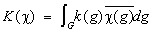
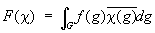
— the generalized Fourier transform of the functions f (g) and k (g), which extends to an isomorphism of L2(G, dg) onto L2( , dc). For non-commutative groups the situation becomes considerably more complicated. If G is compact, then the representation of the group of shift operators (or, more briefly, the group of shifts) can be well described; in this case L2(G, dg) decomposes into a direct sum of finite-dimensional subspaces invariant under shifts. If G is non-compact, then a decomposition of L2(G, dg) into simpler invariant parts is also obtained, but no longer into a direct sum, but into a direct integral.
If G =  , then the theory of unitary representations can be reduced to the theory of self-adjoint operators. Namely, a one-parameter group of unitary operators Tl, l ∈
  in a Hilbert space H admits the representation Tl = exp ilA, where A is a self-adjoint operator (Stone's theorem); the operator A is called the infinitesimal operator (generator) of the group {T'l}. This result finds important applications in the study of transformations of the phase space of classical mechanics. This connection, as well as applications in statistical physics, underlie an extensive branch of functional analysis — ergodic theory. The connection between one-parameter groups of transformations and their generators admits significant generalizations: the operators Tl need not be unitary, may act in Banach and more general spaces, and may even be defined only for l ≥ 0 (the so-called theory of semigroups of operators). This branch of functional analysis has applications in the theory of partial differential equations and the theory of random (namely, Markov) processes.
Functional analysis in its present state includes the following branches:

Comments