
Lecture
A Banach algebra over the complex or real field is an associative algebra that is also a Banach space. Moreover, multiplication in it must be consistent with the norm:
 .
.
This property is required for the continuity of the multiplication operation with respect to the norm.
A Banach algebra is called unital, or a Banach algebra with identity, if it has an identity (that is, an element 1 , such that for all x∈A we have x1=1x=x). It is usually also required that the norm of the identity equal 1. If an identity exists, it is unique. Every Banach algebra A can be isometrically embedded into its corresponding unital Banach algebra Ae as a closed two-sided ideal.
A Banach algebra is called commutative if the multiplication operation in it is commutative.
 and
and  with respect to the standard operations of addition and multiplication. These are unital commutative algebras.
 — the space of complex-valued functions vanishing at infinity, where Ω is a locally compact space.
 is a locally compact Hausdorff topological group with Haar measure μ
 , then the Banach space
  of complex-valued functions on G integrable with respect to the measure μ is a Banach algebra with respect to convolution multiplication, defined by the formula
  .
.
 — the algebra of summable functions on the line with convolution as multiplication. This is a special case of the previous example.
Certain elementary functions can be defined for elements of a Banach algebra by means of power series. In particular, one can define the exponential of an element of a Banach algebra, trigonometric functions, and, in general, any entire function. For elements of a Banach algebra, the formula for the sum of an infinitely decreasing geometric progression (the Neumann series) remains valid.
The set of invertible elements Inv(A) of the algebra A is an open set. Moreover, the mapping Inv
 , which assigns to each invertible element its inverse, is a homeomorphism. Thus, Inv(A) — a topological group.
In a unital algebra, the identity cannot be a commutator: xy−yx≠1 for any x, y ∈ A. It follows that λ1, λ≠0 is also not a commutator.
The Gelfand–Mazur theorem holds: every unital complex Banach algebra in which all nonzero elements are invertible is isomorphic to C.
In unital Banach algebras, the notion of a spectrum is introduced, which extends the notion of the spectrum of an operator to a more general class of objects.
An element a∈A of the algebra A is called invertible if there exists an element  such that
  . The spectrum σ(a)
 of an element a
 is the set of all
  such that the element a−λ1 is not invertible. The spectrum of any element of a unital complex Banach algebra is a nonempty compactum. On the other hand, for any compactum
  the spectrum of the element w
 of the algebra C(K), defined by the formula w(z)=z
 , coincides with
  , so there are no other restrictions on the spectrum of an element in an arbitrary Banach algebra.
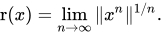
The spectral radius r(x) of an element x∈A
 is defined as the quantity
 .
.
The Beurling–Gelfand formula for the spectral radius holds:
The resolvent set of an element a∈A is the set
  . The resolvent set of an element of a Banach algebra is always open. The resolvent of an element a∈A is the function of a complex variable
 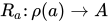 , defined by the formula
  . The resolvent of an element of a Banach algebra is a holomorphic function.
If  is a function holomorphic in a neighbourhood
  of the spectrum σ(a), one can define
  by the formula
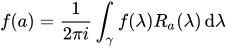 ,
,
where γ is a rectifiable Jordan contour lying in D , containing the spectrum of the element x
 and positively oriented, and Ra
 is the resolvent of the element a. In particular, this formula can be used to define the exponential of an element of a Banach algebra.
Let A be a unital commutative Banach algebra over the field of complex numbers. A character χ of the algebra A is a nonzero linear functional possessing the property of multiplicativity: for any a, b ∈ A we have χ(ab) = χ(a)χ(b) and χ(1) = 1. That is, a character is a nonzero homomorphism of the algebras A and C. One can check that every character of a Banach algebra is continuous and its norm equals 1.
The kernel of a character is a maximal ideal in A. If m is a maximal ideal, then the quotient algebra A/m
 is a field and a Banach algebra, and hence, by the Gelfand–Mazur theorem, it is isomorphic to . Therefore, to each maximal ideal m there corresponds a unique character χ such that ker χ = m. This character is defined as the composition of the quotient map and the isomorphism of A/m onto C. Thus a bijection is established between the set of characters and the set of maximal ideals.
The set of all characters is called the space of maximal ideals or the spectrum of the algebra A and is denoted Spec A. This set can be endowed with the topology inherited from the weak* topology (the topology of pointwise convergence) in the dual space A*. From the Banach–Alaoglu theorem and the closedness of Spec A, it follows that Spec A is a compact Hausdorff topological space.
The Gelfand transform of an element a of the algebra A is the continuous function  , defined by the formula
  for all characters χ. The Gelfand transform is a contracting homomorphism of the algebra A into the algebra C(Spec A) of continuous functions on a compactum.
The radical of the algebra A is the intersection of all its maximal ideals. If the radical consists only of zero, the algebra A is called semisimple. The kernel of the Gelfand transform coincides with the radical of the algebra, so the Gelfand transform is injective if and only if the algebra A is semisimple. Thus, every semisimple commutative Banach algebra with identity coincides, up to isomorphism, with some algebra of functions continuous on a compactum — with the image of the Gelfand transform.
A Banach *-algebra A — is a Banach algebra over the field of complex numbers together with a mapping  possessing the following properties:
 for all x∈A(hence the map is an involution).
 for all x,y∈A.
 for every λ∈C and every x∈A; here,
  denotes the complex conjugate of λ.
 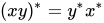 for all x,y∈A.
 In other words, a Banach *-algebra — is a Banach algebra over it is also a *-algebra.
In most natural examples the involution is also isometric, that is‖x∗‖=‖x‖ for all x∈A. Some authors include this isometric property in the definition of a Banach *-algebra.
A Banach *-algebra satisfying‖x∗x‖=‖x∗‖‖x‖ is a C*-algebra.
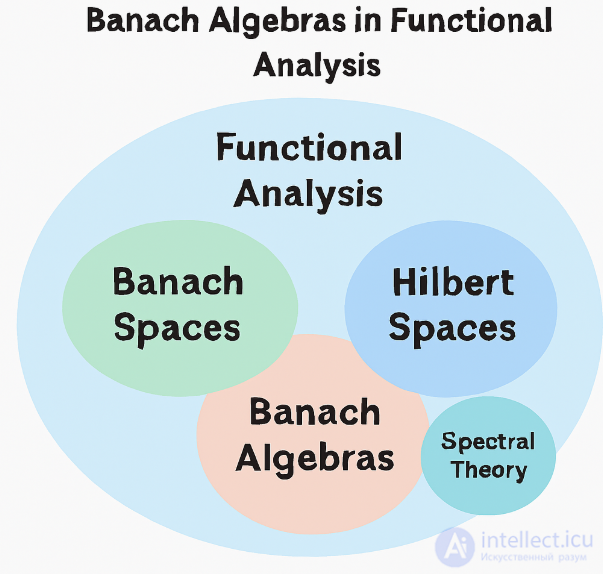
Banach algebras are used in functional analysis, the spectral theory of operators, harmonic analysis, and quantum physics. They serve as a universal language for describing operators, spectra, and algebraic structures associated with infinite-dimensional spaces.
Spectral theory of operators
Banach algebras make it possible to study the spectrum of linear operators (for example, on Hilbert spaces).
This is important for the analysis of differential equations and dynamical systems.
Operator algebras
The algebra of bounded operators on a Hilbert space is a classical example of a Banach algebra.
They underlie the theory of C*-algebras, which is used in quantum mechanics and quantum field theory.
Harmonic analysis
Algebras of functions (for example, the L1-algebra on a group) are used to study the Fourier transform and signal analysis.
This connects Banach algebras with the theory of group representations.
Quantum physics and statistical mechanics
C*-algebras and their generalizations are used to formalize physical systems in which operators describe observable quantities.
Banach algebras provide a rigorous mathematical apparatus for quantum theory.
Probability theory and stochastic processes
In some cases, algebras of functions are used to describe random variables and transition operators.
The algebra of all bounded linear operators on a Hilbert space.
The algebra of continuous functions on a compact set with the supremum norm.
The algebra of integrable functions L1(G) on a locally compact group with the convolution operation.
Banach algebras are a bridge between algebra and analysis. They are applied wherever it is necessary to take into account simultaneously the structure of a space and a multiplication operation: from pure mathematics (spectral theory, harmonic analysis) to applied fields (quantum physics, signal theory).

Comments