
Lecture
Definition 14. A real-valued function, whose domain of definition is some system of sets ℜ, is called a function of a set.
Definition 15. A function f is called countably additive if for any at most countable collection of disjoint sets An ∈ ℜ, whose union A = 
 An also belongs to ℜ, the equality holds
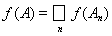

Definition 16. If the equality is restricted to the case when A is a union of a finite number of disjoint sets An (A, An ∈ ℜ), then the function f is called finitely additive or simply additive.
Since functions may take infinite values, it is necessary to agree on arithmetic operations with the symbol infinity. In the main these rules are analogous to those used in mathematical analysis. For example: ∞ ± a = ∞; ∞ + ∞ = ∞, and so on. But there are certain differences. Thus we assume that 0×∞ = 0 and ∞ - ∞ = -∞ - (-∞) = 0. In mathematical analysis the last two operations were regarded as indeterminate.
Lemma 2. If the set function f is additive and takes finite values on the sets A, B, B\A ∈ℜ, and A ⊂ B, then f(B\A) = f(B) – f(A).
The statement follows easily from the disjoint representation B = A + B\A.
Corollary. If the set function f is additive, nonnegative, and takes finite values on the sets A, B, B\A ∈ℜ, and A ⊂ B, then f(B) ≥ f(A).
Theorem 4. In order for an additive function f, taking finite values and defined on a ring K, to be countably additive, it is necessary and sufficient that for any decreasing sequence of sets Ai ∈ K (i = 1,2,...), i.e. such that A1 ⊃ A2 ⊃ A3 ⊃ …, with empty intersection, f(Ai) → 0 as i →∞.
Necessity. Let Ai be a decreasing sequence of sets, i.e., such that 
 = ∅. We construct a system of disjoint sets Bi = Ai\Ai+1. Then it is easy to see that A1 =
 . By the countable additivity of the set function f(A1) =
 . The latter equality means that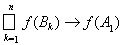
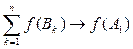 as n → ∞. But
 . This last equality, combined with the behaviour of the partial sums, proves the statement.
Sufficiency. Let An ∈ K be disjoint sets, whose union A = 
 Ak also belongs to K. We construct a sequence of decreasing sets Bn = A\
 . By the lemma, the additivity of the set function, and the conditions of the theorem, f(Bn) = f(A) – f( ) = f(A) -
 → 0. This proves the countable additivity of the set function.
The following theorem is proved analogously.
Theorem 5. Let f be a countably additive function defined on a ring K. If A ∈K and A = 
 Ai, where Ai ∈K and form an increasing sequence, i.e. A1 ⊂ A2 ⊂…, then
f(A) = 
 f(Ai).
The same equality holds if A = 
 Ai (A, Ai ∈ K), Ai form a decreasing sequence and f(Ai) are finite numbers, starting from some i.

Comments