5. Existence of an Eigenvalue of a Completely Continuous Operator in a Hilbert Space. The Hilbert-Schmidt Theorem

Lecture


5. Existence of an eigenvalue of a completely continuous operator in a Hilbert space.

The largest and smallest eigenvalues.

Spectral decomposition of self-adjoint operators.

The Hilbert-Schmidt theorem on expansion in eigenvectors

We now turn to the fundamental theorem on symmetric completely continuous operators.

Theorem 8. (Hilbert-Schmidt). In a separable Hilbert space, every symmetric completely continuous operator possesses a complete orthogonal system of eigenvectors.

We shall carry out the proof of this theorem in several stages.

Lemma 7. If 5. Existence of an Eigenvalue of a Completely Continuous Operator in a Hilbert Space. The Hilbert-Schmidt Theorem 5. Existence of an Eigenvalue of a Completely Continuous Operator in a Hilbert Space. The Hilbert-Schmidt Theorem and A – is a symmetric operator, then

5. Existence of an Eigenvalue of a Completely Continuous Operator in a Hilbert Space. The Hilbert-Schmidt Theorem 5. Existence of an Eigenvalue of a Completely Continuous Operator in a Hilbert Space. The Hilbert-Schmidt Theorem

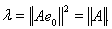
moreover, equality is possible only in the case when e is an eigenvector of the operator 5. Existence of an Eigenvalue of a Completely Continuous Operator in a Hilbert Space. The Hilbert-Schmidt Theorem 5. Existence of an Eigenvalue of a Completely Continuous Operator in a Hilbert Space. The Hilbert-Schmidt Theorem with eigenvalue 5. Existence of an Eigenvalue of a Completely Continuous Operator in a Hilbert Space. The Hilbert-Schmidt Theorem 5. Existence of an Eigenvalue of a Completely Continuous Operator in a Hilbert Space. The Hilbert-Schmidt Theorem

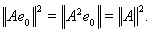
Proof. By virtue of the symmetry of the operator and the Cauchy – Bunyakovsky inequality we have:


5. Existence of an Eigenvalue of a Completely Continuous Operator in a Hilbert Space. The Hilbert-Schmidt Theorem 5. Existence of an Eigenvalue of a Completely Continuous Operator in a Hilbert Space. The Hilbert-Schmidt Theorem (12)

The Cauchy – Bunyakovsky inequality becomes an equality only when the vectors involved in it are collinear, hence in the case of equality we have 5. Existence of an Eigenvalue of a Completely Continuous Operator in a Hilbert Space. The Hilbert-Schmidt Theorem 5. Existence of an Eigenvalue of a Completely Continuous Operator in a Hilbert Space. The Hilbert-Schmidt Theorem i.e., it is an eigenvector of the operator A2. Substituting the resulting expression into (12), we find 5. Existence of an Eigenvalue of a Completely Continuous Operator in a Hilbert Space. The Hilbert-Schmidt Theorem 5. Existence of an Eigenvalue of a Completely Continuous Operator in a Hilbert Space. The Hilbert-Schmidt Theorem: 5. Existence of an Eigenvalue of a Completely Continuous Operator in a Hilbert Space. The Hilbert-Schmidt Theorem 5. Existence of an Eigenvalue of a Completely Continuous Operator in a Hilbert Space. The Hilbert-Schmidt Theorem

The lemma is proved.

We call a maximal vector of a bounded operator A such a unit vector 5. Existence of an Eigenvalue of a Completely Continuous Operator in a Hilbert Space. The Hilbert-Schmidt Theorem 5. Existence of an Eigenvalue of a Completely Continuous Operator in a Hilbert Space. The Hilbert-Schmidt Theoremat which the quantity 5. Existence of an Eigenvalue of a Completely Continuous Operator in a Hilbert Space. The Hilbert-Schmidt Theorem 5. Existence of an Eigenvalue of a Completely Continuous Operator in a Hilbert Space. The Hilbert-Schmidt Theorem attains its greatest value 5. Existence of an Eigenvalue of a Completely Continuous Operator in a Hilbert Space. The Hilbert-Schmidt Theorem 5. Existence of an Eigenvalue of a Completely Continuous Operator in a Hilbert Space. The Hilbert-Schmidt Theorem Generally speaking, not every bounded operator has a maximal vector.

Lemma 8. A symmetric completely continuous operator possesses a maximal vector.

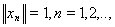
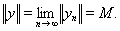
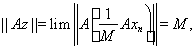
Proof. Choose a sequence 5. Existence of an Eigenvalue of a Completely Continuous Operator in a Hilbert Space. The Hilbert-Schmidt Theorem 5. Existence of an Eigenvalue of a Completely Continuous Operator in a Hilbert Space. The Hilbert-Schmidt Theorem, where 5. Existence of an Eigenvalue of a Completely Continuous Operator in a Hilbert Space. The Hilbert-Schmidt Theorem 5. Existence of an Eigenvalue of a Completely Continuous Operator in a Hilbert Space. The Hilbert-Schmidt Theorem such that 5. Existence of an Eigenvalue of a Completely Continuous Operator in a Hilbert Space. The Hilbert-Schmidt Theorem 5. Existence of an Eigenvalue of a Completely Continuous Operator in a Hilbert Space. The Hilbert-Schmidt Theorem From the sequence 5. Existence of an Eigenvalue of a Completely Continuous Operator in a Hilbert Space. The Hilbert-Schmidt Theorem 5. Existence of an Eigenvalue of a Completely Continuous Operator in a Hilbert Space. The Hilbert-Schmidt Theorem we can extract, by virtue of the complete continuity of A, a convergent subsequence; discarding the extra vectors and renumbering, we may assume that the sequence itself 5. Existence of an Eigenvalue of a Completely Continuous Operator in a Hilbert Space. The Hilbert-Schmidt Theorem 5. Existence of an Eigenvalue of a Completely Continuous Operator in a Hilbert Space. The Hilbert-Schmidt Theorem converges as 5. Existence of an Eigenvalue of a Completely Continuous Operator in a Hilbert Space. The Hilbert-Schmidt Theorem 5. Existence of an Eigenvalue of a Completely Continuous Operator in a Hilbert Space. The Hilbert-Schmidt Theorem; let 5. Existence of an Eigenvalue of a Completely Continuous Operator in a Hilbert Space. The Hilbert-Schmidt Theorem 5. Existence of an Eigenvalue of a Completely Continuous Operator in a Hilbert Space. The Hilbert-Schmidt Theorem By continuity of the norm 5. Existence of an Eigenvalue of a Completely Continuous Operator in a Hilbert Space. The Hilbert-Schmidt Theorem 5. Existence of an Eigenvalue of a Completely Continuous Operator in a Hilbert Space. The Hilbert-Schmidt Theorem Let us show that the vector 5. Existence of an Eigenvalue of a Completely Continuous Operator in a Hilbert Space. The Hilbert-Schmidt Theorem 5. Existence of an Eigenvalue of a Completely Continuous Operator in a Hilbert Space. The Hilbert-Schmidt Theorem is the sought maximal vector. First of all, by continuity of the operator A we have:
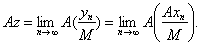
5. Existence of an Eigenvalue of a Completely Continuous Operator in a Hilbert Space. The Hilbert-Schmidt Theorem 5. Existence of an Eigenvalue of a Completely Continuous Operator in a Hilbert Space. The Hilbert-Schmidt Theorem

The vectors 5. Existence of an Eigenvalue of a Completely Continuous Operator in a Hilbert Space. The Hilbert-Schmidt Theorem 5. Existence of an Eigenvalue of a Completely Continuous Operator in a Hilbert Space. The Hilbert-Schmidt Theorem belong to the unit ball, and therefore the vectors 5. Existence of an Eigenvalue of a Completely Continuous Operator in a Hilbert Space. The Hilbert-Schmidt Theorem 5. Existence of an Eigenvalue of a Completely Continuous Operator in a Hilbert Space. The Hilbert-Schmidt Theorem do not exceed in length 5. Existence of an Eigenvalue of a Completely Continuous Operator in a Hilbert Space. The Hilbert-Schmidt Theorem 5. Existence of an Eigenvalue of a Completely Continuous Operator in a Hilbert Space. The Hilbert-Schmidt Theorem. Applying Lemma 7, we obtain:

5. Existence of an Eigenvalue of a Completely Continuous Operator in a Hilbert Space. The Hilbert-Schmidt Theorem 5. Existence of an Eigenvalue of a Completely Continuous Operator in a Hilbert Space. The Hilbert-Schmidt Theorem.

Whence it follows that

5. Existence of an Eigenvalue of a Completely Continuous Operator in a Hilbert Space. The Hilbert-Schmidt Theorem 5. Existence of an Eigenvalue of a Completely Continuous Operator in a Hilbert Space. The Hilbert-Schmidt Theorem

i.e., 5. Existence of an Eigenvalue of a Completely Continuous Operator in a Hilbert Space. The Hilbert-Schmidt Theorem 5. Existence of an Eigenvalue of a Completely Continuous Operator in a Hilbert Space. The Hilbert-Schmidt Theorem is the maximal vector of the operator A. The lemma is proved.

Lemma 9. If 5. Existence of an Eigenvalue of a Completely Continuous Operator in a Hilbert Space. The Hilbert-Schmidt Theorem 5. Existence of an Eigenvalue of a Completely Continuous Operator in a Hilbert Space. The Hilbert-Schmidt Theorem is a maximal vector for a symmetric operator 5. Existence of an Eigenvalue of a Completely Continuous Operator in a Hilbert Space. The Hilbert-Schmidt Theorem 5. Existence of an Eigenvalue of a Completely Continuous Operator in a Hilbert Space. The Hilbert-Schmidt Theorem, then 5. Existence of an Eigenvalue of a Completely Continuous Operator in a Hilbert Space. The Hilbert-Schmidt Theorem 5. Existence of an Eigenvalue of a Completely Continuous Operator in a Hilbert Space. The Hilbert-Schmidt Theorem is an eigenvector for the operator 5. Existence of an Eigenvalue of a Completely Continuous Operator in a Hilbert Space. The Hilbert-Schmidt Theorem 5. Existence of an Eigenvalue of a Completely Continuous Operator in a Hilbert Space. The Hilbert-Schmidt Theorem with eigenvalue 5. Existence of an Eigenvalue of a Completely Continuous Operator in a Hilbert Space. The Hilbert-Schmidt Theorem 5. Existence of an Eigenvalue of a Completely Continuous Operator in a Hilbert Space. The Hilbert-Schmidt Theorem

Proof. By Lemma 7 and by the definition of the operator norm we have:

5. Existence of an Eigenvalue of a Completely Continuous Operator in a Hilbert Space. The Hilbert-Schmidt Theorem 5. Existence of an Eigenvalue of a Completely Continuous Operator in a Hilbert Space. The Hilbert-Schmidt Theorem

whence it follows that 5. Existence of an Eigenvalue of a Completely Continuous Operator in a Hilbert Space. The Hilbert-Schmidt Theorem 5. Existence of an Eigenvalue of a Completely Continuous Operator in a Hilbert Space. The Hilbert-Schmidt Theorem

By virtue of Lemma 7 the vector 5. Existence of an Eigenvalue of a Completely Continuous Operator in a Hilbert Space. The Hilbert-Schmidt Theorem 5. Existence of an Eigenvalue of a Completely Continuous Operator in a Hilbert Space. The Hilbert-Schmidt Theoremis an eigenvector of the operator 5. Existence of an Eigenvalue of a Completely Continuous Operator in a Hilbert Space. The Hilbert-Schmidt Theorem 5. Existence of an Eigenvalue of a Completely Continuous Operator in a Hilbert Space. The Hilbert-Schmidt Theorem with eigenvalue 5. Existence of an Eigenvalue of a Completely Continuous Operator in a Hilbert Space. The Hilbert-Schmidt Theorem 5. Existence of an Eigenvalue of a Completely Continuous Operator in a Hilbert Space. The Hilbert-Schmidt Theorem The lemma is proved.

Lemma 10. If the operator 5. Existence of an Eigenvalue of a Completely Continuous Operator in a Hilbert Space. The Hilbert-Schmidt Theorem 5. Existence of an Eigenvalue of a Completely Continuous Operator in a Hilbert Space. The Hilbert-Schmidt Theorem possesses an eigenvector with eigenvalue 5. Existence of an Eigenvalue of a Completely Continuous Operator in a Hilbert Space. The Hilbert-Schmidt Theorem 5. Existence of an Eigenvalue of a Completely Continuous Operator in a Hilbert Space. The Hilbert-Schmidt Theorem, then the operator A has an eigenvector with eigenvalue 5. Existence of an Eigenvalue of a Completely Continuous Operator in a Hilbert Space. The Hilbert-Schmidt Theorem 5. Existence of an Eigenvalue of a Completely Continuous Operator in a Hilbert Space. The Hilbert-Schmidt Theorem or 5. Existence of an Eigenvalue of a Completely Continuous Operator in a Hilbert Space. The Hilbert-Schmidt Theorem 5. Existence of an Eigenvalue of a Completely Continuous Operator in a Hilbert Space. The Hilbert-Schmidt Theorem

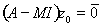
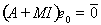
Proof. The equality 5. Existence of an Eigenvalue of a Completely Continuous Operator in a Hilbert Space. The Hilbert-Schmidt Theorem 5. Existence of an Eigenvalue of a Completely Continuous Operator in a Hilbert Space. The Hilbert-Schmidt Theorem can be written in the form 5. Existence of an Eigenvalue of a Completely Continuous Operator in a Hilbert Space. The Hilbert-Schmidt Theorem 5. Existence of an Eigenvalue of a Completely Continuous Operator in a Hilbert Space. The Hilbert-Schmidt Theorem

Suppose that 5. Existence of an Eigenvalue of a Completely Continuous Operator in a Hilbert Space. The Hilbert-Schmidt Theorem 5. Existence of an Eigenvalue of a Completely Continuous Operator in a Hilbert Space. The Hilbert-Schmidt Theorem. Then from the condition 5. Existence of an Eigenvalue of a Completely Continuous Operator in a Hilbert Space. The Hilbert-Schmidt Theorem 5. Existence of an Eigenvalue of a Completely Continuous Operator in a Hilbert Space. The Hilbert-Schmidt Theoremor, equivalently, 5. Existence of an Eigenvalue of a Completely Continuous Operator in a Hilbert Space. The Hilbert-Schmidt Theorem 5. Existence of an Eigenvalue of a Completely Continuous Operator in a Hilbert Space. The Hilbert-Schmidt Theoremit follows that 5. Existence of an Eigenvalue of a Completely Continuous Operator in a Hilbert Space. The Hilbert-Schmidt Theorem 5. Existence of an Eigenvalue of a Completely Continuous Operator in a Hilbert Space. The Hilbert-Schmidt Theorem is an eigenvector of the operator 5. Existence of an Eigenvalue of a Completely Continuous Operator in a Hilbert Space. The Hilbert-Schmidt Theorem 5. Existence of an Eigenvalue of a Completely Continuous Operator in a Hilbert Space. The Hilbert-Schmidt Theorem with eigenvalue 5. Existence of an Eigenvalue of a Completely Continuous Operator in a Hilbert Space. The Hilbert-Schmidt Theorem 5. Existence of an Eigenvalue of a Completely Continuous Operator in a Hilbert Space. The Hilbert-Schmidt TheoremIf, however, 5. Existence of an Eigenvalue of a Completely Continuous Operator in a Hilbert Space. The Hilbert-Schmidt Theorem 5. Existence of an Eigenvalue of a Completely Continuous Operator in a Hilbert Space. The Hilbert-Schmidt Theorem, then 5. Existence of an Eigenvalue of a Completely Continuous Operator in a Hilbert Space. The Hilbert-Schmidt Theorem 5. Existence of an Eigenvalue of a Completely Continuous Operator in a Hilbert Space. The Hilbert-Schmidt Theoremand then the vector 5. Existence of an Eigenvalue of a Completely Continuous Operator in a Hilbert Space. The Hilbert-Schmidt Theorem 5. Existence of an Eigenvalue of a Completely Continuous Operator in a Hilbert Space. The Hilbert-Schmidt Theoremis an eigenvector of the operator A with eigenvalue 5. Existence of an Eigenvalue of a Completely Continuous Operator in a Hilbert Space. The Hilbert-Schmidt Theorem 5. Existence of an Eigenvalue of a Completely Continuous Operator in a Hilbert Space. The Hilbert-Schmidt Theorem The lemma is proved.

Lemmas 7-10 show that every symmetric completely continuous operator A possesses an eigenvector with eigenvalue 5. Existence of an Eigenvalue of a Completely Continuous Operator in a Hilbert Space. The Hilbert-Schmidt Theorem 5. Existence of an Eigenvalue of a Completely Continuous Operator in a Hilbert Space. The Hilbert-Schmidt Theorem We shall now show that from the eigenvectors of the operator A we can construct an orthogonal system in the space H.

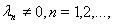
Lemma 6 allows us to draw certain conclusions concerning the collection of all eigenvectors and eigenvalues of the operator A. Consider on the real axis the set of all eigenvalues of the operator A. By virtue of Lemma 6, there exists only a finite number of eigenvalues exceeding in absolute value a given positive number 5. Existence of an Eigenvalue of a Completely Continuous Operator in a Hilbert Space. The Hilbert-Schmidt Theorem 5. Existence of an Eigenvalue of a Completely Continuous Operator in a Hilbert Space. The Hilbert-Schmidt Theorem, therefore, if the set of eigenvalues is infinite (obviously countable), then they form a sequence converging to zero. Consequently, we can number all the eigenvalues with natural numbers in order of decreasing absolute value. Let us agree that in doing so we shall assign to each eigenvalue as many consecutive numbers as the dimension of the corresponding eigenspace (this dimension is called the multiplicity of this eigenvalue). In this case the sequence of nonzero eigenvalues of the operator A

5. Existence of an Eigenvalue of a Completely Continuous Operator in a Hilbert Space. The Hilbert-Schmidt Theorem 5. Existence of an Eigenvalue of a Completely Continuous Operator in a Hilbert Space. The Hilbert-Schmidt Theorem

we can associate a sequence of eigenvectors 5. Existence of an Eigenvalue of a Completely Continuous Operator in a Hilbert Space. The Hilbert-Schmidt Theorem 5. Existence of an Eigenvalue of a Completely Continuous Operator in a Hilbert Space. The Hilbert-Schmidt Theoremmoreover 5. Existence of an Eigenvalue of a Completely Continuous Operator in a Hilbert Space. The Hilbert-Schmidt Theorem 5. Existence of an Eigenvalue of a Completely Continuous Operator in a Hilbert Space. The Hilbert-Schmidt Theorem We may assume that the vectors 5. Existence of an Eigenvalue of a Completely Continuous Operator in a Hilbert Space. The Hilbert-Schmidt Theorem 5. Existence of an Eigenvalue of a Completely Continuous Operator in a Hilbert Space. The Hilbert-Schmidt Theoremare mutually orthogonal and normalized. Indeed, if 5. Existence of an Eigenvalue of a Completely Continuous Operator in a Hilbert Space. The Hilbert-Schmidt Theorem 5. Existence of an Eigenvalue of a Completely Continuous Operator in a Hilbert Space. The Hilbert-Schmidt Theorem then orthogonality 5. Existence of an Eigenvalue of a Completely Continuous Operator in a Hilbert Space. The Hilbert-Schmidt Theorem 5. Existence of an Eigenvalue of a Completely Continuous Operator in a Hilbert Space. The Hilbert-Schmidt Theoremholds by virtue of Lemma 5; if, on the other hand, 5. Existence of an Eigenvalue of a Completely Continuous Operator in a Hilbert Space. The Hilbert-Schmidt Theorem 5. Existence of an Eigenvalue of a Completely Continuous Operator in a Hilbert Space. The Hilbert-Schmidt Theoremthen within the finite eigenspace corresponding to the eigenvalue 5. Existence of an Eigenvalue of a Completely Continuous Operator in a Hilbert Space. The Hilbert-Schmidt Theorem 5. Existence of an Eigenvalue of a Completely Continuous Operator in a Hilbert Space. The Hilbert-Schmidt Theorem we can always perform orthogonalization. Normalization of all the vectors obtained completes the construction.

Let us now show that every vector 5. Existence of an Eigenvalue of a Completely Continuous Operator in a Hilbert Space. The Hilbert-Schmidt Theorem 5. Existence of an Eigenvalue of a Completely Continuous Operator in a Hilbert Space. The Hilbert-Schmidt Theorem, orthogonal to all the constructed vectors 5. Existence of an Eigenvalue of a Completely Continuous Operator in a Hilbert Space. The Hilbert-Schmidt Theorem 5. Existence of an Eigenvalue of a Completely Continuous Operator in a Hilbert Space. The Hilbert-Schmidt Theoremis carried by the operator A into zero.

Lemma 11. Let 5. Existence of an Eigenvalue of a Completely Continuous Operator in a Hilbert Space. The Hilbert-Schmidt Theorem 5. Existence of an Eigenvalue of a Completely Continuous Operator in a Hilbert Space. The Hilbert-Schmidt Theorem – be a subspace in a Hilbert space H, invariant with respect to a symmetric operator A (i.e., every vector of the subspace 5. Existence of an Eigenvalue of a Completely Continuous Operator in a Hilbert Space. The Hilbert-Schmidt Theorem 5. Existence of an Eigenvalue of a Completely Continuous Operator in a Hilbert Space. The Hilbert-Schmidt Theorem is carried by the operator A into a vector of this same space). Then the orthogonal complement 5. Existence of an Eigenvalue of a Completely Continuous Operator in a Hilbert Space. The Hilbert-Schmidt Theorem 5. Existence of an Eigenvalue of a Completely Continuous Operator in a Hilbert Space. The Hilbert-Schmidt Theorem of the subspace 5. Existence of an Eigenvalue of a Completely Continuous Operator in a Hilbert Space. The Hilbert-Schmidt Theorem 5. Existence of an Eigenvalue of a Completely Continuous Operator in a Hilbert Space. The Hilbert-Schmidt Theorem is also invariant with respect to the operator A.

Proof. Let 5. Existence of an Eigenvalue of a Completely Continuous Operator in a Hilbert Space. The Hilbert-Schmidt Theorem 5. Existence of an Eigenvalue of a Completely Continuous Operator in a Hilbert Space. The Hilbert-Schmidt Theorem – be any vector from the subspace 5. Existence of an Eigenvalue of a Completely Continuous Operator in a Hilbert Space. The Hilbert-Schmidt Theorem 5. Existence of an Eigenvalue of a Completely Continuous Operator in a Hilbert Space. The Hilbert-Schmidt Theorem, 5. Existence of an Eigenvalue of a Completely Continuous Operator in a Hilbert Space. The Hilbert-Schmidt Theorem 5. Existence of an Eigenvalue of a Completely Continuous Operator in a Hilbert Space. The Hilbert-Schmidt Theorem– any vector from the subspace 5. Existence of an Eigenvalue of a Completely Continuous Operator in a Hilbert Space. The Hilbert-Schmidt Theorem 5. Existence of an Eigenvalue of a Completely Continuous Operator in a Hilbert Space. The Hilbert-Schmidt Theorem. By assumption 5. Existence of an Eigenvalue of a Completely Continuous Operator in a Hilbert Space. The Hilbert-Schmidt Theorem 5. Existence of an Eigenvalue of a Completely Continuous Operator in a Hilbert Space. The Hilbert-Schmidt Theorem Then by virtue of the symmetry of the operator A it follows that 5. Existence of an Eigenvalue of a Completely Continuous Operator in a Hilbert Space. The Hilbert-Schmidt Theorem 5. Existence of an Eigenvalue of a Completely Continuous Operator in a Hilbert Space. The Hilbert-Schmidt Theorem This means that the vector 5. Existence of an Eigenvalue of a Completely Continuous Operator in a Hilbert Space. The Hilbert-Schmidt Theorem 5. Existence of an Eigenvalue of a Completely Continuous Operator in a Hilbert Space. The Hilbert-Schmidt Theorem is orthogonal to any vector 5. Existence of an Eigenvalue of a Completely Continuous Operator in a Hilbert Space. The Hilbert-Schmidt Theorem 5. Existence of an Eigenvalue of a Completely Continuous Operator in a Hilbert Space. The Hilbert-Schmidt Theoremand, consequently, 5. Existence of an Eigenvalue of a Completely Continuous Operator in a Hilbert Space. The Hilbert-Schmidt Theorem 5. Existence of an Eigenvalue of a Completely Continuous Operator in a Hilbert Space. The Hilbert-Schmidt Theorem The lemma is proved.

Now let us consider the collection P of all vectors 5. Existence of an Eigenvalue of a Completely Continuous Operator in a Hilbert Space. The Hilbert-Schmidt Theorem 5. Existence of an Eigenvalue of a Completely Continuous Operator in a Hilbert Space. The Hilbert-Schmidt Theorem orthogonal to all the constructed vectors 5. Existence of an Eigenvalue of a Completely Continuous Operator in a Hilbert Space. The Hilbert-Schmidt Theorem 5. Existence of an Eigenvalue of a Completely Continuous Operator in a Hilbert Space. The Hilbert-Schmidt Theorem This collection P is a closed subspace as the orthogonal complement of the subspace L, generated by the orthogonal system 5. Existence of an Eigenvalue of a Completely Continuous Operator in a Hilbert Space. The Hilbert-Schmidt Theorem 5. Existence of an Eigenvalue of a Completely Continuous Operator in a Hilbert Space. The Hilbert-Schmidt Theorem Since L, obviously, is invariant with respect to the operator A, its orthogonal complement P (by Lemma 11) is also invariant with respect to the operator A. Denote by M(P) the exact upper bound of the values 5. Existence of an Eigenvalue of a Completely Continuous Operator in a Hilbert Space. The Hilbert-Schmidt Theorem 5. Existence of an Eigenvalue of a Completely Continuous Operator in a Hilbert Space. The Hilbert-Schmidt Theorem on the unit sphere of the subspace P. By virtue of Lemmas 9 and 10, in the subspace P there is an eigenvector 5. Existence of an Eigenvalue of a Completely Continuous Operator in a Hilbert Space. The Hilbert-Schmidt Theorem 5. Existence of an Eigenvalue of a Completely Continuous Operator in a Hilbert Space. The Hilbert-Schmidt Theorem with eigenvalue 5. Existence of an Eigenvalue of a Completely Continuous Operator in a Hilbert Space. The Hilbert-Schmidt Theorem 5. Existence of an Eigenvalue of a Completely Continuous Operator in a Hilbert Space. The Hilbert-Schmidt Theorem But by the very construction of the subspace P it cannot contain a single eigenvector with a nonzero eigenvalue. Hence 5. Existence of an Eigenvalue of a Completely Continuous Operator in a Hilbert Space. The Hilbert-Schmidt Theorem 5. Existence of an Eigenvalue of a Completely Continuous Operator in a Hilbert Space. The Hilbert-Schmidt Theorem; but this means that 5. Existence of an Eigenvalue of a Completely Continuous Operator in a Hilbert Space. The Hilbert-Schmidt Theorem 5. Existence of an Eigenvalue of a Completely Continuous Operator in a Hilbert Space. The Hilbert-Schmidt Theorem for any vector 5. Existence of an Eigenvalue of a Completely Continuous Operator in a Hilbert Space. The Hilbert-Schmidt Theorem 5. Existence of an Eigenvalue of a Completely Continuous Operator in a Hilbert Space. The Hilbert-Schmidt Theoremwhich was to be proved.
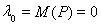
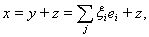
Every vector 5. Existence of an Eigenvalue of a Completely Continuous Operator in a Hilbert Space. The Hilbert-Schmidt Theorem 5. Existence of an Eigenvalue of a Completely Continuous Operator in a Hilbert Space. The Hilbert-Schmidt Theoremcan be represented in the form of a sum

5. Existence of an Eigenvalue of a Completely Continuous Operator in a Hilbert Space. The Hilbert-Schmidt Theorem 5. Existence of an Eigenvalue of a Completely Continuous Operator in a Hilbert Space. The Hilbert-Schmidt Theorem

The vector y can further be expanded in a Fourier series with respect to the system 5. Existence of an Eigenvalue of a Completely Continuous Operator in a Hilbert Space. The Hilbert-Schmidt Theorem 5. Existence of an Eigenvalue of a Completely Continuous Operator in a Hilbert Space. The Hilbert-Schmidt Theorem complete in the space L; the vector z, by what has been proved, is carried by the operator A into the zero vector. We have obtained the following basic theorem:

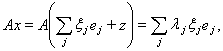
Theorem 9. In a Hilbert space 5. Existence of an Eigenvalue of a Completely Continuous Operator in a Hilbert Space. The Hilbert-Schmidt Theorem 5. Existence of an Eigenvalue of a Completely Continuous Operator in a Hilbert Space. The Hilbert-Schmidt Theorem, in which a symmetric completely continuous operator A is given, every vector 5. Existence of an Eigenvalue of a Completely Continuous Operator in a Hilbert Space. The Hilbert-Schmidt Theorem 5. Existence of an Eigenvalue of a Completely Continuous Operator in a Hilbert Space. The Hilbert-Schmidt Theorem can be represented in the form of an orthogonal sum 5. Existence of an Eigenvalue of a Completely Continuous Operator in a Hilbert Space. The Hilbert-Schmidt Theorem 5. Existence of an Eigenvalue of a Completely Continuous Operator in a Hilbert Space. The Hilbert-Schmidt Theoremwhere 5. Existence of an Eigenvalue of a Completely Continuous Operator in a Hilbert Space. The Hilbert-Schmidt Theorem 5. Existence of an Eigenvalue of a Completely Continuous Operator in a Hilbert Space. The Hilbert-Schmidt Theorem(a finite or infinite) system of eigenvectors of the operator 5. Existence of an Eigenvalue of a Completely Continuous Operator in a Hilbert Space. The Hilbert-Schmidt Theorem 5. Existence of an Eigenvalue of a Completely Continuous Operator in a Hilbert Space. The Hilbert-Schmidt Theorem with nonzero eigenvalues and 5. Existence of an Eigenvalue of a Completely Continuous Operator in a Hilbert Space. The Hilbert-Schmidt Theorem 5. Existence of an Eigenvalue of a Completely Continuous Operator in a Hilbert Space. The Hilbert-Schmidt Theorem
From this theorem also follows the Hilbert theorem. Indeed, in the separable Hilbert space H the subspace P is also separable, and in it one can choose a complete orthogonal system 5. Existence of an Eigenvalue of a Completely Continuous Operator in a Hilbert Space. The Hilbert-Schmidt Theorem 5. Existence of an Eigenvalue of a Completely Continuous Operator in a Hilbert Space. The Hilbert-Schmidt Theoremtogether with the already constructed vectors 5. Existence of an Eigenvalue of a Completely Continuous Operator in a Hilbert Space. The Hilbert-Schmidt Theorem 5. Existence of an Eigenvalue of a Completely Continuous Operator in a Hilbert Space. The Hilbert-Schmidt Theorem one obtains a complete orthogonal system in the whole space H. Each of the vectors of this system is an eigenvector of the operator A: the vectors 5. Existence of an Eigenvalue of a Completely Continuous Operator in a Hilbert Space. The Hilbert-Schmidt Theorem 5. Existence of an Eigenvalue of a Completely Continuous Operator in a Hilbert Space. The Hilbert-Schmidt Theorem with eigenvalues 5. Existence of an Eigenvalue of a Completely Continuous Operator in a Hilbert Space. The Hilbert-Schmidt Theorem 5. Existence of an Eigenvalue of a Completely Continuous Operator in a Hilbert Space. The Hilbert-Schmidt Theoremand the vectors 5. Existence of an Eigenvalue of a Completely Continuous Operator in a Hilbert Space. The Hilbert-Schmidt Theorem 5. Existence of an Eigenvalue of a Completely Continuous Operator in a Hilbert Space. The Hilbert-Schmidt Theorem with eigenvalue 0. Thereby the Hilbert theorem is proved.

From the Hilbert theorem it follows that 5. Existence of an Eigenvalue of a Completely Continuous Operator in a Hilbert Space. The Hilbert-Schmidt Theorem 5. Existence of an Eigenvalue of a Completely Continuous Operator in a Hilbert Space. The Hilbert-Schmidt Theorem i.e., any vector 5. Existence of an Eigenvalue of a Completely Continuous Operator in a Hilbert Space. The Hilbert-Schmidt Theorem 5. Existence of an Eigenvalue of a Completely Continuous Operator in a Hilbert Space. The Hilbert-Schmidt Theorem, where 5. Existence of an Eigenvalue of a Completely Continuous Operator in a Hilbert Space. The Hilbert-Schmidt Theorem 5. Existence of an Eigenvalue of a Completely Continuous Operator in a Hilbert Space. The Hilbert-Schmidt Theorem, admits an expansion in the eigenvectors of the operator 5. Existence of an Eigenvalue of a Completely Continuous Operator in a Hilbert Space. The Hilbert-Schmidt Theorem 5. Existence of an Eigenvalue of a Completely Continuous Operator in a Hilbert Space. The Hilbert-Schmidt Theorem with nonzero eigenvalues.
Problems

1. Prove the following statements:

A) any linear operator A: Rn→Rm is completely continuous;

B) any linear operator A: E1→E2 is completely continuous, if E1is a finite-dimensional space;

C) any bounded linear operator A: E1→E2 is completely continuous, if E2 – is a finite-dimensional space;

D) a bounded linear operator, whose image lies in a finite-dimensional space, is completely continuous.

2. Are the following operators completely continuous in the space C[0, 1]? In the space L2[0, 1]?

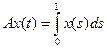
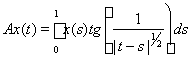
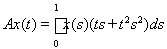
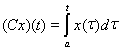
1) 5. Existence of an Eigenvalue of a Completely Continuous Operator in a Hilbert Space. The Hilbert-Schmidt Theorem 5. Existence of an Eigenvalue of a Completely Continuous Operator in a Hilbert Space. The Hilbert-Schmidt Theorem;
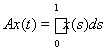
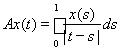
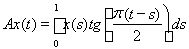
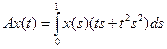
2) 5. Existence of an Eigenvalue of a Completely Continuous Operator in a Hilbert Space. The Hilbert-Schmidt Theorem 5. Existence of an Eigenvalue of a Completely Continuous Operator in a Hilbert Space. The Hilbert-Schmidt Theorem;

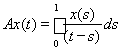
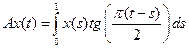
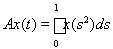
3) 5. Existence of an Eigenvalue of a Completely Continuous Operator in a Hilbert Space. The Hilbert-Schmidt Theorem 5. Existence of an Eigenvalue of a Completely Continuous Operator in a Hilbert Space. The Hilbert-Schmidt Theorem;

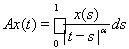
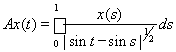
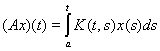
4) 5. Existence of an Eigenvalue of a Completely Continuous Operator in a Hilbert Space. The Hilbert-Schmidt Theorem 5. Existence of an Eigenvalue of a Completely Continuous Operator in a Hilbert Space. The Hilbert-Schmidt Theorem;

5) 5. Existence of an Eigenvalue of a Completely Continuous Operator in a Hilbert Space. The Hilbert-Schmidt Theorem 5. Existence of an Eigenvalue of a Completely Continuous Operator in a Hilbert Space. The Hilbert-Schmidt Theorem;

6) 5. Existence of an Eigenvalue of a Completely Continuous Operator in a Hilbert Space. The Hilbert-Schmidt Theorem 5. Existence of an Eigenvalue of a Completely Continuous Operator in a Hilbert Space. The Hilbert-Schmidt Theorem;

7) 5. Existence of an Eigenvalue of a Completely Continuous Operator in a Hilbert Space. The Hilbert-Schmidt Theorem 5. Existence of an Eigenvalue of a Completely Continuous Operator in a Hilbert Space. The Hilbert-Schmidt Theorem;

8) 5. Existence of an Eigenvalue of a Completely Continuous Operator in a Hilbert Space. The Hilbert-Schmidt Theorem 5. Existence of an Eigenvalue of a Completely Continuous Operator in a Hilbert Space. The Hilbert-Schmidt Theorem;

9) 5. Existence of an Eigenvalue of a Completely Continuous Operator in a Hilbert Space. The Hilbert-Schmidt Theorem 5. Existence of an Eigenvalue of a Completely Continuous Operator in a Hilbert Space. The Hilbert-Schmidt Theorem;

10) Ax(t)=x(t2).

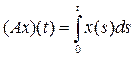
3. Does the operator 5. Existence of an Eigenvalue of a Completely Continuous Operator in a Hilbert Space. The Hilbert-Schmidt Theorem 5. Existence of an Eigenvalue of a Completely Continuous Operator in a Hilbert Space. The Hilbert-Schmidt Theorem have eigenvalues in the space 5. Existence of an Eigenvalue of a Completely Continuous Operator in a Hilbert Space. The Hilbert-Schmidt Theorem 5. Existence of an Eigenvalue of a Completely Continuous Operator in a Hilbert Space. The Hilbert-Schmidt Theorem?
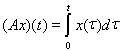
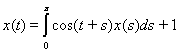
4. Show that for the equation 5. Existence of an Eigenvalue of a Completely Continuous Operator in a Hilbert Space. The Hilbert-Schmidt Theorem 5. Existence of an Eigenvalue of a Completely Continuous Operator in a Hilbert Space. The Hilbert-Schmidt Theorem, where 5. Existence of an Eigenvalue of a Completely Continuous Operator in a Hilbert Space. The Hilbert-Schmidt Theorem 5. Existence of an Eigenvalue of a Completely Continuous Operator in a Hilbert Space. The Hilbert-Schmidt Theorem – is a Volterra operator, and 5. Existence of an Eigenvalue of a Completely Continuous Operator in a Hilbert Space. The Hilbert-Schmidt Theorem 5. Existence of an Eigenvalue of a Completely Continuous Operator in a Hilbert Space. The Hilbert-Schmidt Theorem is continuous for 5. Existence of an Eigenvalue of a Completely Continuous Operator in a Hilbert Space. The Hilbert-Schmidt Theorem 5. Existence of an Eigenvalue of a Completely Continuous Operator in a Hilbert Space. The Hilbert-Schmidt Theorem, all values of the parameter 5. Existence of an Eigenvalue of a Completely Continuous Operator in a Hilbert Space. The Hilbert-Schmidt Theorem 5. Existence of an Eigenvalue of a Completely Continuous Operator in a Hilbert Space. The Hilbert-Schmidt Theorem are regular.

Show that if the value of the parameter l is regular for the operator, then it will also be regular for the operator A + B, when 5. Existence of an Eigenvalue of a Completely Continuous Operator in a Hilbert Space. The Hilbert-Schmidt Theorem 5. Existence of an Eigenvalue of a Completely Continuous Operator in a Hilbert Space. The Hilbert-Schmidt Theorem is sufficiently small.

5. Show that every completely continuous (compact) operator in a separable Hilbert space H is the limit of operators that map the entire space onto a finite-dimensional subspace.

Hint: one may assume that 5. Existence of an Eigenvalue of a Completely Continuous Operator in a Hilbert Space. The Hilbert-Schmidt Theorem 5. Existence of an Eigenvalue of a Completely Continuous Operator in a Hilbert Space. The Hilbert-Schmidt Theorem. If 5. Existence of an Eigenvalue of a Completely Continuous Operator in a Hilbert Space. The Hilbert-Schmidt Theorem 5. Existence of an Eigenvalue of a Completely Continuous Operator in a Hilbert Space. The Hilbert-Schmidt Theorem, then let 5. Existence of an Eigenvalue of a Completely Continuous Operator in a Hilbert Space. The Hilbert-Schmidt Theorem 5. Existence of an Eigenvalue of a Completely Continuous Operator in a Hilbert Space. The Hilbert-Schmidt Theorem.

6. Show that the operator A in a separable Hilbert space, given in an orthonormal basis 5. Existence of an Eigenvalue of a Completely Continuous Operator in a Hilbert Space. The Hilbert-Schmidt Theorem 5. Existence of an Eigenvalue of a Completely Continuous Operator in a Hilbert Space. The Hilbert-Schmidt Theorem by the matrix 5. Existence of an Eigenvalue of a Completely Continuous Operator in a Hilbert Space. The Hilbert-Schmidt Theorem 5. Existence of an Eigenvalue of a Completely Continuous Operator in a Hilbert Space. The Hilbert-Schmidt Theorem by the formulas 5. Existence of an Eigenvalue of a Completely Continuous Operator in a Hilbert Space. The Hilbert-Schmidt Theorem 5. Existence of an Eigenvalue of a Completely Continuous Operator in a Hilbert Space. The Hilbert-Schmidt Theorem is completely continuous, if 5. Existence of an Eigenvalue of a Completely Continuous Operator in a Hilbert Space. The Hilbert-Schmidt Theorem 5. Existence of an Eigenvalue of a Completely Continuous Operator in a Hilbert Space. The Hilbert-Schmidt Theorem

Hint: see Problem 5.

7. Let, for 5. Existence of an Eigenvalue of a Completely Continuous Operator in a Hilbert Space. The Hilbert-Schmidt Theorem 5. Existence of an Eigenvalue of a Completely Continuous Operator in a Hilbert Space. The Hilbert-Schmidt Theorem, 5. Existence of an Eigenvalue of a Completely Continuous Operator in a Hilbert Space. The Hilbert-Schmidt Theorem 5. Existence of an Eigenvalue of a Completely Continuous Operator in a Hilbert Space. The Hilbert-Schmidt Theorem, 5. Existence of an Eigenvalue of a Completely Continuous Operator in a Hilbert Space. The Hilbert-Schmidt Theorem 5. Existence of an Eigenvalue of a Completely Continuous Operator in a Hilbert Space. The Hilbert-Schmidt Theorem. Which of these operators are completely continuous?

8. For 5. Existence of an Eigenvalue of a Completely Continuous Operator in a Hilbert Space. The Hilbert-Schmidt Theorem 5. Existence of an Eigenvalue of a Completely Continuous Operator in a Hilbert Space. The Hilbert-Schmidt Theorem, let 5. Existence of an Eigenvalue of a Completely Continuous Operator in a Hilbert Space. The Hilbert-Schmidt Theorem 5. Existence of an Eigenvalue of a Completely Continuous Operator in a Hilbert Space. The Hilbert-Schmidt Theorem, show that A – is a completely continuous operator.

9. What are the eigenfunctions of the Fredholm integral operator with kernel 5. Existence of an Eigenvalue of a Completely Continuous Operator in a Hilbert Space. The Hilbert-Schmidt Theorem 5. Existence of an Eigenvalue of a Completely Continuous Operator in a Hilbert Space. The Hilbert-Schmidt Theorem on the intervals a) 5. Existence of an Eigenvalue of a Completely Continuous Operator in a Hilbert Space. The Hilbert-Schmidt Theorem 5. Existence of an Eigenvalue of a Completely Continuous Operator in a Hilbert Space. The Hilbert-Schmidt Theorem, b) 5. Existence of an Eigenvalue of a Completely Continuous Operator in a Hilbert Space. The Hilbert-Schmidt Theorem 5. Existence of an Eigenvalue of a Completely Continuous Operator in a Hilbert Space. The Hilbert-Schmidt Theorem?

10. Solve the equation 5. Existence of an Eigenvalue of a Completely Continuous Operator in a Hilbert Space. The Hilbert-Schmidt Theorem 5. Existence of an Eigenvalue of a Completely Continuous Operator in a Hilbert Space. The Hilbert-Schmidt Theorem.

11. In the space C[0, 1] consider the operator
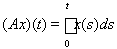
5. Existence of an Eigenvalue of a Completely Continuous Operator in a Hilbert Space. The Hilbert-Schmidt Theorem 5. Existence of an Eigenvalue of a Completely Continuous Operator in a Hilbert Space. The Hilbert-Schmidt Theorem.

Find the spectrum and resolvent of the operator A.

12. In the real linear space C[-p, p] find the eigenvalues and eigenvectors of the operators

a) (Ax)(t) = x(-t);

b) 5. Existence of an Eigenvalue of a Completely Continuous Operator in a Hilbert Space. The Hilbert-Schmidt Theorem 5. Existence of an Eigenvalue of a Completely Continuous Operator in a Hilbert Space. The Hilbert-Schmidt Theorem.
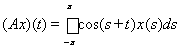
Do these operators have a continuous spectrum in this space? Construct the resolvents on the set of regular values of each operator.

13. In the complex space C[0, 1] consider the operator (Ax)(t) = x(0) + tx(1). Find the point and continuous spectra of the operator A and construct the resolvent on the set of regular values.

14. In the space C[0, 2p] consider the operator (Ax)(t) = eittx(t). Prove that the spectrum of the operator A is the set {l ∈C: |l| = 1}, and no point of the spectrum is an eigenvalue.

15. Find the spectrum and resolvent of the operator A in the space L2[-1, 1]
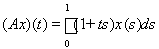
5. Existence of an Eigenvalue of a Completely Continuous Operator in a Hilbert Space. The Hilbert-Schmidt Theorem 5. Existence of an Eigenvalue of a Completely Continuous Operator in a Hilbert Space. The Hilbert-Schmidt Theorem.

16. What should the function j∈C[a, b], be so that the multiplication operator A: C[a, b] → C[a, b], defined by the equality (Ax)(t) = j(tx(t) was completely continuous.

17. Find the spectrum and eigenvalues of the multiplication operator by a fixed continuous function in the space C[a, b].

18. Find the spectrum of the operator A in the space L2(R):
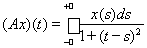
5. Existence of an Eigenvalue of a Completely Continuous Operator in a Hilbert Space. The Hilbert-Schmidt Theorem 5. Existence of an Eigenvalue of a Completely Continuous Operator in a Hilbert Space. The Hilbert-Schmidt Theorem.

19. Let the number p > 1 and q – be conjugate to it, i.e. 1/p + 1/q = 1. Consider the operator A: lp → lq, which is defined by the formula
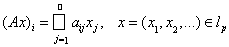

5. Existence of an Eigenvalue of a Completely Continuous Operator in a Hilbert Space. The Hilbert-Schmidt Theorem 5. Existence of an Eigenvalue of a Completely Continuous Operator in a Hilbert Space. The Hilbert-Schmidt Theorem,

where the numerical matrix 5. Existence of an Eigenvalue of a Completely Continuous Operator in a Hilbert Space. The Hilbert-Schmidt Theorem 5. Existence of an Eigenvalue of a Completely Continuous Operator in a Hilbert Space. The Hilbert-Schmidt Theorem is such that the double series 5. Existence of an Eigenvalue of a Completely Continuous Operator in a Hilbert Space. The Hilbert-Schmidt Theorem 5. Existence of an Eigenvalue of a Completely Continuous Operator in a Hilbert Space. The Hilbert-Schmidt Theorem converges. Prove that the operator A is completely continuous.

20. Consider the operator A: lp → lq, which is defined by the formula

Ax = (l1x1, l2x2, …), x = (x1, x2, …)

where lk – is a given sequence of numbers, k =1, 2, … What should this sequence of numbers be so that the operator A was completely continuous.

21. Let a bounded linear operator A be given in a Hilbert space H such that A*A is a completely continuous operator in H. Prove that the operator A is completely continuous?

Comments

To leave a comment

If you have any suggestion, idea, thanks or comment, feel free to write. We really value feedback and are glad to hear your opinion.
To reply

Lectures and tutorial on "Functional analysis"

Terms: Functional analysis