
Lecture
Definition 15. Let X be a metric space. A set A ⊂ X is called nowhere dense if its closure `A has no interior points. The latter is equivalent to the fact that in every ball there is a ball containing no points of `A.
Indeed, take any ball S. It cannot lie entirely in the set `A, since in that case all its interior points would be interior points of `A. Consequently, S∩(X - `A) ≠ ∅. Then for any point x ∈ S∩(X - `A) (the set X - `A is open) there is a ball of small radius S1 which lies entirely in S∩(X - `A), and hence has no points in common with `A. The converse is obvious.
Definition 16. A countable union of nowhere dense sets is called a set of the first category, and a set that is not a set of the first category is called a set of the second category.
Theorem 17 (Baire). A complete metric space is a set of the second category, i.e. it cannot be a union of a countable set of nowhere dense sets.
Proof. Suppose to the contrary that the complete metric space X is a countable union of sets nowhere dense in X : X = 
 . Consider the nonempty open set X – `A1 and some point x1 from this set. There is an open ball S(xl, r1), which is contained in the set X – `A1. For this ball the relations S(x1, r1/2) ⊂ S[x1, r1/2] ⊂ S(x1, r1) hold. Consequently, S[x1, r1/2] ∩`A1 = ∅.
Take the point x2 from the nonempty open set S(x1, r1/2)∩ (X – `A2) (see the argument after Definition 15). There is an open ball S(x2, r2), contained in this intersection. Without loss of generality, we may assume that r2 ≤ r1/2, i.e. we can decrease the radius of the ball without violating the inclusion
S(x2, r2) ⊂ S(x1, r1/2)∩ (X – `A2).
Then the following inclusions hold
S(x2, r2/2) ⊂ S[x2, r2/2] ⊂ S(x2, r2) ⊂ S(x1, r1/2)⊂ S[x1, r1/2],
and moreover S[x2, r2/2] ∩`A2 = ∅.
Further, by induction, in the nonempty open set
S(xn - 1, rn - 1/2)∩ (X – `An)
there is an open ball S(xn, rn), rn ≤ rn – 1/2, for which the following inclusions hold
S(xn, rn/2) ⊂ S[xn, rn/2] ⊂ S(xn, rn) ⊂ S(xn - 1, rn - 1/2)⊂ S[xn - 1, rn - 1/2],
and moreover S[xn, rn/2] ∩`An = ∅.
We have constructed a sequence { S[xn, rn/2]} of closed nested balls with radii rn/2 ≤ rn – 1/22 ≤ … ≤ r1/2n, tending to zero as n → ∞, for which S[xn, rn/2] ∩`An = ∅. By the completeness criterion for metric spaces there exists a point x, belonging to all the balls. From the equality X = it follows that x belongs to one of the sets, say Am.. We obtain a contradiction: x ∈ S[xm, rm/2] ∩Am, while at the same time, by the construction of the balls, S[xm, rm/2] ∩`Am = ∅ and hence, a fortiori, S[xm, rm/2] ∩Am = ∅.
Corollary. If a complete metric space X is a countable union of closed sets, then at least one of them contains a ball of positive radius.
1. Let M be a nowhere dense set of a metric space. What will its complement be?
2. Let X – be the space of elements of the form 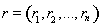
 , where n – is fixed,
 - are rational numbers, with the metric
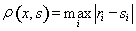

Will this space be complete? What will be its completion?
3. In the space 
 construct a sequence of closed sets nested within one another with empty intersection.
4. Show that the space 
 of continuous functions with the metric
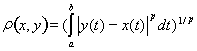
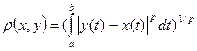
is not complete for any p.
5. Introduce on the line 
 a metric by the formula


Verify that all the axioms of a metric space hold. Will this space be complete?
6. Prove that the space Cm[a, b] is complete for any m.
7. Is the space of all numerical sequences complete
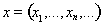

where 
 , with the metric given by the formula
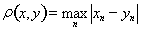
 ?
?
8. Consider three spaces of functions on the line with the metric d(f(x), g(x)) = 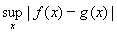
 :
:
a) all bounded continuous functions;
b) all continuous functions for which 
 ;
;
c) all continuous functions, each of which is equal to zero outside some interval.
Will the indicated spaces be complete?
9. The mapping A on the half-line 
 sends the point x to
 . Is the mapping contractive? Does it have a fixed point?
10. Let the function 
 , given and differentiable on the interval [0, 1], satisfy the inequalities
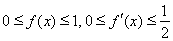

Will the equation 
 have a solution?
11. In the space 
 of elements of the form
 with the metric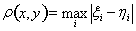
 . Find the condition for solvability of the system
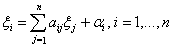

12. Are the functions 
 , where B – is a set in the metric space X, continuous.
13. Given a mapping of a compactum into itself, satisfying the condition 
 for
for 
 . Show that this mapping has a unique fixed point.
14. Can a compact set be unbounded?
15. Give an example of a set, compact in the space m, all of whose points have infinitely many coordinates different from zero.
16. In the space C[a, b], will the set of all powers 
 be compact?
17. Show that the sequence of continuous functions 
 on the interval [0, 1], where
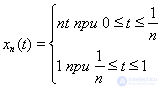
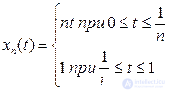
converges by distance to 
 and in
 and in
 (see problem 4), but does not tend, in C[a, b] with the Chebyshev metric (Example 7, Ch. 1), to unity at t = 0.
18. Let X be a metric space in which every sequence of points contains a fundamental subsequence. Prove that the space X is separable.
19. Show that the space h of all numerical sequences, each of which has only a finite number of terms different from zero, with the metric d(x, y) = sup n |xn - yn|, is an incomplete separable metric space. What is the completion of this space?
20. Show that the space C(-∞, ∞) of all continuous functions defined on the real line, each of which vanishes outside some interval, with the metric


is an incomplete separable metric space. What is the completion of this space?
21. Show that a set F is closed if and only if d(x, F) = 0 implies x∈F.
22. In every metric space, does the closure of the open ball S(x, r) coincide with the closed ball S[x, r]?
23. Denote by AK the set of all functions from C[a, b] satisfying the Lipschitz condition with one and the same constant K:
|x(t) - x(s)| ≤ K|t - s|.
Show that the set AK coincides with the closure of the set of all functions x(t) differentiable on the segment [a, b] such that |x′(t)| ≤ K.
24. Indicate, in the Euclidean plane, two closed disjoint sets A and B such that d(A, B) = 1, but there do not exist points a∈A and b∈B such that d(a, b) = 1.
25. Show that if A is compact and B is a closed set in the metric space X, and A∩B = ∅, then d(A, B) > 0.
26. Let f(x) be a continuous one-to-one mapping of a compact metric space X onto a metric space Y. Prove that the inverse mapping f -1(y) of the space Y onto the space X is continuous.
27. Prove that if an increasing sequence {xn(t)} of real continuous functions, defined on a compact metric space X, converges pointwise to a continuous function x(t), then it converges to x(t) uniformly.
28. Let d(x, y) be a metric on X. Show that


is also a metric on X and that these three metrics are pairwise equivalent.
29. Let X be a metric space in which every sequence of points contains a fundamental subsequence. Prove that the space X is separable.
30. Show that the space h of all numerical sequences, each of which has only a finite number of terms different from zero, with the metric d(x, y) = sup n |xn - yn|, is an incomplete separable metric space. What is the completion of this space?
31. Let X be a metric space with the metric
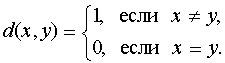
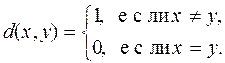
Answer the following questions: 1) In what case will {xn} be a convergent sequence in X? 2) In what case will {xn} be a fundamental sequence in X? 3) Will X be a complete space? 4) What sets are everywhere dense in X? 5) In what case is X a separable space? 6) What sets in X are open, closed?
32. In every metric space, does the closure of the open ball S(x, r) coincide with the closed ball S[x, r]?

Comments