
Lecture
Theorem 9. Let X, Y be topological spaces, X compact, and f: X → Y a continuous mapping. Then the image f(X) is a compact space in Y.
Proof. Let {Va} be an arbitrary open cover of f (X). By the definition of a continuous mapping, the sets f -1(Va) are also open and, obviously, form an open cover of X. By the compactness of X there exists a finite subfamily of this cover such that 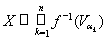
 . But then also f (X)
 , which proves the compactness of f (X).
Theorem 10. Let X, Y be topological spaces, X compact, Y separated (Hausdorff), and f: X → Y a continuous mapping. Then f is a closed mapping.
Proof. Every closed subset of a compact space is itself a compact set (Theorem 1.13). So let B be a closed set in the space X (hence compact). By the previous theorem f (B) is a compact set. By the separability of Y this set must be closed (Theorem 1.15).
Theorem 11. Let X, Y be topological spaces, X compact, Y separated (Hausdorff), and f: X → Y a continuous bijective mapping. Then f is a homeomorphism.
The proof is practically obvious.
Theorem 12 (Weierstrass). Every continuous function f : X → R on a compact space X is bounded and attains its upper (lower) bound on X.
Proof. By the compactness of X and the continuity of f the image f (X) is a compact set in R. But any compact set in R is bounded and closed. The boundedness of f (X) means the boundedness of the function. The closedness of the numerical set f (X) implies that it contains its exact bounds. This means that the exact bound (for example, the supremum) is attained at some element x0 ∈X, i.e. f (x0) = sup f (X).
Theorem 13 (Cantor). Every continuous function f(x), defined on a compact set Q, of a metric space (X, r), is uniformly continuous on it: in other words, for any ε > 0 one can find such δ>0, that from ρ(x, y)< δ it follows that |f(x) - f(y)| < ε
Proof. Assuming the contrary, for some ε0 we can find sequences xn and yn such that
ρ (xn, yn)< 
 , |f(xn) - f(yn)|
 ε0 (12)
The sequence {xn} by assumption contains a subsequence {xni}, converging to some point x0. Then the subsequence {yni} also converges to the point x0. Starting from some index, the points xni and yni fall into such a neighbourhood of the point x0 in which the inequality |f(x ) - f(x0)|< 
 holds. But then
|f(xni ) - f(yni)| 
 |f(xni) - f(x0)| + |f(x0) - f(yni)| < + = ε0
which contradicts condition (12). The theorem is proved.

Comments