
Lecture
Suppose that {fn(x)} 
 and f(x) are measurable and finite functions on the measurable space (X, S, m) .
Definition 5. We say that the sequence fn(x) ⇒ f(x) on X as n → ∞ (converges in measure on X), if for every e > 0 the limit

 = 0.
= 0.
Note that, unlike almost everywhere convergence, for which the measurability of the limit function is established, the definition of convergence in measure immediately assumes the measurability of the function f(x) itself. Since the definition of convergence in measure differs significantly from the definitions of pointwise and uniform convergence, let us establish some properties of this convergence.
Theorem 4. The limit of a sequence of functions converging in measure is unique up to equivalence.
Proof. Suppose that the sequence fn(x) ⇒ f(x) and fn(x) ⇒ g(x) as n → ∞. Then for every e > 0 and for every n we have
{x ∈ X: |f(x) - g(x)| > e} ⊂ {x ∈ X: |fn(x) - f(x)| > e/2} ∪ {x ∈ X: |fn(x) - g(x)| > e/2},
from which it is clear that m({x ∈ X: |f(x) - g(x)| > 0}) = 0, i.e. f(x) = g(x) almost everywhere.
Theorem 5. Let fn(x) ⇒ f(x) and gn(x) ⇒ g(x) as n → ∞. Then fn(x) + gn(x) ⇒ f(x) + g(x) as n → ∞.
Proof. The statement of the theorem follows immediately from the inclusion, valid for every e > 0 and every n,
{x ∈ X: |( fn(x) + gn(x)) - (f(x) + g(x))| > e} ⊂
⊂ {x ∈ X: | fn(x) – f(x)| > e/2}∪{x ∈ X: |gn(x) – g(x)| > e/2}.
Theorem 6. If m(X) < ∞, an open set G ⊂ R1, a function g(x) is continuous on the set G, and a sequence fn(x) ⇒ f(x) as n → ∞, and moreover all the functions fn(x) and the function f(x) map the set X into G, then g(fn(x)) ⇒ g(f(x)) as n → ∞.
Proof. Since any interval (a, b) on the real line is a countable union of segments [a + 1/n, b – 1/n], then it follows from Theorem 1.3 that the representation holds 
 , where all the sets Kn are compact in R1, i.e. closed and bounded, and K1 ⊂ K2 ⊂ ... Consider the preimages En = f -1(Kn) for n = 1, 2, .... In this case E1 ⊂ E2 ⊂ ... and
 .
.
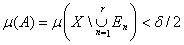
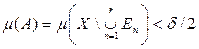
Let e > 0 and d > 0 be given. By the theorem on continuity of measure, r can be chosen so that
Let r > 0 be the distance from the compact set K= 
 to the closed set F = R1 \ G. Define the compact set K0 = {y ∈R1: minx∈K|x - y| ≤ r/2} ⊂ G.
Then the function g(x) is uniformly continuous on K0, and, hence, there exists an s > 0 such that for x, y ∈ K0 and |x – y| < s we have |g(x) - g(y)| < e.
Choose N such that for n > N the inequality holds
m(Bn) = m({x ∈ X: | fn(x) - f(x)| ≥ min(r/2, s)}) < d/2.
Now m(A∪Bn) < d, and if x ∈ X\( A∪Bn), then f(x) ∈ K ⊂ K0, fn(x) ∈ K0 and | fn(x) - f(x)| < s, whence | g(fn(x)) - g(f(x))| < e. The theorem is proved.
Corollary 1. If m(X) < ∞ and the sequence fn(x) converges in measure to f(x) as n → ∞, then fn2(x) ⇒ f 2(x) as n → ∞. If, in addition, the functions f(x) and fn(x) for n = 1, 2, ... do not vanish on X, then 1/fn(x) ⇒ 1/ f(x) as n → ∞.
Remark. As the example of the sequence fn(x) = x + 1/n on the line R1 shows, the condition that the measure of X is finite is essential for the validity of the corollary.
Corollary 2. If m(X) < ∞, the sequence fn(x) ⇒ f(x) and gn(x) ⇒ g(x) as n → ∞, then fn(x)gn(x) ⇒ f(x)g(x) as n → ∞.
Proof. The statement follows immediately from the theorem and its first corollary, and from the following equalities:
(fn(x) + gn(x))2 = fn2(x) + 2 fn(x) gn(x) + gn2(x), (f(x) + g(x))2 = f 2(x) + 2f(x)g(x) + g2(x).

 .
.
Corollary 3. If m(X) < ∞, the sequence fn(x) ⇒ f(x) and gn(x) ⇒ g(x) as n → ∞, and the functions g(x) and gn(x) for n = 1, 2, ... do not vanish on X, then fn(x)/gn(x) ⇒ f(x)/g(x) as n → ∞.

Comments