
Lecture
Definition 21. Let X be an arbitrary set. An outer measure on X is a real-valued nonnegative function m*, defined on the collection of all subsets of the set X and satisfying the following properties:
1. m*(∅) = 0;
2. If E ⊂ 
 En, where the collection of sets En ⊂ X is at most countable, then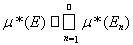
 (countable semi-additivity of the outer measure).
Theorem 8. Let m be a measure on X, defined on a semiring P, and let m* be a function defined for " E ⊂ X by the following rule:
1. If for E there exists an at most countable covering from the semiring P, i.e. E ⊂ 
 An, where An ∈ P (n = 1, 2,...), then m*(E) = inf{
 m(An)}, where the infimum is taken over all coverings of the indicated type.
2. Otherwise m*(E) = +∞.
Then m* is an outer measure on X, and m*(A) = m(A) for "A ∈ P.
Proof. We first note that for "A ∈ P the equality m*(A) = m(A) holds. Indeed, if A ⊂ An, where An ∈ P (n = 1, 2,...), then by Theorem 6 m(A) ≤ m(An). Hence the inf in the definition of m* is attained on the covering consisting of a single set, namely A itself. The first property of the outer measure follows immediately from the equality obtained.
If for at least one n the equality m*(En) = +∞ holds, then the second property of the outer measure is obvious. Let m*(En) < +∞ for all n. Then for an arbitrary e > 0 there exists a covering En ⊂ 
 Bkn by sets Bkn from the semiring P such that m*(En) ≥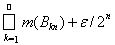
 . Since E ⊂ En, and En ⊂ Bkn, then E ⊂ Bkn. Hence
m*(E) ≤ 
 m(Bkn) ≤
 (m*(En) + e/2n) = m*(En) + e.
By the arbitrariness of e, the second property in the definition of the outer measure is proved.
Definition 22. We shall say that the outer measure m*, constructed in this theorem, is generated by the measure m.

Comments