
Lecture
Let (X, S, m) be a measurable space with a countably additive complete measure m and a set E ∈ S. Further we write that functions f ≤ g on the set E, if the inequality f(x) ≤ g(x) holds for all x ∈ E.
Definition 2. The sequence of functions {fn} on the set E converges to the function f(x) = 
 , if the equality f(x) = holds for all x ∈ E.
The sequence of functions {fn} converges monotonically increasing fn f on E, if f = , on E and the sequence is nondecreasing fi ≤ fi+l, i =1,2,..., on the set E. Monotone convergence of the type fn ↔ f on the set E.
Definition 3. The function h: E → R is called simple, if it takes a finite set of values. Let h take the values hj on the sets Hj, j = 1, 2, ...,k. Then Hj form a finite partition of the set 
 and the equality holds
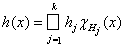
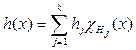 ,
, 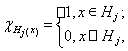
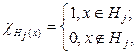
where 
 - is the characteristic function of the set Hj. A direct check shows that the simple function h(x) is measurable if and only if all the sets Hj are measurable. In the representation given, it is assumed that hj are distinct for distinct values of j. In practice there are cases where tracking this condition is burdensome, and we allow the function to take the same value for different values of the index.
Theorem 2. For every nonnegative measurable function f on the set E ∈ S there exists a sequence of simple nonnegative measurable functions hn(x), which converges monotonically hn f on the set E.
Proof. We define a sequence of simple functions on the set E by the formula:
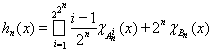
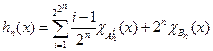 ,
,
where 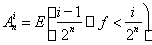
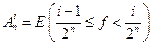 and Bn = E(f ≥ 2n). These functions are nonnegative and measurable on the set E. We show that the sequence of simple functions {hn} is nondecreasing. Since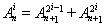
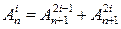 , then

 .
.
Further, since 0 ≤ f(x) – hn(x) < 1/2n for all x ∈ E(f < 2n), then this sequence converges monotonically to the function f on the set E.
Corollary 1. For every nonnegative bounded measurable function f on the set E ∈ S there exists a sequence hn(x) of simple nonnegative measurable functions, such that {hn} converges monotonically and uniformly on the set E to the function f.
The statement of the corollary has essentially already been established in the course of the proof of the theorem.
Definition 4. A sequence of functions {fn} converges almost everywhere (a.e.) to the function f on the set E, if there exists a set A∈S of measure zero m(A) = 0, such that the equality f(x) = holds for all x ∈ E\A.
Two functions are called equivalent f~g, if there exists a set A ∈ E of measure zero m(A) = 0, such that f(x) = g(x) for all x ∈ E\A. By the completeness of the measure, the measurability of a function implies the measurability of any equivalent function.
In the space S(E) of all measurable functions on the set E equivalent functions are identified, so that the elements of this space are, in fact, classes of equivalent functions.
It is easy to verify that the limit f(x) = of an almost everywhere convergent sequence of measurable functions is also a measurable function and is determined uniquely up to equivalence. Indeed, let A be the set of measure zero from the definition. Then the sequence {fncE\A} converges for all x ∈ E\A to the function f(x) ·cE\A. By Corollary 2 of Lemma 1 the latter function is measurable. Then the function f(x) ·cE\A + cA is measurable on E, as the sum of two measurable functions. Moreover, the function constructed is equivalent to f(x), and hence the latter is a measurable function.
Lemma 2. Let E = {x ∈X: fn(x) → f(x) as n →∞}. Then
X\E = 

Proof. The point x ∈ X \ E if and only if fn(x) does not converge to f(x). But by definition this means that for some m0, for every n ≥ 1 there exists a k > n, such that |fk(x) – f(x)| > 
 . This means that x ∈
 for all n. Hence, x ∈
 and x ∈
 . The reverse inclusion is now easy to verify.
Theorem 3 (criterion for almost everywhere convergence). Let m(X) <∞. Then the sequence fn(x) → f(x) almost everywhere on X if and only if for every e > 0 the equality holds

 .
.
Proof. It suffices to establish that almost everywhere convergence is equivalent to the following: for every natural t
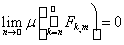
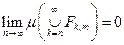
In the notation of Lemma 2 the convergence fn(x) → f(x) almost everywhere on X is equivalent to m(X \E) = 0 or 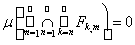
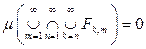 . But this, in turn, is equivalent to the fact that for every t the equality holds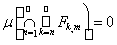
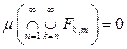 . Let us define, for a fixed m, the sets Gn =
 for all natural n. Then G1 ⊃ G2 ⊃... To complete the proof it remains only to note that, by the theorem on continuity of measure (Theorem 3.5)
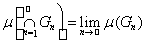
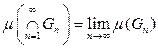 .
.

Comments