
Lecture
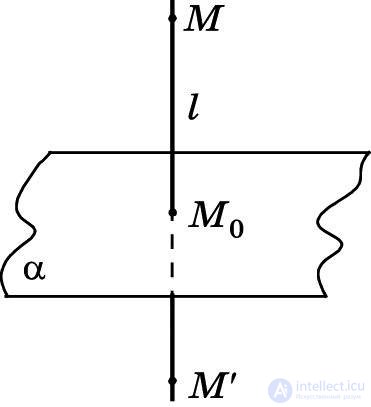
Fig. 19
DEFINITION. A point m′ of space, not lying on the plane α, is called symmetric to a point M with respect to the plane α, if the segment MM′ is perpendicular to this plane and is bisected by it. Any point of the plane α is considered symmetric to itself with respect to this plane (fig. 19).
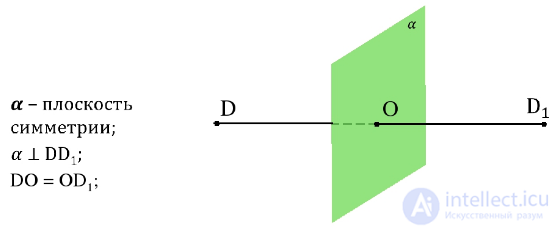
From the definition it follows that if a point M′ is symmetric to a point M with respect to a plane α, then the point M is symmetric to the point M′ with respect to the same plane α.
Let us now define the following mapping of space onto itself. To each point M of space we assign the point M′, symmetric to it with respect to the plane α. By analogy with central symmetry, it can be proved that this mapping is a transformation of space. In doing so, every point of the plane α maps to itself.
Symmetry with respect to a plane means that a figure or object looks the same when reflected with respect to that plane. The plane of symmetry acts as an axis about which the reflection takes place, dividing the figure into two equal halves that are mirror images of one another.
For example, if we take the simple case of the letter "A" and draw a plane of symmetry vertically through the middle of the letter, then its two halves will be identical mirror images of each other. That is, reflecting one half of the letter "A" with respect to the plane of symmetry produces exactly the other half.
Symmetry with respect to a plane has wide application in geometry and art. Many objects and figures, such as circles, squares, triangles, plants, animals, and so on, can possess symmetry with respect to various planes. This type of symmetry is visually pleasing and is often used to create aesthetically attractive compositions and designs.
DEFINITION. A transformation of space in which every point of space is mapped to a point symmetric to it with respect to the plane α, is called the symmetry of space with respect to the plane α. The plane α is called the plane of symmetry.
Symmetry with respect to the plane α is denoted Sα. If under this symmetry a point M (a figure F) is mapped to a point M′ (a figure F′), then we write Sα(M) = M′ (Sα(F) = F′). This transformation is also called a "reflection in the plane", or "mirror symmetry", or "mirror reflection from the plane", by analogy with a "reflection in a mirror".
From the definition of symmetric points with respect to the plane α it follows that
Sα(M) = M′ ⇔ Sα(M′) = M.
Therefore, it is said that the points M and M′ are symmetric with respect to the plane α. On the other hand, it was shown earlier that the point M′ maps to its preimage — the point M — under the inverse transformation. Hence,
Sα(M) = M′ ⇒  (M′) = M.
We obtain
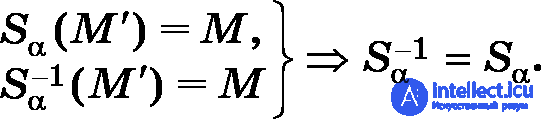
Thus, a reflection in a plane is a transformation of space that coincides with its own inverse transformation.
Then for any point M of space we have
(Sα ∘ Sα)(M) = Sα(Sα (M)) = Sα(M′) =  (M′) = M.
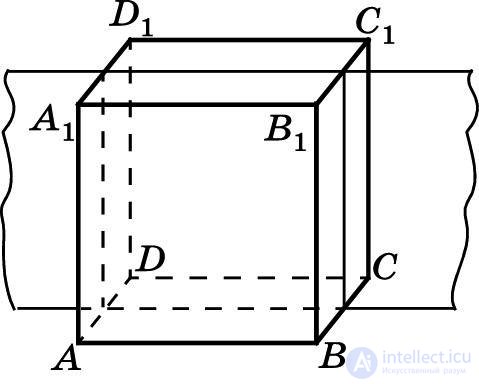
Fig. 20
But for the identity transformation E we have E(M) = M. Since the point M — is arbitrary, the transformations Sα ∘ Sα and E are equal: Sα ∘ Sα = E, i.e. the composition of two reflections in one and the same plane is the identity transformation.
If under a reflection in the plane α a figure F maps onto itself (Sα(F) = F), then the plane α is called a plane of symmetry of this figure. In this case the figure F is said to be symmetric with respect to the plane α (or the plane α is a plane of symmetry of the figure F).
For example, the plane passing through the midpoints of the parallel edges AD, BC, B1C1 and A1D1 of the cube ABCDA1B1C1D1 (Fig. 20), is a plane of symmetry of this cube. Prove this and find other planes of symmetry of the given cube.
A reflection in a plane can be specified by a pair of corresponding (symmetric) points A and A′ (why?).
Let us derive formulas that would allow, from the coordinates of an arbitrary point M of space, finding the coordinates of its image — the point M′ = Sα(M).
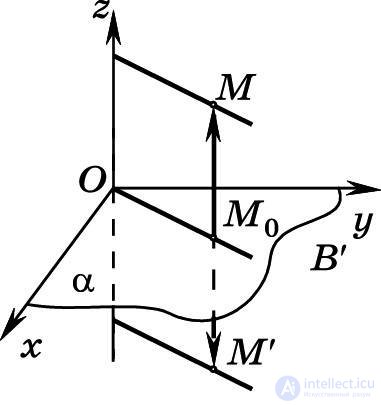
Fig. 21
Let us choose a rectangular coordinate system Oxyz so that its coordinate plane Oxy coincides with the plane of symmetry α. Consider in this coordinate system an arbitrary point M(x; y; z) and its image M′(x′; y′; z′) under the reflection in the plane Oxy (Fig. 21).
By the definition of a reflection in a plane we have MM′ ⟂ (Oxy), | M0M | = | M0M′ |, where M0 — is the point of intersection of the line MM′ with the plane Oxy. This means that the points M and M′ lie in different half-spaces relative to the plane Oxy, are equidistant from it, and the line MM′ is parallel to the coordinate axis Oz. Therefore the coordinates of these points are related by
x′ = x, y′ = y, z′ = –z,
which are called the transformation formulas of a reflection in the plane Oxy.
Using the coordinate formulas of the reflection, let us prove that a reflection in a plane is a motion of space.
Let A(x1; y1; z1), C(x2; y2; z2) — be given points, then A′(x1; y1; –z1), C′(x2; y2; –z2) — are their images under the reflection S(Oxy).
We find:
| AC | =  ;
;
| A′C′ | =  =
=
=  = | AC |,
i.e. the reflection under consideration is a motion, which is what was to be proved. ▼
Let us consider the question of fixed points, fixed lines, and fixed planes of a mirror reflection.
A fixed point of the reflection in the plane α is every point of the plane α; there are no other fixed points under this reflection.
The fixed lines of the reflection Sα in the plane α can be divided into two kinds:
—every line of the plane α; any point of such a line is a fixed point of the reflection Sα, and the reflection Sα induces the identity transformation E on each of these lines;
—every line of space perpendicular to the plane α; on any such line a point reflection is induced with respect to the point of intersection of this line with the plane α.
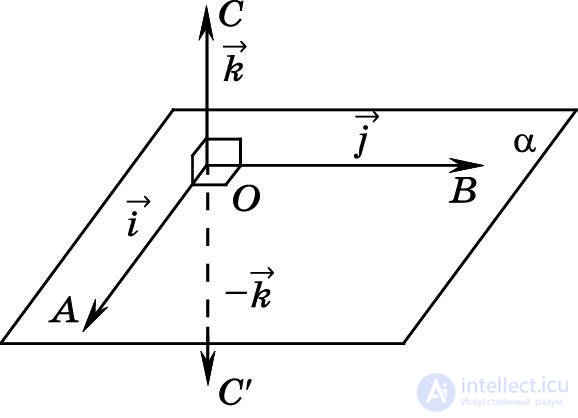
Fig. 22
The fixed planes of the reflection Sα can likewise be divided into two kinds:
—the plane α itself; each of its points is a fixed point of the reflection Sα, and the reflection Sα induces the identity transformation E on this plane;
—every plane perpendicular to the plane α; on any such plane there is induced the axial symmetry known to you from planimetry, about the line of intersection of this plane with the plane α.
To investigate whether a reflection in a plane changes the orientation of a tetrahedron, let us choose a triple of unit pairwise mutually perpendicular vectors  ,
,  and
and  , such that the points O, A and B lie in the plane α. Then under the reflection Sα the tetrahedron OABC maps onto a tetrahedron OABC′, such that ′ = – (Fig. 22). This means that the orientations of the tetrahedra OABC and OABC′ = Sα(OABC) differ, i.e. a reflection in a plane changes the orientation of a tetrahedron, and hence is a motion of the second kind.
It is interesting to note that if three planes α, β and γ are pairwise mutually perpendicular, then the composition of the reflections in these three planes is a point reflection about their common point (the point of intersection of the planes α, β and γ), i.e. Sγ ∘ Sβ ∘ Sα = ZO, where O — is the common point of these three planes. Try to prove this yourself by the coordinate method.
A plane of symmetry - is a hypothetical plane that divides an object into two equal and mirror-reflected parts. When an object is reflected with respect to this plane, it remains unchanged, or symmetric.
The plane of symmetry can be vertical, horizontal, or diagonal, depending on the orientation of the object. For example, for a rectangle the plane of symmetry can be horizontal, passing through its center, so that the upper half is a mirror image of the lower half.
Some objects can have several planes of symmetry. For example, an equilateral triangle has three planes of symmetry — each of the sides of the triangle is a plane of symmetry, dividing the triangle into two equal parts.
The plane of symmetry plays an important role in geometry, art, and other fields. It helps in creating balanced and harmonious compositions, and is also used in determining the properties of objects and figures.

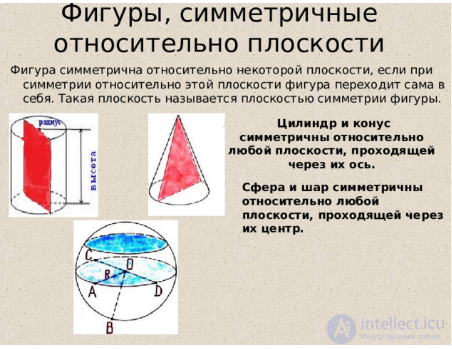
Figures symmetric with respect to a plane

Comments