The excess of a spherical triangle, or spherical excess, is a quantity in spherical trigonometry showing by how much the sum of the angles of a spherical triangle exceeds a straight angle.
Spherical triangle
Definition
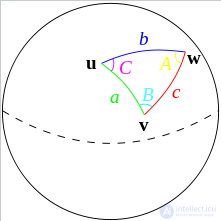
Let A, B, C denote the radian measures of the angles of a spherical triangle. Then the excess

Properties and computation
- Since in any spherical triangle, unlike a triangle in the plane, the sum of the angles is always greater than π, the excess is always positive. From above it is bounded by the number 2π, that is, it is always less than this number :15.
- To compute the excess of a spherical triangle with sides a, b, c, L'Huilier's formula is used :94:

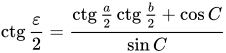
- To compute the excess of a spherical triangle from sides a, b and the angle C between them, the following formula is used :95:
Applications
- The excess of a spherical triangle is used in computing its area, since
 (here
(here  is the radius of the sphere on which the spherical triangle lies, and the excess is expressed in radians) :99.
- The solid angle of a trihedral angle is expressed, by L'Huilier's theorem, in terms of its plane angles
 at the vertex, as:
 , where
 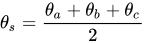 is the semiperimeter.
In terms of the dihedral angles  the solid angle is expressed as:

See also
- Aeronavigation
- Celestial navigation
- Ellipsoidal trigonometry
- Great-circle distance, or spherical distance
- Lenart sphere
- Schwarz triangle
- Spherical geometry
- Spherical polyhedron


Comments