
Lecture
Kepler—Poinsot solid — a solid representing a regular star polyhedron that is not a compound of Platonic and stellated solids.
If all the faces of an octahedron are extended until they intersect one another, the resulting figure is what Johannes Kepler called the "stella octangula" (extended octahedron). It is also found in nature: it is the so-called double crystal. We are forced to recognize the «stella octangula» as a regular polyhedron: after all, all its faces are regular triangles of the same size, and all the angles between them are equal!
In 1811 the French mathematician Augustin Cauchy established that there are only 4 regular star solids that are not compounds of Platonic and stellated solids. These include the small stellated dodecahedron and the great stellated dodecahedron, discovered in 1619 by Johannes Kepler, as well as the great dodecahedron and the great icosahedron, discovered in 1809 by Louis Poinsot. The remaining regular star polyhedra are either compounds of Platonic solids or compounds of Kepler—Poinsot solids
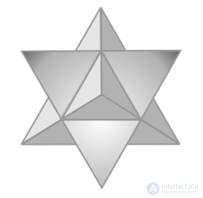
«stella octangula»
So is this the sixth Platonic solid?! No, since this polyhedron is not convex.
In addition to the «extended octahedron», four more polyhedra must be added, each of which will be «almost regular». All of them are obtained by «stellating» a Platonic solid, that is, by extending its faces until they intersect one another, and are therefore called stellated. The cube and the tetrahedron do not give rise to new figures — their faces, however far extended, never intersect.
The icosahedron and the dodecahedron give the world four «almost regular polyhedra» at once. One of them is the small stellated dodecahedron, first obtained by Johannes Kepler.
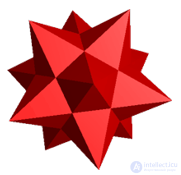
Small stellated dodecahedron
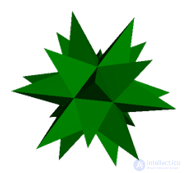
Great stellated dodecahedron
Kepler did not realize that the figure he had obtained had a twin. The polyhedron called the «great dodecahedron» was constructed by the French geometer Louis Poinsot two hundred years after Kepler's stellated figures.
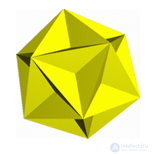
Stellated icosahedron
The great icosahedron was first described by Louis Poinsot in 1809. And again, having "seen" the great stellated dodecahedron, Kepler left the honor of discovering the second figure to Louis Poinsot.
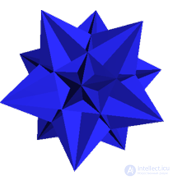
Great icosahedron
These figures "half" obey Euler's formula.
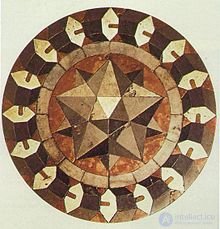
Mosaic in St Mark's Basilica in Venice, sometimes attributed to Paolo Uccello.
Some of the Kepler—Poinsot polyhedra were known in one form or another even before Kepler. Thus, an image of the small stellated dodecahedron is present in the marble mosaic decorating the floor of St Mark's Basilica in Venice. This mosaic dates to the 15th century, and its authorship is sometimes attributed to Paolo Uccello. In the 16th century, the German goldsmith Wenzel Jamnitzer, in his work Perspectiva corporum regularium (Perspectives of the regular solids), depicts the great dodecahedron and the great stellated dodecahedron. It appears that before Kepler none of the artists and scholars knew all the properties of these solids.
The small and great stellated dodecahedra, which are sometimes called «Kepler's polyhedra», were first fully described in Johannes Kepler's 1619 treatise Harmonices Mundi. Each of these solids has a central convex region on each face, «hidden» inside, so that only triangular planes are visible. Kepler describes the polyhedra using the same model that Plato uses in the dialogue Timaeus to describe the construction of the regular polyhedra from regular triangles. Kepler's final step was to recognize that these polyhedra are regular, even though they are not convex, unlike the ordinary Platonic solids.
In 1809, Louis Poinsot again investigated Kepler's polyhedra and discovered two more regular star polyhedra — the great icosahedron and the great dodecahedron. Poinsot, however, was not certain that he had identified all possible kinds of regular star polyhedra. But in 1811 Augustin Louis Cauchy proved that there are only 4 regular star solids that are not compounds of Platonic and star solids, and in 1858 Joseph Bertrand presented a more general proof. In 1859 Arthur Cayley gave Kepler's and Poinsot's polyhedra the names by which they are generally known today. A hundred years later John Conway developed a terminology for star polygons. Within this terminology he proposed slightly altered names for two of the regular star polyhedra.
| Cayley's terminology | Conway's terminology |
| Small stellated dodecahedron | Stellated dodecahedron |
| Great dodecahedron | Great dodecahedron |
| Great stellated dodecahedron | Stellated great dodecahedron |
| Great icosahedron | Great icosahedron |
Conway's terminology is used today, but has not become widespread.
These solids have faces in the shape of pentagons. The small and great stellated dodecahedra have faces in the shape of non-convex regular stars. The great dodecahedron and the great icosahedron have convex faces [10].
In all these solids, two planes can intersect, forming a line that is not an edge of either plane, and thus part of each face passes through the interior of the solid. Such lines of intersection are sometimes called false edges. Similarly, in the case where three such lines intersect at a point that does not belong to the angle of either plane, these points are called false vertices. For example, the small stellated dodecahedron has 12 pentagonal faces with a central pentagonal part hidden inside the solid. The visible parts of each face consist of five isosceles triangles that touch the face at five points. These triangles can be regarded as 60 separate planes forming a new, irregular polyhedron that outwardly looks identical to the original one. Each edge will now be split into three short edges (of two different kinds), and in doing so the 20 false vertices become true ones, so that the solid will have a total of 32 vertices (again of two kinds). The hidden interior pentagons will no longer be part of the polyhedral surface, and may disappear. Now the Euler characteristic contains: 60 — 90 + 32 = 2. But this new polyhedron is no longer described by the Schläfli symbol {5/2, 5} , and therefore is not a Kepler — Poinsot solid, although it still looks like one[10].
Kepler — Poinsot solids cover the area of their circumscribed spheres more than once, with the centers of the faces acting as points of inflection on surfaces that have pentagonal facets, and the vertices as points of inflection on other surfaces. Because of this, Kepler — Poinsot solids are not necessarily topologically equivalent to a sphere, unlike the Platonic solids, and, in particular, the Euler characteristic

does not always hold for them. Schläfli established that all polyhedra must have χ = 2, and concluded that the small stellated dodecahedron and the great dodecahedron are not regular polyhedra[11]. This view was not widely accepted.
A modified form of Euler's formula, derived by Arthur Cayley, valid both for convex polyhedra and for Kepler — Poinsot solids, looks like this:
 .
.
Kepler — Poinsot solids exist in dual pairs[12]:
The properties of the Kepler-Poinsot solids are presented in the following table:
| Name |
Small stellated dodecahedron |
Great dodecahedron |
Great stellated dodecahedron |
Great icosahedron |
| Image |  |
 |
 |
 |
| Spherical
projection
|
 |
 |
 |
 |
| Stellation diagram of the polyhedron |
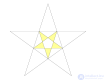 |
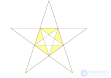 |
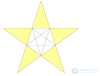 |
 |
| Schläfli symbol {p, q} |
{5/2,5} | {5,5/2} | {5/2,3} | {3,5/2} |
| Faces {p} |
12 {5/2}  |
12 {5}  |
12 {5/2}  |
20 {3}  |
| Edges | 30 | 30 | 30 | 30 |
| Vertices | 12 {5}  |
12 {5/2} |
20 {3}  |
12 {5/2} |
| χ
Euler characteristic
|
-6 | -6 | 2 | 2 |
| Density | 3 | 3 | 7 | 7 |
| Symmetry groups | Ih | Ih | Ih | Ih |
|
Dual polyhedron |
Great dodecahedron |
Small stellated dodecahedron |
Great icosahedron |
Great stellated dodecahedron |
| Have the same vertex arrangement: | Have the same vertices and edges: |
|---|---|
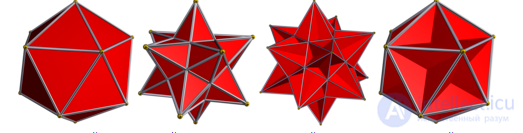 Icosahedron, small stellated dodecahedron, great icosahedron, and great dodecahedron. |
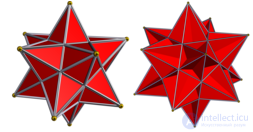 Small stellated dodecahedron and great icosahedron. |
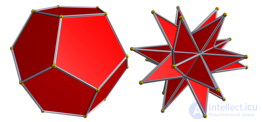 Dodecahedron and great stellated dodecahedron. |
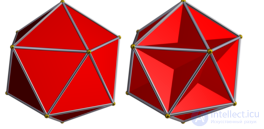 Icosahedron and great dodecahedron. |
The small stellated dodecahedron and the great icosahedron have the same vertices and edges. The icosahedron and the great dodecahedron also have the same vertices and edges.
All three dodecahedra are stellated regular convex dodecahedra, and the great icosahedron is a stellated regular convex icosahedron[14].
If new edges and vertices arise where the figures intersect, the resulting polyhedra will not be regular, but they can still be regarded as stellated.
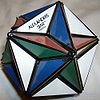
Alexander's Star
In the 20th century, Maurits Escher, a well-known representative of imp art, often turned in his work to subjects based on the perception of various multidimensional figures; in particular, his lithograph Gravitation (Eng.) depicts a small stellated dodecahedron.
The twisty puzzle of the 1980s — Alexander's Star — is based on the great dodecahedron.

Comments