
Lecture
The distance from a point on the sphere to its center is called the radius of the sphere. A sphere of radius 1 is called a unit sphere.
The sphere also has a volume and a surface area.
Perhaps, apart from the definition, the difference lies in the fact that in problems the volume of a sphere is never sought. As a rule, it is the volume of a ball that is sought. This does not mean that a sphere has no volume. It is a three-dimensional figure, so it does have a volume.
Another difference, which can be considered more or less significant: the cross-section of a sphere is a circle, which has no interior area but has a length. The cross-section of a ball is a disk, which has an area and has no circumference.
A ball is customarily called a solid bounded by a sphere, i.e. a ball and a sphere are different geometric solids. However, both words « shar» (ball) and « sfera» (sphere) come from one and the same Greek word « sphaira» - ball. In this case the word « shar» arose from the shift of the consonants sf to sh. In Book XI of the «Elements» Euclid defines a sphere as a figure described by a semicircle rotating about a fixed diameter. In antiquity the sphere was held in great esteem. Astronomical observations of the celestial vault invariably evoked the image of a sphere. The sphere has always been widely used in various fields of science and technology.
A sphere is a surface of revolution formed by rotating a semicircle about its diameter. The area of a sphere in angular measure, taking into account the non-constancy of arc size values, is 41252.96 square degrees.
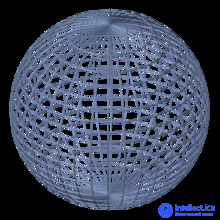
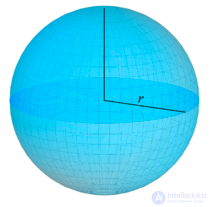 A sphere is the surface of a ball
A sphere is a special case of an ellipsoid in which all three axes (semi-axes, radii) are equal. A sphere is the surface of a ball. Of all surfaces bounding a given volume, a sphere has the smallest area, and likewise, of all surfaces with a given area, a sphere bounds the largest volume. This is why bodies of spherical shape occur in nature — for example, small drops of water in free fall take on a spherical shape precisely because surface tension minimizes the surface area.
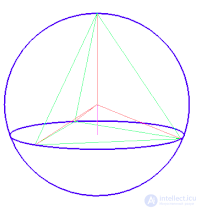
The volume of a cylinder, the volume of a ball inscribed in it and touching both of its bases, and the volume of a cone with its vertex at the center of one base of the cylinder and its base coinciding with the other base of the cylinder, are in the ratio 3 : 2 : 1 .
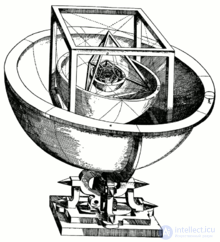
«Kepler's Cup»: a model of the Solar System made of the five regular polyhedra and their inscribed and circumscribed spheres.
The perfection of the spherical shape has long attracted the attention of thinkers and scholars, who used spheres to try to explain the harmony of the surrounding world. The ancient Greek scholar Pythagoras, along with a spherical Earth at the center of the Universe, introduced a distant crystal sphere surrounding the Earth, to which the stars were attached, and seven closer rotating crystal spheres, to which the Sun, the Moon and the five planets known at that time (excluding the Earth) were attached. This model was later made more complex: Eudoxus of Cnidus already considered 27 such spheres, and Aristotle — 55 crystal spheres . Ideas about rotating celestial spheres prevailed at least until the Middle Ages and even entered the heliocentric world system of Nicolaus Copernicus, who titled his main work «On the Revolutions of the Celestial Spheres» (Latin: De revolutionibus orbium coelestium).
Celestial spheres, since the time of Ancient Greece, were part of the more general concept of the harmony of the spheres concerning the musical-astronomical structure of the world, which also included the notion of the «music of the spheres». This concept also existed at least until the Middle Ages. For one of the most famous astronomers, Johannes Kepler, the sphere held a central place in his entire system of religious-mystical views; he wrote: «The image of the triune God is a spherical surface, namely: God the Father at the center, God the Son — on the surface, and the Holy Spirit — in symmetrical relation between the center and the spherical surface described around it» . One of Kepler's first significant works, «The Cosmographic Mystery» (Latin: Mysterium Cosmographicum), was devoted to the parameters of the celestial spheres; Kepler believed that he had discovered a remarkable connection between the regular polyhedra, of which there are only five, and the celestial spheres of the six planets known at that time (including the Earth), which were, according to Kepler, the circumscribed and inscribed spheres of these polyhedra. Ideas about the harmony of the spheres played a major role in Kepler's discovery of the third law of motion of celestial bodies (at any rate, they can be regarded as a stimulus for the search for astronomical relations) . However, for Kepler the celestial spheres were already purely mathematical objects, and not physically existing bodies. By that time Tycho Brahe had shown that the motion of comets, in particular the Great Comet of 1577, was incompatible with the existence of solid celestial spheres . As a convenient mathematical model, a single celestial sphere remained, by means of which astronomers to this day represent the apparent positions of stars and planets.
The equation of a sphere in a rectangular coordinate system:

where  — are the coordinates of the center of the sphere,
  — its radius.
The parametric equation of a sphere with center at the point :
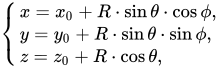
where  and
and 
The Gaussian curvature of a sphere is constant and equal to 1/R².
Through four points in space  there can pass a unique sphere with center



where:















Radius of the given sphere:

Surface area of a sphere

Volume of the ball bounded by the sphere

Area of a spherical segment of height 
 .
.
A circle lying on a sphere whose center coincides with the center of the sphere is called a great circle of the sphere. Great circles are the geodesic lines on the sphere; any two of them intersect at two points. In other words, the great circles of a sphere are analogues of straight lines on a plane, and the distance between points on the sphere is the length of the arc of the great circle passing through them. The angle between lines on a plane corresponds to the dihedral angle between the planes of the great circles. Many theorems of plane geometry also hold in spherical geometry; there are analogues of the law of sines and the law of cosines for spherical triangles. At the same time, there are quite a few differences: for example, in a spherical triangle the sum of the angles is always greater than 180 degrees, the three criteria for triangle congruence are joined by congruence by three angles, and a spherical triangle can have two or even three right angles — for example, the spherical triangle formed by the equator and the meridians 0° and 90°.
If the spherical coordinates of two points are given, the distance between them can be found as follows:

However, if the angle  is defined not between the Z axis and the vector to the point on the sphere, but between this vector and the XY plane (as is customary in terrestrial coordinates given by latitude and longitude), then the formula will be as follows:

In this case  and
and  are called latitudes, and
  and
and  are called longitudes.
In the general case, the equation of an (n−1)-dimensional sphere (in n-dimensional Euclidean space) has the form:
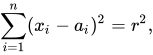
where  — the center of the sphere, and
  — the radius.
The intersection of two n-dimensional spheres is an (n−1)-dimensional sphere lying on the radical hyperplane of these spheres.
In n-dimensional space, no more than n+1 spheres can be pairwise tangent to each other (at different points).
n-dimensional inversion takes an (n−1)-dimensional sphere to an (n−1)-dimensional sphere or a hyperplane.
One of the millennium problems is connected with the three-dimensional sphere — the Poincaré conjecture, which states that every simply connected compact three-dimensional manifold without boundary is homeomorphic to such a sphere. This conjecture was proved by G. Ya. Perelman in the early 2000s based on the results of Richard Hamilton.
A plane having only one point in common with a sphere is called a tangent plane to the sphere, and their common point is called the point of tangency of the plane and the sphere.
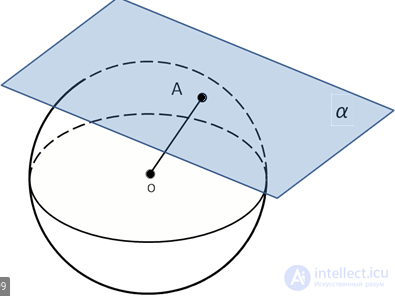
A sphere and a plane can:
1) intersect in a circle. This is the case when the distance from the center of the sphere to the plane is less than the radius of the sphere.
Then the section of the sphere by the plane is a circle;
2) not intersect. The case where the distance from the center of the sphere to the plane is greater than the radius of the sphere.
Then the sphere and the plane have no common points.
3) and have only one common point. The case where the distance from the center of the sphere to the plane is equal to the radius of the sphere.
Let us look in more detail at the last case, when the sphere and the plane have only one common point.
Definition:
A plane that has only one common point with a sphere is called a tangent plane to the sphere, and their common point is called the point of tangency of the plane and the sphere.

Comments