
Lecture
There is a family of solids related to the Platonic solids – these are the semiregular convex polyhedra, or Archimedean solids. In them, all polyhedral angles are equal, and all faces are regular polygons, but of several different types. There are 13 or 14 Archimedean solids (the number is inexact, since the pseudo-rhombicuboctahedron is sometimes not counted as part of this family): the truncated icosahedron, truncated tetrahedron, truncated cube, truncated octahedron, truncated dodecahedron, truncated cuboctahedron, truncated icosidodecahedron, rhombicuboctahedron, rhombicosidodecahedron, icosidodecahedron, cuboctahedron, snub cube, snub dodecahedron, and pseudo-rhombicuboctahedron.
The discovery of the thirteen semiregular convex polyhedra is attributed to Archimedes.
An Archimedean solid (or Archimedean polyhedron) — is a convex polyhedron that has, as its faces, two or more types of regular polygons meeting at identical vertices. Here "identical vertices" means that for any two vertices there is an isometry of the whole solid that carries one vertex into the other.
Archimedean solids differ from the Platonic solids (regular polyhedra), which consist of only one type of polygon at identical vertices, and from the Johnson solids, whose regular polygonal faces belong to different types of vertices.
Sometimes it is only required that the faces adjoining one vertex be isometric to the faces at another vertex. This difference in definitions determines whether the elongated square gyrobicupola (pseudo-rhombicuboctahedron) is considered an Archimedean solid or a Johnson solid — it is the only convex polyhedron in which the polygonal faces meet at a vertex in the same way at every vertex, but the polyhedron has no global symmetry that would carry any vertex into any other. Based on the existence of the pseudo-rhombicuboctahedron, Grünbaum proposed a terminological distinction in which an Archimedean solid is defined as having the same vertex figure at every vertex (including the elongated square gyrobicupola), while a uniform polyhedron is defined as a solid in which any vertex is symmetric to any other (which excludes the gyrobicupola).
Prisms and antiprisms, whose symmetry groups are dihedral groups, are usually not considered Archimedean solids, despite the fact that they fall under the definition given above. With this restriction, there is only a finite number of Archimedean solids. All solids except the elongated square gyrobicupola can be obtained by Wythoff constructions from the Platonic solids using tetrahedral, octahedral[en] and icosahedral symmetries.
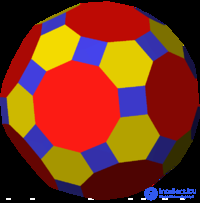
The truncated icosidodecahedron is the largest Archimedean solid by volume (for unit edge length), and also has more vertices and edges than any other.
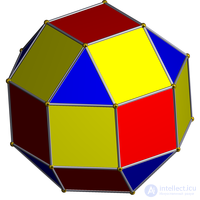
The pseudo-rhombicuboctahedron has a single vertex figure, 3.4.4.4, but with one square cupola rotated. Unlike the (unrotated) rhombicuboctahedron, the figure is not vertex-transitive.
The Archimedean solids are named after Archimedes, who discussed them in a now-lost work. Pappus refers to this work and states that Archimedes enumerated 13 polyhedra . During the Renaissance, artists and mathematicians valued pure forms and rediscovered them all. This research was almost entirely completed around 1620 by Johannes Kepler , who defined the notions of prisms, antiprisms, and nonconvex solids known as the Kepler — Poinsot solids.
Kepler may also have found the elongated square gyrobicupola (pseudorhombicuboctahedron) — at the very least, he claimed that there were 14 Archimedean solids. However, his published enumerations include only the 13 uniform polyhedra, and the first clear statement of the existence of the pseudorhombicuboctahedron was made in 1905 by Duncan Sommerville[en] .
There are 13 Archimedean solids (not counting the elongated square gyrocupola; 15 if the mirror reflections of the two enantiomorphs, which are listed separately below, are counted).
Here vertex configuration refers to the types of regular polygons that meet at a vertex. For example, the vertex configuration (4,6,8) means that a square, a hexagon, and an octagon meet at the vertex (the order of listing is taken clockwise around the vertex).
| Name (Alternative name) |
Schläfli Coxeter |
Transparent | Opaque | Net | Vertex figure |
Faces | Edges | Vertices | Volume (for unit edge) |
Point group |
|
|---|---|---|---|---|---|---|---|---|---|---|---|
| Truncated tetrahedron | {3,3}   |
 |
 |
 |
3.6.6 |
8 | 4 triangles 4 hexagons |
18 | 12 | 2.710576 | Td |
| Cuboctahedron (rhombitetrahedron) |
r{4,3} or rr{3,3} or or |
 |
 |
 |
3.4.3.4 |
14 | 8 Triangles 6 squares |
24 | 12 | 2.357023 | Oh |
| Truncated cube | t{4,3} |
 |
 |
 |
3.8.8 |
14 | 8 triangles 6 octagons |
36 | 24 | 13.599663 | Oh |
| Truncated octahedron (truncated tetratetrahedron) |
t{3,4} or tr{3,3} or |

|
 |
 |
4.6.6 |
14 | 6 squares 8 hexagons |
36 | 24 | 11.313709 | Oh |
| Rhombicuboctahedron (small rhombicuboctahedron) |
rr{4,3} |
 |
 |
 |
3.4.4.4 |
26 | 8 triangles 18 squares |
48 | 24 | 8.714045 | Oh |
| Truncated cuboctahedron (great rhombicuboctahedron) |
tr{4,3} |
 |
 |
 |
4.6.8 |
26 | 12 squares 8 hexagons 6 octagons |
72 | 48 | 41.798990 | Oh |
| Snub cube (snub cuboctahedron) |
sr{4,3} |
 |
 |
 |
3.3.3.3.4 |
38 | 32 triangles 6 squares |
60 | 24 | 7.889295 | O |
| Icosidodecahedron | r{5,3} |
 |
 |
 |
3.5.3.5 |
32 | 20 triangles 12 pentagons |
60 | 30 | 13.835526 | Ih |
| Truncated dodecahedron | t{5,3} |
 |
 |
 |
3.10.10 |
32 | 20 triangles 12 decagons |
90 | 60 | 85.039665 | Ih |
| Truncated icosahedron | t{3,5} |
 |
 |
 |
5.6.6 |
32 | 12 pentagons 20 hexagons |
90 | 60 | 55.287731 | Ih |
| Rhombicosidodecahedron (small rhombicosidodecahedron) |
rr{5,3} |
 |
 |
 |
3.4.5.4 |
62 | 20 triangles 30 squares 12 pentagons |
120 | 60 | 41.615324 | Ih |
| Truncated icosidodecahedron | tr{5,3} |
 |
 |
 |
4.6.10 |
62 | 30 squares 20 hexagons 12 decagons |
180 | 120 | 206.803399 | Ih |
| Snub dodecahedron (snub icosidodecahedron) |
sr{5,3} |
 |
 |
 |
3.3.3.3.5 |
92 | 80 triangles 12 pentagons |
150 | 60 | 37.616650 | I |
Some definitions of semiregular polyhedra include one more solid — the elongated square gyrocupola, or the «pseudorhombicuboctahedron» .
The number of vertices equals the ratio of 720° to the angular defect at the vertex.
The cuboctahedron and the icosidodecahedron are edge-transitive[en] and are called quasiregular.
The dual polyhedra of the Archimedean solids are called the Catalan solids. Together with the bipyramids and trapezohedra, they are face-transitive solids with regular vertices.
The snub cube and the snub dodecahedron are chiral, since they occur in left- and right-handed variants. If something has several forms that are three-dimensional mirror images of each other, these shapes are called enantiomorphs (this name is also used for certain forms of chemical compounds).
Detailed discussion of the topic: Uniform polyhedra and Conway polyhedron notation
Archimedean solids can be constructed by placing a generator point in a kaleidoscope
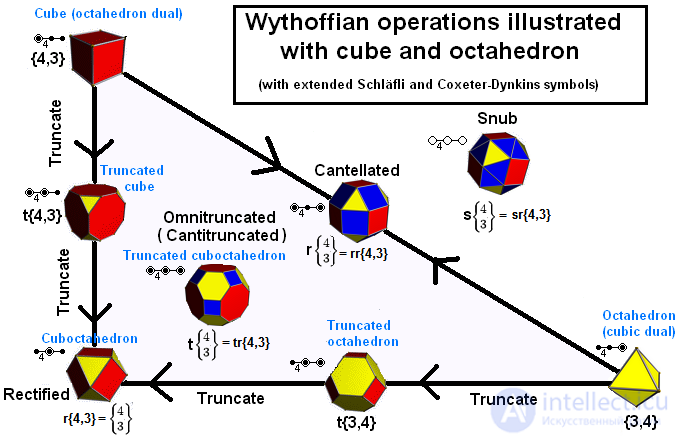
Various Archimedean and Platonic solids can be obtained from one another by means of a handful of operations. Starting from the Platonic solids, one can use the corner-truncation operation. To preserve symmetry, the truncation is made by a plane perpendicular to the line joining the corner to the center of the polygon. Depending on how deep the truncation is carried out (see the table below), various Platonic and Archimedean (and other) solids are obtained. Expansion or cantellation is carried out by moving the faces (in the direction) away from the center (by the same distance, to preserve symmetry) and then constructing the convex hull. Expansion with twisting is also carried out by rotating the faces; this breaks the rectangles that arise in place of the edges into triangles. The last construction we give here is the truncation of both corners and edges. If scaling is ignored, expansion can also be regarded as a truncation of corners and edges, but with a certain ratio between the corner and edge truncations.
| Symmetry | Tetrahedral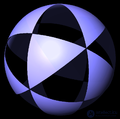 |
Octahedral[en]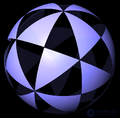 |
Icosahedral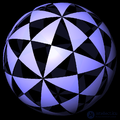 |
|||
|---|---|---|---|---|---|---|
| Initial solid Operation |
Symbol {p, q}   |
Tetrahedron {3,3}  |
Cube {4,3}  |
Octahedron {3,4}  |
Dodecahedron {5,3}  |
Icosahedron {3,5}  |
| Truncation (t) | t{p, q} |
Truncated tetrahedron |
Truncated cube |
Truncated octahedron |
Truncated dodecahedron |
Truncated icosahedron |
| Rectification (r) Ambo (a) |
r{p, q} |
Tetratetrahedron |
Cuboctahedron |
Icosidodecahedron |
||
| Deep truncation[en] (2t) (dk) |
2t{p, q} |
Truncated tetrahedron |
truncated octahedron |
truncated cube |
truncated icosahedron |
truncated dodecahedron |
| Double rectification (2r) Dual (d) |
2r{p, q} |
tetrahedron |
octahedron |
cube |
icosahedron |
dodecahedron |
| Cantellation (rr) Expansion (e) |
rr{p, q} |
Cuboctahedron |
Rhombicuboctahedron |
rhombicosidodecahedron |
||
| Snub rectification (sr) Rectification (s) |
sr{p, q} |
snub tetratetrahedron |
snub cube |
snub icosidodecahedron |
||
| omnitruncation[en] (tr) Cantitruncation (b) |
tr{p, q} |
Truncated octahedron |
Truncated cuboctahedron |
Rhombitruncated icosidodecahedron |
Note the duality between the cube and the octahedron, and between the dodecahedron and the icosahedron. Also, partly due to the self-duality of the tetrahedron, only one Archimedean solid has only tetrahedral symmetry.

Comments