
Lecture
Conic section, or conic , — the intersection of a plane with the surface of a circular cone. There are three main types of conic sections: ellipse, parabola, and hyperbola; in addition, there are degenerate sections: a point, a line, and a pair of lines. A circle can be regarded as a special case of an ellipse. In addition, a parabola can be regarded as a limiting case of an ellipse, one of whose foci is infinitely far away.
Conic sections can be obtained as the intersection of a plane with a double-napped cone
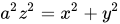 (in a Cartesian coordinate system)
Here

 — the angle between the generator of the cone and its axis.
If the plane passes through the origin, a degenerate section is obtained. In the non-degenerate case,
The equation of a circular cone is quadratic, hence all conic sections are quadrics, and also all planar quadrics are conic sections (although two parallel lines form a degenerate quadric that cannot be obtained as a section of a cone, but it can be obtained as a section of a cylinder — a degenerate cone, and is usually considered a «degenerate conic section»).
In mathematics, a conic section (or simply a conic) is a curve obtained as the intersection of a cone-shaped surface with a plane. There are three types of conic section: the hyperbola, the parabola, and the ellipse; the circle is a special case of the ellipse, although historically it was sometimes referred to as a fourth type. Ancient Greek mathematicians studied conic sections, culminating in the systematic work of Apollonius of Perga on their properties around 200 BC.
Conic sections in the Euclidean plane have various distinguishing properties, many of which can be used as alternative definitions. One such property defines a non-circular conic as the set of those points whose distance to a certain fixed point, called the focus, and to a certain fixed line, called the directrix, is in a fixed ratio, called the eccentricity. The type of conic is determined by the magnitude of the eccentricity. In analytic geometry, a conic can be defined as a plane algebraic curve of degree 2; that is, as a set of points whose coordinates satisfy a quadratic equation in two variables. This equation can be written in matrix form, and some geometric properties can be studied as algebraic conditions.
On the Euclidean plane the three types of conic sections look completely different, but they share many common properties. By extending the Euclidean plane to include the line at infinity, obtaining the projective plane, the visible difference disappears: the branches of the hyperbola meet at two points at infinity, forming a single closed curve; and the two ends of the parabola meet, forming a closed curve tangent to the line at infinity. Further extension, achieved by extending the real coordinates to complex coordinates, provides the means for an algebraic analysis of this unification.
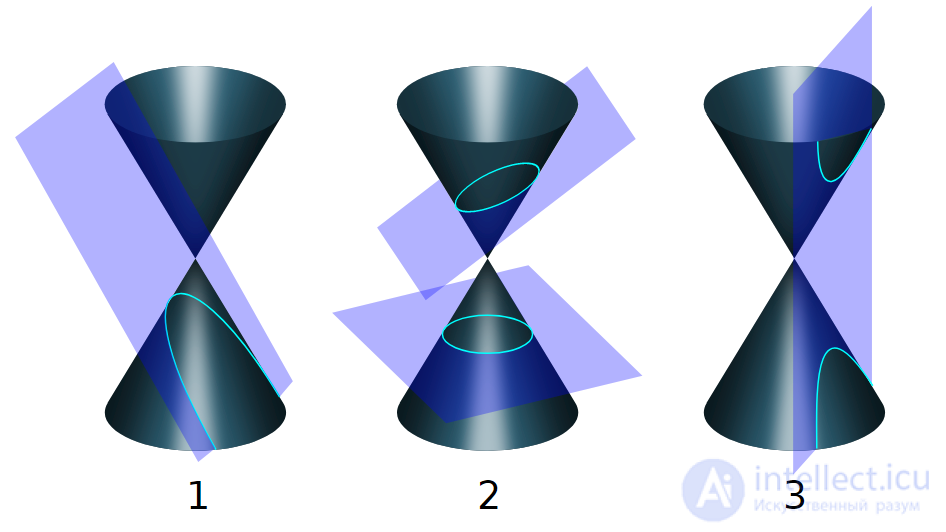
Types of conic sections:
1. Parabola
2. Circle and ellipse
3. Hyperbola.
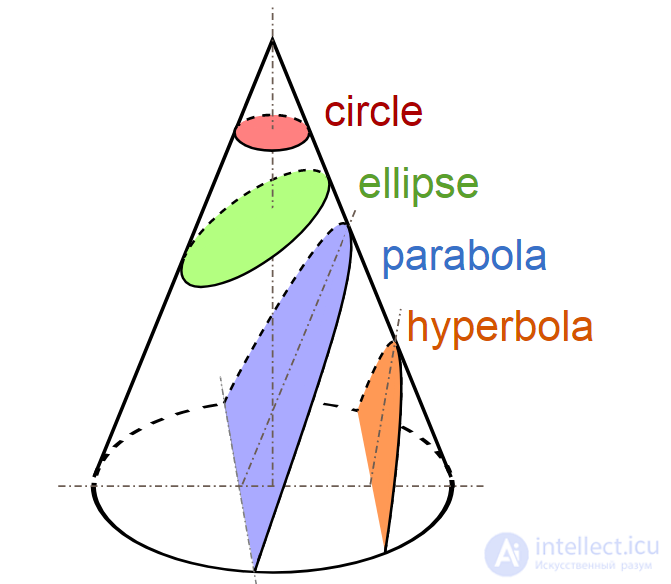
The black borders of the colored regions represent the conic sections. The other half of the hyperbola is not shown, since it lies on the other, unshown half of the double cone.
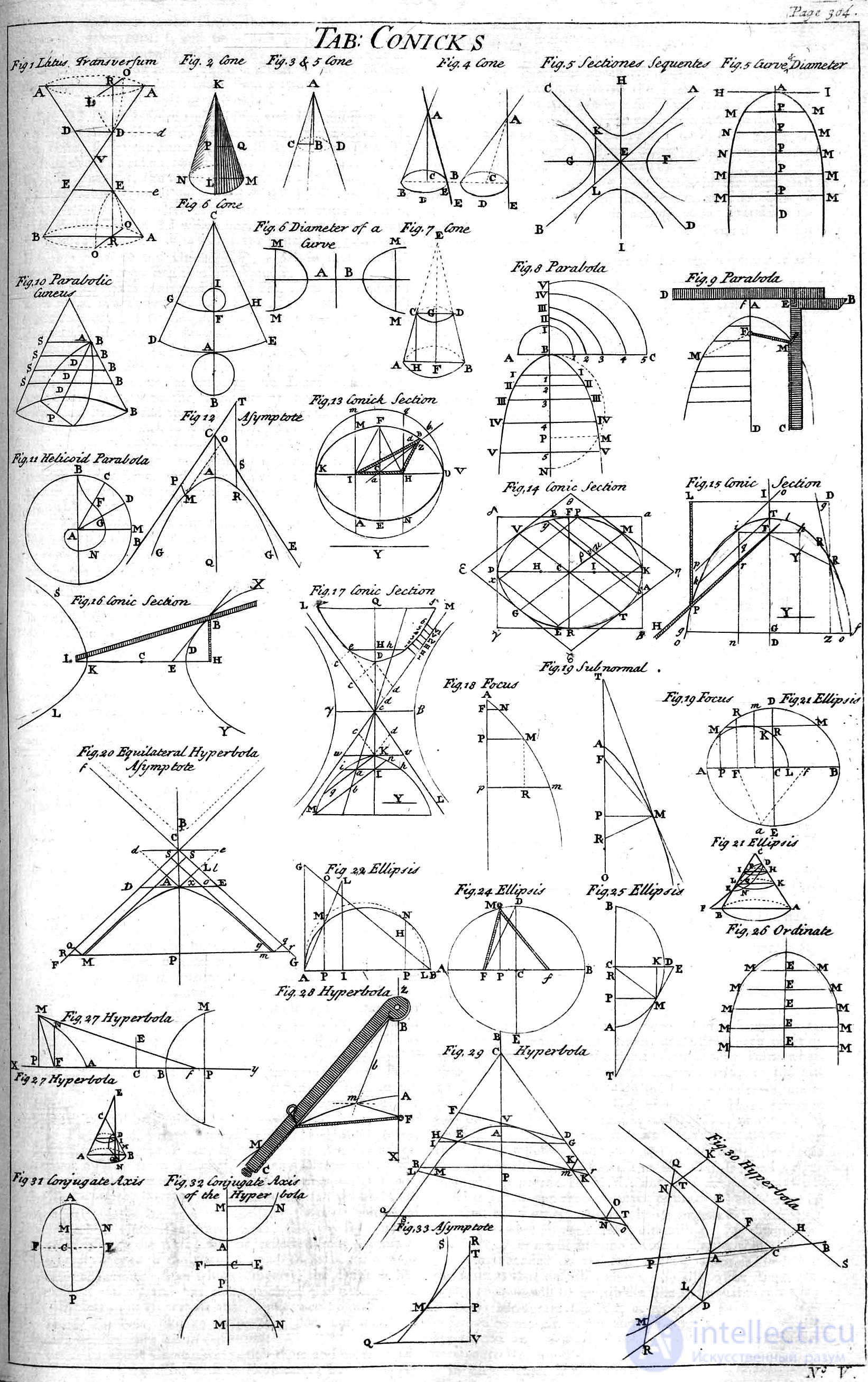 Table of Conics, 1728.
Conic sections were already known to the mathematicians of Ancient Greece.
The most complete work devoted to these curves was the «Conics» of Apollonius of Perga (around 200 BC). He was apparently the first to describe the foci of the ellipse and the hyperbola :41.
Pappus of Alexandria was the first to describe the focus of the parabola and derived the general equation for a conic section as the locus of points for which the ratio of the distances to the focal point and the directrix is constant
It is believed that the first definition of a conic section was given by Menaechmus (died 320 BC) as part of his solution to the Delian problem (Doubling the cube). [26] [27] His works have not survived; even the names he used for these curves are known only from secondary sources. [28] The definition used at that time differs from the one commonly used today. Cones were constructed by rotating a right triangle around one of its legs so that the hypotenuse formed the surface of the cone (such a line is called a generator). The three types of cones were defined by the angles at their apexes (measured as twice the angle formed by the hypotenuse and the leg, rotating around the right triangle). The conic section was then defined by intersecting one of these cones with a plane perpendicular to the generator. The type of conic is determined by the type of cone, that is, by the angle formed at the apex of the cone: if the angle is acute, the conic is an ellipse; if the angle is right, the conic is a parabola; and if the angle is obtuse, the conic is a hyperbola (but only one branch of the curve). [29]
Euclid (around 300 BC) is said to have written four books on conics, but they too were lost. [30] Archimedes (died around 212 BC) is known to have studied conics, determining the area bounded by a parabola and a chord in his Quadrature of the Parabola . His main interest lay in measuring the areas and volumes of figures related to conics, and part of this work survives in his book on solids of revolution of conics, «On Conoids and Spheroids» . [31]
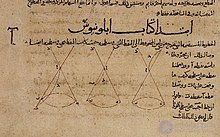
The greatest progress in the study of conics by the ancient Greeks was achieved by Apollonius of Perga (died around 190 BC), whose eight-volume « Conic Sections» or « Conics» summarized and significantly expanded the existing knowledge. [32] Apollonius's study of the properties of these curves made it possible to show that any plane intersecting a fixed double cone (two vertices), regardless of its angle, will produce a conic in accordance with the earlier definition, leading to the commonly used definition today. In this way circles can also be obtained, which cannot be constructed by the previous method. This may explain why Apollonius considered circles a fourth type of conic section, but this distinction is no longer made. Apollonius used the names ellipse, parabola, and hyperbola for these curves, borrowing the terminology from earlier works of Pythagoras on areas. [33]
Pappus of Alexandria (died c. 350 AD) is credited with clarifying the importance of the concept of the focus of a conic and with a detailed description of the corresponding concept of the directrix, including the case of the parabola (which is absent from the known works of Apollonius). [34]
A tool for drawing conic sections was first described in 1000 by the Islamic mathematician Al-Kuhi . [35] : 30 [36]
Apollonius's work was translated into Arabic, and much of it survives only in the Arabic version. The Persians found applications for the theory, most notably the Persian [37] mathematician and poet Omar Khayyam , who found a geometric method for solving cubic equations using conic sections. [38] [39]
Johannes Kepler extended the theory of conics with the help of « the principle of continuity », a precursor to the concept of limits. Kepler was the first to use the term « foci» in 1604 [40].
Girard Desargues and Blaise Pascal developed the theory of conics using an early form of projective geometry, and this helped give impetus to the study of this new field. In particular, Pascal discovered the theorem known as the hexagrammum mysticum, from which many other properties of conics can be derived.
René Descartes and Pierre Fermat applied their newly discovered analytic geometry to the study of conics. As a result, the geometric problems of conics were reduced to problems of algebra. However, it was John Wallis who, in his 1655 treatise Tractatus de sectionibus conicis, first defined conic sections as examples of second-degree equations. [41] Written earlier but published later, Jan de Witt«s Elementa Curvarum Linearum begins with Kepler's kinematic construction of conics, and then the construction of algebraic equations. This work, which uses Fermat's methodology and Descartes's notation, has been called the first textbook on the subject. [42] De Witt coined the term directrix . [42]
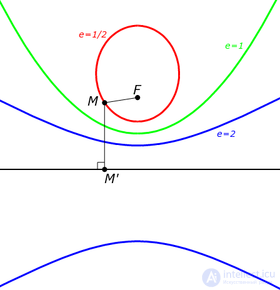
All non-degenerate conic sections, except the circle, can be described in the following way:
Let us choose a point  in the plane and a line
  and set a real number
  . Then the locus of points for which the distance to the point and to the line {\displaystyle d} differs by a factor of
  , is a conic section. The point is called the focus of the conic section, the line {\displaystyle d} the directrix, and the number the eccentricity.

Depending on the eccentricity, we get:
 — a hyperbola.
 — a parabola;
 — an ellipse;
For a circle we take  (although in fact for {\displaystyle e=0} the locus is only the point ).
The eccentricity is related to the parameters of the cone and the position of the cutting plane relative to the axis of the cone by the following relation :46,47:
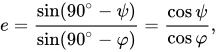
here {\displaystyle \psi } is the angle of inclination of the cutting plane to the axis of the cone, and
  is the angle between the generator and the axis of the cone, equal to half the apex angle of the cone. From this formula it is clear that, by intersecting a given cone with a plane, one can obtain an ellipse with any eccentricity, and a parabola, while a hyperbola can only be obtained with an eccentricity not exceeding
  . This maximum value is attained when the given cone is cut by a plane parallel to its axis.
Some important properties of conic sections are obtained by considering two spheres tangent to the conic section and to the cone — the Dandelin spheres. For example, they are used to establish the geometric meaning of the focus, directrix, and eccentricity of a conic section :46,47.
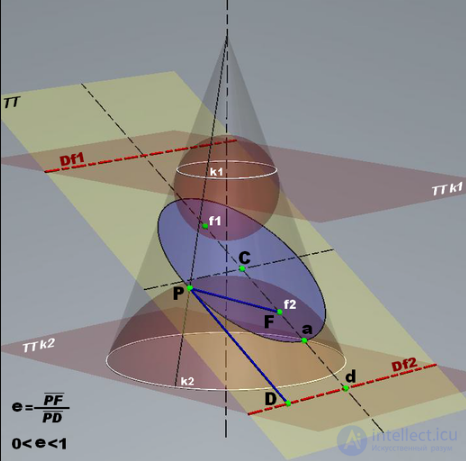
An ellipse (blue) as a conic section separating the Dandelin spheres; the directrices of the ellipse (Df1 and Df2), its foci (f1 and f2), and the eccentricity (e)
 — a point on the plane,
  — a conic with foci and
  ,
,  — the tangents
  , where the symbol
  denotes a directed, or oriented, angle. A special case of the isogonal property — when the point {\displaystyle P} lies on the conic and the two tangents "merge" into one — is the above-mentioned optical property. on it be given. Then all chords of the conic visible from the point at a right angle pass through one point. at an angle equal to
  or
or  are tangent to some conic. — an arbitrary point and
  — a projective transformation. Then the set of intersection points of
  and
and  , where — a line passing through , is a conic passing through the points and
  .
.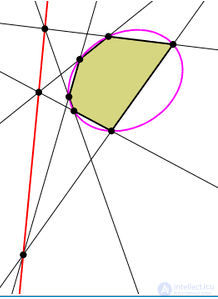 Pascal's theorem for an ellipse
Let us fix a circle {\displaystyle \omega } on the plane. To any point {\displaystyle P} of the plane we can assign its polar {\displaystyle p}
 with respect to {\displaystyle \omega } — and conversely, to any line we can assign its pole. The resulting transformation, which assigns lines to points and points to lines, is called a polar correspondence and is an involution; the images of points and lines under such a transformation are called dual images. A polar correspondence can be defined not only with respect to a circle, but also with respect to any conic — in which case it will represent the composition of a projective transformation taking this conic to a circle, the polar correspondence with respect to that circle, and the inverse projective transformation.
We call the dual image of a smooth curve the set of dual images of all tangents to that curve. Then it is true that the dual image of a conic is also a conic. Thus, some statements, for example, Pascal's and Brianchon's theorems, are polar duals of each other.
In Cartesian coordinates, conic sections are described by the general quadratic polynomial:

In other words, conic sections are curves of the second order. The sign of the discriminant

determines the type of the conic section.
In polar coordinates  , with the center at one of the foci and zero direction along the major axis, the conic section is represented by the equation

where e denotes the eccentricity, and l the focal parameter.
Conic sections have some very similar properties in the Euclidean plane, and the reasons for this become clearer when conics are considered from the point of view of a larger geometry. The Euclidean plane can be embedded in the real projective plane, and conics can be considered as objects in this projective geometry. One way to do this is to introduce homogeneous coordinates and define a conic as a set of points whose coordinates satisfy an irreducible quadratic equation in three variables (or, equivalently, the zeros of an irreducible quadratic form). More technically, the set of points that are zeros of a quadratic form (in any number of variables) is called a quadric, and irreducible quadrics in two-dimensional projective space (i.e., with three variables) are traditionally called conics.
The Euclidean plane R 2 is embedded in the real projective plane, adjoining the line at infinity (and its corresponding points at infinity), so that all lines of a parallel class meet on that line. Conversely, starting from the real projective plane, the Euclidean plane is obtained by singling out some line as the line at infinity and removing it and all its points.
In a projective space over any field, but in particular over the real or complex numbers, all nondegenerate conics are equivalent, so in projective geometry one simply speaks of «a conic», without specifying the type. That is, there exists a projective transformation that maps any nondegenerate conic onto any other nondegenerate conic. [44]
The three types of conic sections reappear in the affine plane obtained by choosing a line of the projective space as the line at infinity. These three types are then determined by how this line at infinity intersects the conic in the projective space. In the corresponding affine space one obtains an ellipse if the conic does not intersect the line at infinity, a parabola if the conic intersects the line at infinity at a single double point corresponding to the axis, and a hyperbola if the conic intersects the line at infinity at two points corresponding to the asymptotes. [45]
In homogeneous coordinates, a conic section can be represented as:

Or in matrix notation
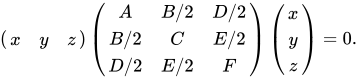
The 3 × 3 matrix above is called the matrix of the conic section .
Some authors prefer to write the general homogeneous equation as

(or a variant of it), so that the matrix of the conic section has a simpler form:
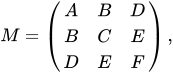
but this notation is not used in this article. [46]
If the determinant of the matrix of the conic section is zero, the conic section is degenerate .
Since multiplying all six coefficients by the same nonzero scalar gives an equation with the same set of zeros, one can regard the conics represented by ( A , B , C , D , E , F ), as points in a five-dimensional projective space. Space 
The metric concepts of Euclidean geometry (concepts related to measuring lengths and angles) cannot be immediately extended to the real projective plane. [47] They must be redefined (and generalized) in this new geometry. This can be done for arbitrary projective planes , but to obtain the real projective plane as an extended Euclidean plane, a certain choice must be made. [48]
Let us fix an arbitrary line in the projective plane, which we will call the absolute line . Choose two distinct points on the absolute line and call them the absolute points . With reference to these choices, several metric concepts can be defined. So , for example, given a line containing points A and B , the midpoint of the line segment AB is defined as the point C that is the harmonic conjugate of the intersection point of AB and the absolute line, with respect to A and B .
A conic in the projective plane containing two absolute points is called a circle . Since five points determine a conic, a circle (which may be degenerate) is determined by three points. To obtain the extended Euclidean plane, the line at infinity is chosen as the line infinitely far from the Euclidean plane, and the absolute points are two special points on this line, called the circular points at infinity . Lines containing two points with real coordinates do not pass through the circular points at infinity, so in the Euclidean plane a circle, according to this definition, is determined by three points that do not lie on the same line . [49] : 72
It has been mentioned that circles in the Euclidean plane cannot be defined by the focus-directrix property. However, if the line at infinity is regarded as the directrix, then, if the eccentricity is taken equal to e = 0, the circle will possess the focus-directrix property, but is still not defined by this property. [50] In this situation one must be careful to correctly use the definition of eccentricity as the ratio of the distance from a point on the circle to the focus (the length of the radius) to the distance from that point to the directrix (this distance being infinite), which gives a zero limiting value.
A synthetic (coordinate-free) approach to defining conic sections in the projective plane was given by Jakob Steiner in 1867.
 of lines at two points
  (all lines containing
  and
and  respectively) and a projective, but not perspective, mapping
 from
from  onto
onto  . Then the points of intersection of corresponding lines form a nondegenerate projective conic section. [51] [52] [53] [54]
Perspective mapping of the pencil onto the pencil is a one-to-one correspondence such that corresponding lines meet on a fixed line , which is called the axis of perspectivity.
Projective mapping is a finite sequence of perspective mappings.
Since a projective mapping in a projective plane over a field ( a Pappian plane ) is uniquely determined by specifying the images of three lines [55] to generate a Steiner conic section, besides the two pointsit is only necessary to specify the images of three lines. These 5 elements (2 points, 3 lines) uniquely determine the conic section.
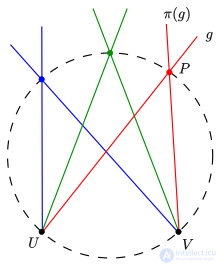
Steiner's generation definition of a conic section
According to the principle of duality in the projective plane, the dual of each point is a line, and the dual of a set of points (a set of points satisfying some condition) is called the envelope of lines. Using Steiner's definition of a conic (this set of points will now be called a point conic ) as the intersection of corresponding rays of two related pencils, is easy to dualize to obtain the corresponding envelope, consisting of the joins of corresponding points of two related ranges (points on a line) on different bases (lines on which the points lie). Such an envelope is called a line conic (or a dual conic ).
In the real projective plane a point conic has the property that every line meets it in two points (which may coincide or may be complex), and any set of points with this property is a point conic. Dually, it follows that a line conic has two lines passing through every point, and any envelope of lines with this property is a line conic. At every point of a point conic there is a unique tangent line, and, dually, on every line of a line conic there is a unique point, called the point of contact . An important theorem states that the tangent lines of a point conic form a line conic, and the points of contact of a line conic form a point conic. [56] : 48–49
Karl Georg Christian von Staudt defined a conic as the point set given by all the absolute points of a polarity that has absolute points. Von Staudt introduced this definition in Geometrie der Lage (1847) as part of his attempt to remove all metrical concepts from projective geometry.
A polarity , π , of a projective plane, P , is an involutory (i.e., of order two) bijection between the points and lines of P , preserving the incidence relation . Thus, a polarity relates a point Q to a line q and, after Gergonne , q is called the polar of Q and Q the pole of q . [57] An absolute point ( line ) of a polarity is one that is incident with its polar (pole).[58]
Von Staudt's conic in the real projective plane is equivalent to Steiner's conic . [59]
It is impossible to construct a continuous arc of a conic using straightedge and compass. However, there exist several straightedge-and-compass constructions for any number of individual points on the arc.
One of them is based on the converse of Pascal's theorem, namely, if the points of intersection of opposite sides of a hexagon lie on one line, then the six vertices lie on a conic. In particular, from five points A , B , C , D , E and a line through E , say EG , one can construct a point F, which lies on this line and lies on the conic determined by these five points. Let AB intersect DE at L , BC intersect EG at M and let CD intersectLM atN. Then corresponds EG at the required pointF. [60] : 52–53 By varying the line throughE, one can construct as many additional points on the conic as desired.
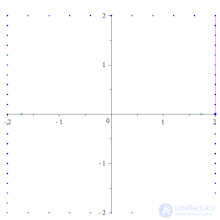
Another method, based on Steiner's construction and useful in engineering applications, is the parallelogram method , in which the conic is constructed point by point by connecting certain equally spaced points on horizontal and vertical lines. [61] In particular, to construct an ellipse using the equationx 2/a 2 + y 2/b 2= 1 , first construct rectangle ABCD with vertices A ( a , 0), B ( a , 2 b ), C (- a , 2 b ) and D (- a , 0) . Divide side BC into n equal segments and use parallel projection with respect to diagonal AC , to form equal segments on side AB (the lengths of these segments will equalb/atimes the length of segments BC ). On side BC label the left endpoints of the segments A 1 through A n , starting at B and proceeding toward C . On side AB label the upper endpoints D 1 through D n , starting at A and proceeding toward B . The intersection points AA i ∩ DD i for 1 ≤ i ≤ n will be points of the ellipse between A andP (0, b ) . The labeling connects the pencil of lines through point A with the pencil of lines through point D projectively, but not perspectively. The required conic is obtained by this construction, since the three points A , D and P and the two tangents (vertical lines at points A and D) uniquely determine the conic. If a different diameter (and its conjugate diameter) is used instead of the major and minor axes of the ellipse, the construction uses a parallelogram that is not a rectangle, giving the method its name. The union of the pencils of lines can be extended to obtain other points on the ellipse. The constructions are analogous for hyperbolas [62] and parabolas [63] .
Another common method uses the property of polarity to construct the tangent envelope of the conic (the line conic). [64]
In the complex plane C 2 ellipses and hyperbolas are indistinguishable: a hyperbola can be regarded as an ellipse with an imaginary axis length. For example, the ellipse becomes a hyperbola under the substitution
  a geometrically complex rotation giving
  . Thus, there is a two-way classification: ellipse/hyperbola and parabola. The extension of the curves to the complex projective plane corresponds to intersecting the line at infinity at two distinct points (corresponding to the two asymptotes) or at one double point (corresponding to the axis of the parabola); thus a real hyperbola is a more convincing real picture for a complex ellipse/hyperbola, since it also has 2 (real) intersections with the line at infinity.
Further unification occurs in the complex projective plane CP 2 : non-degenerate conics cannot be distinguished from one another, since any one can be transformed into any other by a projective linear transformation.
It can be proved that in CP 2 two conic sections have four common points (counting multiplicity), so there are from 1 to 4 points of intersection . The following intersection cases are possible: four distinct points, two simple points and one double point, two double points, one simple point and one of multiplicity 3, one point of multiplicity 4. If any point of intersection has multiplicity> 1, the two curves are said to be tangent . If there is a point of intersection with multiplicity at least 3, the two curves are said to be osculating . If there is only one point of intersection, and its multiplicity is 4, the two curves are called superosculating .[65]
Furthermore, every straight line intersects every conic section twice. If the point of intersection is double, the line is a tangent . Every conic section that intersects the line at infinity has two points at infinity. If these points are real, the curve is a hyperbola ; if they are imaginary conjugates, it is an ellipse ; if there is only one double point, it is a parabola . If the points at infinity are the circular points (1, i , 0) and (1, - i , 0) , the conic section is a circle . If the coefficients of the conic section are real, the points at infinity are either real or complex conjugates .
What should be regarded as a degenerate case of a conic depends on the definition used and on the geometric parameters of the conic section. Some authors define a conic as a two-dimensional nondegenerate quadric. In this terminology there are no degenerate conics (only degenerate quadrics), but we will use the more traditional terminology and avoid this definition.
In the Euclidean plane, using the geometric definition, a degenerate case arises when the cutting plane passes through the apex of the cone. A degenerate conic is either: a point , when the plane meets the cone only at the apex; a straight line , when the plane is tangent to the cone (it contains exactly one generator of the cone); or a pair of intersecting lines (two generators of the cone). [66] They correspond to the limiting forms of an ellipse, a parabola, and a hyperbola, respectively.
If a conic in the Euclidean plane is defined by the zeros of a quadratic equation (that is, as a quadric), then the degenerate conics are: the empty set , a point, or a pair of lines, which may be parallel, intersect at a point, or coincide. The case of the empty set can correspond either to a pair of complex conjugate parallel lines, for example the equation or to an imaginary ellipse , for example with the equation
 An imaginary ellipse does not satisfy the general definition of degeneracy and is therefore usually not considered degenerate. [67] The case of two lines arises when the quadratic expression factors into two linear factors, the zeros of each of which give a line. If the coefficients are the same, the corresponding lines coincide, and we call this line a double line (a line of multiplicity 2), and this is the previous case of a tangent cutting plane.
In the real projective plane, since parallel lines intersect at a point at infinity, the case of a line parallel to the Euclidean plane can be regarded as intersecting lines. However, since the point of intersection is the vertex of the cone, the cone itself degenerates into a cylinder, that is, one with its vertex at infinity. The remaining sections in this case are called cylindrical sections . [68] Nondegenerate cylindrical sections are ellipses (or circles).
Viewed from the standpoint of the complex projective plane, the degenerate cases of a real quadric (i.e. the quadratic equation has real coefficients) can be regarded as a pair of lines, possibly coincident. The empty set can be the line at infinity, regarded as a double line, the (real) point is the intersection of two complex conjugate lines, and the other cases as mentioned earlier.
To distinguish degenerate cases from nondegenerate cases (including the empty set among the former), using matrix notation, let β be the determinant of the 3 × 3 matrix of the conic section, that is β = ( AC -B 2/4) F +BCD - CD 2 - AE 2/4; and let the discriminant α = B 2 - 4 AC . Then the conic section is nondegenerate if and only if β ≠ 0 . If β = 0, we have a point when α <0 , two parallel lines (possibly coincident) when α = 0 , or two intersecting lines when α > 0 . [69]
A (nondegenerate) conic is completely determined by five points in general position (no three collinear) in the plane, and the system of conics passing through a fixed set of four points (again in the plane, and no three collinear) is called a pencil of conics . [70] : 64 The four common points are called the base points of the pencil. Through any point, other than a base point, there passes a unique conic of the pencil. This notion generalizes the pencil of circles . [71] : 127
The solutions of a system of two second-degree equations in two variables can be regarded as the coordinates of the intersection points of two conic sections in general position. In particular, two conics may have zero, two, or four intersection points, possibly coincident. An efficient method for finding these solutions uses the homogeneous matrix representation of conic sections, that is, a symmetric 3x3 matrix that depends on six parameters.
The procedure for determining the intersection points consists of the following steps, where the conics are represented by matrices: [72]
 as well as
  consider the pencil of conics defined by their linear combination
 that correspond to a degenerate conic of the pencil. This can be done by imposing the condition that
 and solving for
  as well as
  . It turns out that these are the solutions of a cubic equation.
 , determine the two, possibly coincident, lines composing it.
Conics can be defined over other fields (that is, in other Pappian geometries ). However, some care must be taken when the field has characteristic 2, since some formulas cannot be used. For example, the matrix representations used above require division by 2.
A generalization of a non-degenerate conic on the projective plane is an oval . An oval is a set of points that has the following properties, which are also satisfied by conics: 1) any line intersects the oval in zero, one, or two points, 2) at any point of the oval there is a unique tangent line.
Generalizing the focal properties of conics to the case where there are more than two foci gives sets called generalized conics .
The classification into elliptic, parabolic, and hyperbolic is widespread in mathematics and often divides a field into clearly defined subfields. The classification mainly arises from the presence of a quadratic form (in two variables this corresponds to the associated discriminant ), but can also correspond to eccentricity.
Classification of quadratic forms:
Quadratic forms
Quadratic forms over the real numbers are classified by Sylvester's law of inertia , namely by their positive, zero, and negative indices: a quadratic form in n variables can be transformed into a diagonal form , as where the number of coefficients +1, k, is the positive index, the number of coefficients −1 ,, is the negative index, and the remaining variables represent the zero index m, so that
 In two variables, nonzero quadratic forms are classified as:
 - positive-definite (negative also included), corresponding to ellipses,
 - degenerate, corresponding to parabolas, and
 - indefinite, corresponding to hyperbolas.
In two variables, quadratic forms are classified by the discriminant, similarly to conics, but in higher dimensions a more useful classification is definite (all positive or all negative), degenerate (some zeros), or indefinite (a combination of positive and negative, but no zeros). This classification underlies many later ones.
Curvature
The Gaussian curvature of a surface describes the geometry of the infinitesimal, and at each point can be either positive - elliptic geometry , zero - Euclidean geometry (flat, parabola), or negative - hyperbolic geometries ; infinitesimally, to second order, the surface looks like the graph (or 0), or . Indeed, by the uniformization theorem, any surface can be considered globally (at every point) as positively curved, flat, or negatively curved. In higher dimensions, the Riemann curvature tensor is a more complex object, but manifolds with constant sectional curvature are interesting objects of study and have quite different properties, as discussed under sectional curvature .
Second-order PDEs
Second-order partial differential equations (PDEs) are classified at each point as elliptic, parabolic, or hyperbolic, respectively, since their second-order terms correspond to an elliptic, parabolic, or hyperbolic quadratic form. The behavior and theory of these different types of PDEs differ dramatically - a characteristic example is that the Poisson equation is elliptic, the heat equation is parabolic, and the wave equation is hyperbolic.
The classification by eccentricity includes:
Möbius transformations
Real Möbius transformations (elements of PSL 2 ( R ) or its 2-fold cover, SL 2 ( R ) ) are classified as elliptic, parabolic, or hyperbolic respectively, since their half-trace
 or
or  mirrors the classification by eccentricity.
Variance-to-mean ratio
The variance-to-mean ratio classifies several important families of discrete probability distributions : the constant distribution as circular (eccentricity 0), binomial distributions as elliptic, Poisson distributions as parabolic, and negative binomial distributions as hyperbolic. This is developed in the cumulants of some discrete probability distributions .
Conic sections are important in astronomy : the orbits of two massive objects that interact according to Newton's law of universal gravitation are conic sections, if their common center of mass is considered to be at rest. If they are bound together, they will both trace out ellipses; if they are moving apart, they will both follow parabolas or hyperbolas. See the two-body problem .
The reflective properties of conic sections are used in the construction of searchlights, radio telescopes, and some optical telescopes. [43] In searchlights, a parabolic mirror with a light bulb at the focus is used as the reflector; and a similar design is used for the parabolic microphone . The 4.2-metre Herschel optical telescope on La Palma, in the Canary Islands, uses a primary parabolic mirror to reflect light into a secondary hyperbolic mirror, which reflects it again to a focus behind the first mirror.
Within the framework of classical mechanics, the trajectory of a material point or a rigid, spherically symmetric body in the field of a force obeying the inverse-square law is one of the conic sections — a parabola, a hyperbola, an ellipse (in particular a circle), or a straight line. When such a force is a force of attraction, all of these trajectories are possible (depending on the initial conditions); if it is a repulsive force, only straight lines and hyperbolas are possible.
The trajectory of a body (or its center of mass, in the case of any non-point body) in the field of a uniform constant force is, within classical mechanics, an exact parabola.
This conclusion holds not only for a fixed (stationary) position of the center of force , but also for the interaction of two point or spherical bodies of comparable mass . The second statement is exact within classical mechanics (in practice, as exact as the interaction force satisfies the inverse-square law and no other forces are present). For more than two interacting bodies, all of this is, generally speaking, not true (that is, the orbits can be exact conic sections precisely only in rare special cases — for specially chosen initial conditions), but it can be a good approximation in the case of one massive central body and comparatively weakly interacting, much less massive other bodies, in particular for the Solar System as a whole, with the exception of small celestial bodies that sometimes approach the planets too closely.
Physically, the situation may relate both to the interaction of point-like (having a very small size compared to the distance to other bodies) or spherical bodies under the action of gravitational forces obeying the law of universal gravitation (this law is a fairly good approximate description of real gravitational interaction in most cases we encounter within the Solar System) and/or electrostatic forces obeying Coulomb's law .
In order for the trajectories of bodies to be conic sections , it is important that the conditions on the number and/or masses of the interacting bodies described above be satisfied, and also that ideally all other forces be absent (in practice they should be negligibly small, or sometimes well compensated), such as, for example, aerodynamic drag forces (for this, for example, a sufficiently rarefied medium, a vacuum, is needed), radiation losses (in the case of motion of electrically charged bodies these can be significant; within Newtonian gravity such losses are always zero, although in reality losses to gravitational-wave radiation can be noticeable in the interaction of close, massive, and fast-moving objects). Besides ordinary aerodynamic drag, forces such as the pressure force and the drag force caused by the solar wind can also be significant. When celestial bodies move, as a rule, these conditions are satisfied at least to some degree, so that a conic section is an acceptable, and often a very good, approximation of the real orbit (over some period of time).
In the Solar System the orbits of the planets are, to a fairly good approximation, ellipses (the deviation from exact ellipticity is greatest for Mercury), the trajectories of comets are ellipses, hyperbolas[10] the trajectories of comets are often «almost parabolic»[11] (see also Celestial mechanics). The trajectory of a cannonball's flight in the Earth's gravitational field, neglecting the effect of air, is an arc of an ellipse close to a parabola (since the ball's speed is much less than the first cosmic velocity).
In a small laboratory (compared to the radius of the Earth) the gravitational field can be considered uniform and constant. If the air is pumped out well enough in such a laboratory, the trajectory of a stone thrown in it will be practically an exact parabola (or a straight line)[12]. Under ordinary conditions (with air present) the trajectories of thrown bodies generally differ quite strongly from parabolas and straight lines (except for a strictly vertical throw), but at low speeds and short flight distances they can be fairly close to a parabola.
The ancient Greeks studied the ellipse, the hyperbola and the parabola, regarding them as conic sections. Apollonius (262 BC — 190 BC, born in Perga but working in Alexandria, a contemporary of Archimedes) wrote the work «Conics» in eight books, half of which have come down to us only in medieval Arabic translations.
Apollonius considered the foci of the ellipse and the hyperbola, although he had no special term for these points, and knew their properties, including the optical ones.
Diocles, a younger contemporary of Apollonius, in his treatise «On Burning Mirrors» gives the optical property of the parabola, apparently based on the results of scholars of Archimedes' circle. This treatise has also survived only thanks to Arabic translations, in which the paraboloid of revolution was called a «burning mirror», and the focus of the parabola — the «place of burning».
When Latin translations of Arabic mathematical texts were published, the «place of burning» could not help but turn into the Latin focus — «hearth, fire». As a term, «focus» was introduced by Johannes Kepler in his work «The Optical Part of Astronomy» («Astronomiae pars optica», 1604), and not only for the parabola, but also for the ellipse and the hyperbola.
The optical property of the parabola appears as an experimental fact if you make a parabolic billiard table.
In this model the curved cushion represents a parabola, and a focus is marked on the cloth — the point where the target ball must be placed. The main ball will roll down a movable ramp, which is always placed so that the direction of the rolling ball is parallel to the axis of the parabola (for example, the ramp can be slid along a straight wall of the billiard table that is perpendicular to the axis of the parabola). After rolling down the ramp and reflecting off the cushion, the ball will always end up hitting the ball placed at the focus of the parabola!
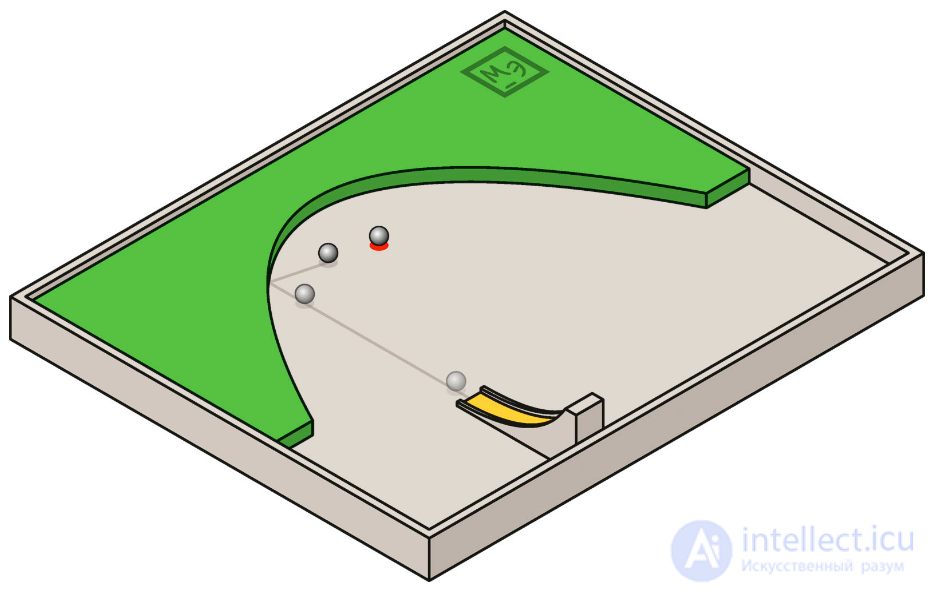
When making the model yourself, keep in mind that the cushion is an equidistant curve of the parabola — its shift at every point along the normal to the parabola by a distance equal to the radius of the ball (in an ideal geometric model it is the center of the ball, a point, that is reflected from the parabola). The radius of the ball should not be too small, so as to smooth out possible errors.
The quality of the finished model can be assessed by running an experiment with the target ball removed. A ball rolling down the ramp, after the first reflection from the cushion, should pass through the marked focus, and after the second — roll parallel to the axis of the parabola.
The geometric definition makes it possible to draw a parabola with a given focus and a given directrix.
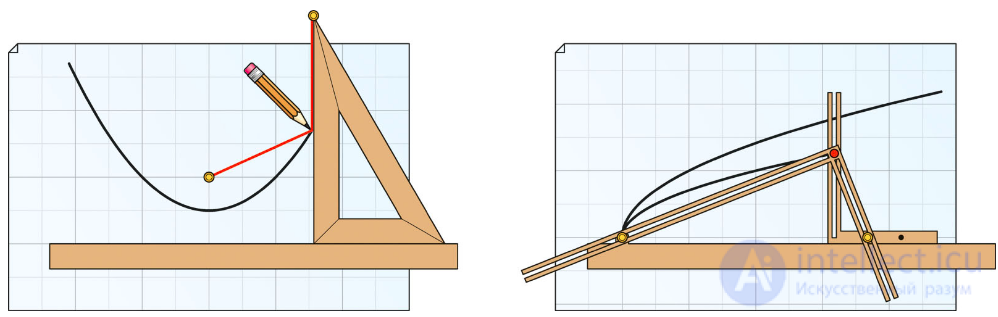
Lay a ruler along the directrix, and pin one end of a thread at the focus. The other end of the thread is fastened at the vertex of a set square, one leg of which is placed against the ruler. If you press the thread against the second leg with a pencil, keeping it taut while sliding the set square along the ruler, the line drawn will be a parabola.
Devices that draw parabolas are called parabolographs. An elegant design was invented in the 17th century by the Italian mathematician Bonaventura Cavalieri (known as a forerunner of the creators of integral calculus).
The device consists of three connected parts: a ruler fixed relative to the sheet (the horizontal) and two rigid right angles. For the first angle, the horizontal side slides along the ruler, while its vertical side has the vertex (with a stylus) of the second angle sliding along it. At the same time, at every moment the sides of the second angle pass through pins: one fixed on the stationary ruler, and the other — on the horizontal side of the moving angle.
The fact that the line drawn by the stylus will be a parabola follows from the well-known property of a right triangle: the square of the length of the altitude dropped to the hypotenuse equals the product of the lengths of the segments into which the altitude divides it. The parameter of the parabola is adjusted by moving the pin on the horizontal side of the first angle.
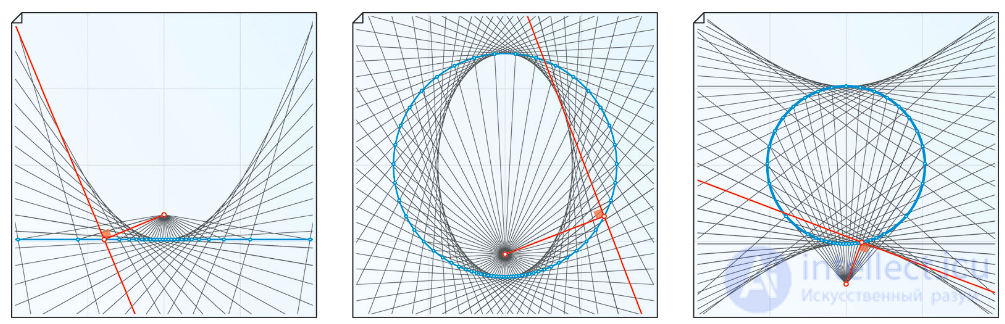
A parabola can be «made» by carrying out a series of experiments with a sheet of paper — as a result you get not a drawn but a «visible» line, touched by numerous straight lines.
On a sheet of paper draw a straight line and mark a point not lying on this line (the focus of the future parabola). Through a chosen point on the line, draw a perpendicular to the segment connecting that point with the marked one. The perpendicular does not even need to be drawn with a pencil — it can be judged by eye, and the sheet of paper folded along it. After repeating the procedure for several points on the line, you will see a parabola as the boundary of the region «surrounded» by the fold lines.
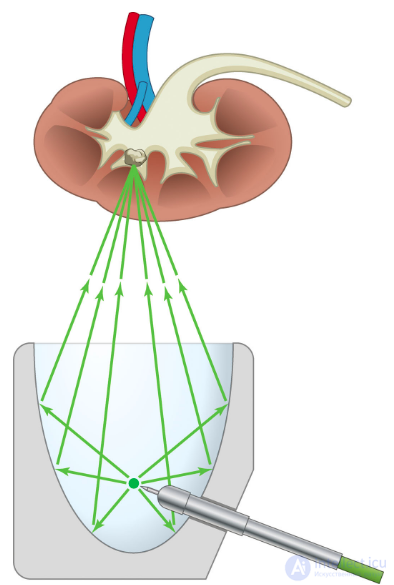
As the envelope of a family of lines (see Boltyansky V. G. «The Envelope») other conic sections can also be obtained, only instead of the initial line you need to take a circle. If the point (focus) is inside the circle, an ellipse is obtained (see «Kidney Stone Crushing»); if outside — a hyperbola (see «Shukhov Towers»).
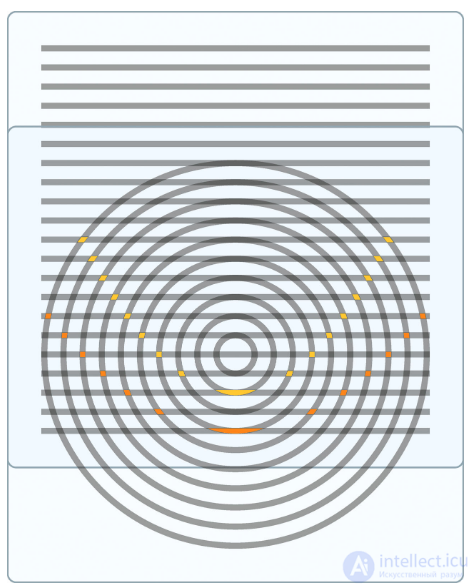
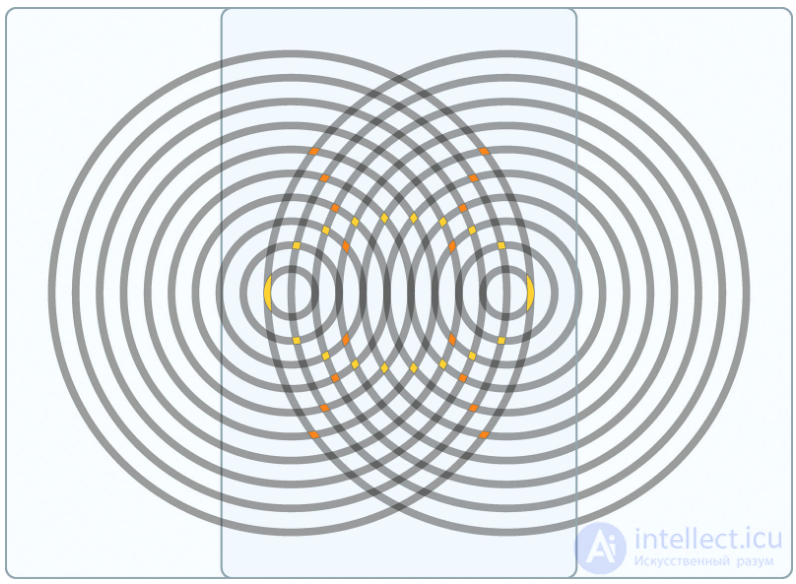
All conic sections (ellipse, parabola, hyperbola) can be obtained in the form of a moiré pattern — an additional geometric pattern formed by superimposing two images.
Take a transparency and print straight stripes on it with a fixed distance between neighboring ones. On another sheet, print circular stripes (concentric circles) of the same width and with the same distance between neighboring ones.
If you overlay these sheets on top of each other so that one of the straight lines passes through the center of the circles, you will see a family of parabolas. And if you overlay two identical «circular» transparencies so that the distance between the centers of the circles is a multiple of the distance between the circles, you can see ellipses and the hyperbolas that intersect them.
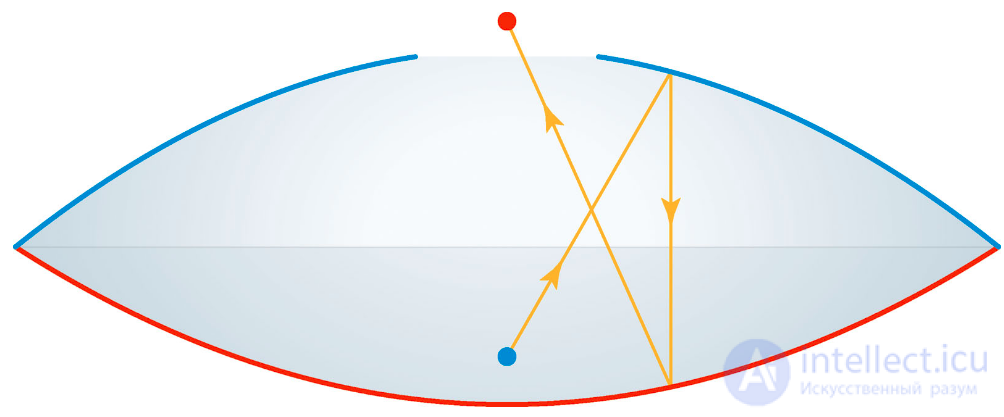
The reader may have come across an impressive toy: on the lid of a «flying saucer» you see an object, tangibly three-dimensional, you try to grab it, and… your fingers meet emptiness. This is an illusory object, and its «appearance» — is the result of an optical property of the parabola.
The toy consists of two coaxial paraboloids of revolution, whose bowls face each other, with the cap of the upper bowl cut off. On the lower bowl, at the focus of the upper paraboloid, is placed an object; after reflections off the mirrored walls of the paraboloids, an image is formed at the focus of the lower one.
Isaac Newton observed that when a cylindrical vessel is rotated, the surface of the liquid poured into it takes the shape of a paraboloid, and he explained this phenomenon using laws he himself had discovered.
Nowadays this effect is used in the manufacture of large parabolic mirrors for telescopes — this method is faster and cheaper than classical grinding. And sometimes «temporary» liquid-mirror telescopes are also created: a vessel of mercury is rotated only during the observations.
Such alpine and arctic flowers as the alpine pasqueflower, glacier beckwithia, and the Arctic poppy are «parabolic». Thanks to the optical property of the parabola, seed ripening is accelerated in such flowers. Another useful consequence of their parabolic shape for the flowers is the attraction of insects, which like to «bask» in the cup of the flower, and this affects pollination.
If on the parabola, on opposite sides of the axis, points and are taken, then the segment connecting them will intersect the axis at the point . This was first noted by August Möbius, whose name is borne by the famous one-sided strip.
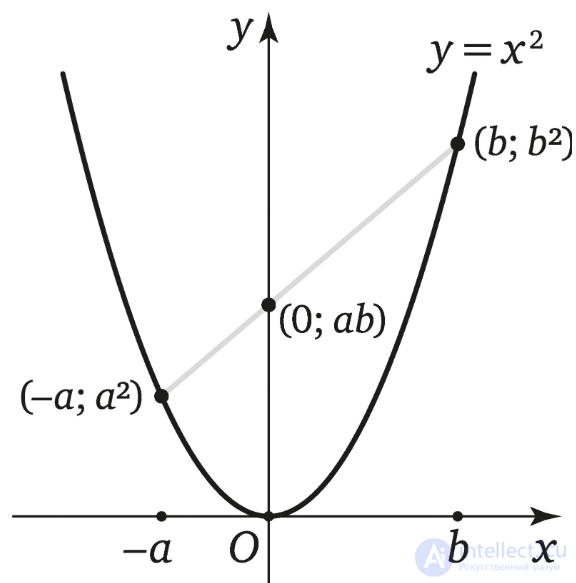
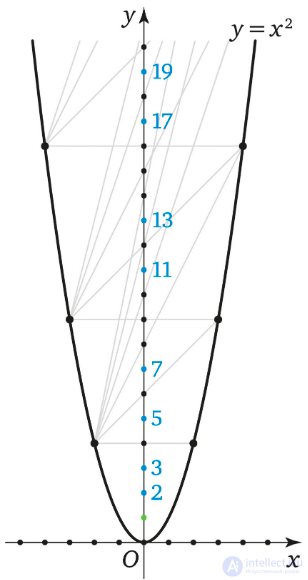
One can look at this fact from another angle: through the point , where — is a composite number, there passes a chord of the parabola of the described kind ( and — natural numbers other than 1). But through a point of the form , where — is a prime number, no such chord passes.
This observation can be turned into an algorithm for finding all prime numbers up to some : «the parabolic sieve», which sifts out all composite numbers.

Comments