
Lecture
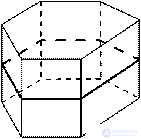
A plane of symmetry passing through the midpoints of the lateral edges.
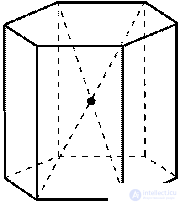
1. When the base has an even number of sides, the center of symmetry is the point of intersection of the diagonals of the regular prism
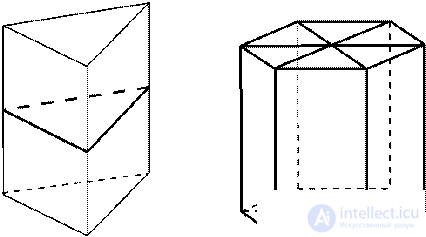
2. Planes of symmetry: the plane passing through the midpoints of the lateral edges; when the base has an even number of sides — the planes passing through opposite edges
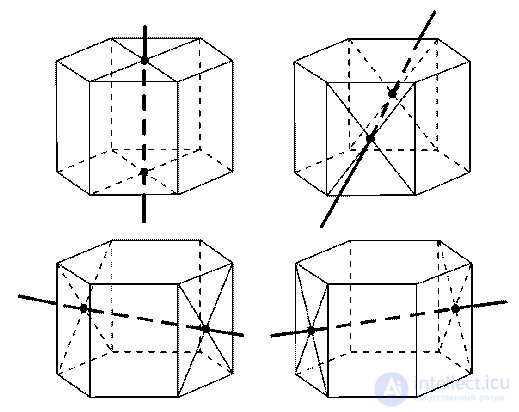
3. Axes of symmetry: when the base has an even number of sides — the axis of symmetry passing through the centers of the bases, and the axes of symmetry passing through the points of intersection of the diagonals of opposite lateral faces .
Recall that a right prism is called regular if its base is a regular polygon. The symmetry of regular prisms is determined by the symmetry of their bases (fig. 1), as well as by the perpendicularity of the lateral edges and faces to the bases.
A regular n-gonal prism has n planes of symmetry passing through the corresponding axes of symmetry of the prism's bases (fig. 2).
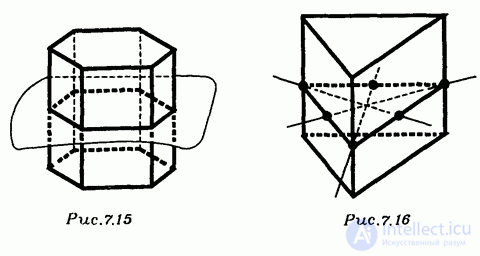
In addition, it has one more plane of symmetry, which passes through the midpoints of the lateral edges (fig. 7/15).
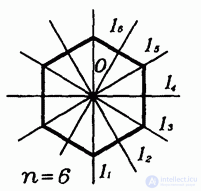
fig. 1
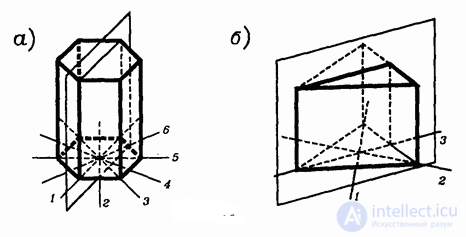
fig. 2
The axes of symmetry of a regular n -gonal prism are always the n axes of symmetry of the cross-section of this prism that passes through the midpoints of the lateral edges (fig. 7.16). If, moreover, n is even, then there is one more axis of symmetry — the line joining the centers of the bases (fig. 7.17). If n is odd, this is not the case, and there are no other n axes of symmetry.
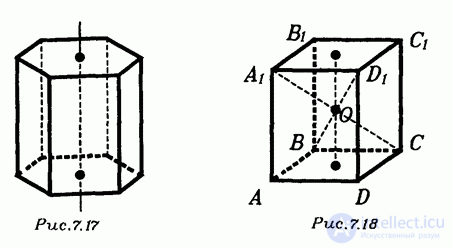
The segment joining the centers of the bases of a regular prism is called its axis (fig. 7.17).
If n is even, the midpoint of the axis of a regular n-gonal prism is the center of symmetry of this prism (fig. 7.18).
If n is odd, however, the regular prism has no center of symmetry (just as its base does not).
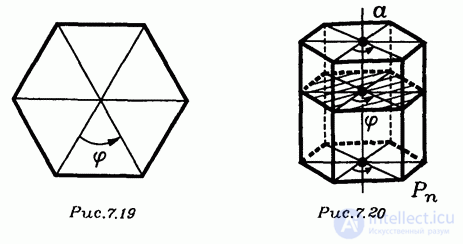
Thus, the symmetry of a regular n-gonal prism is determined by the symmetry of its base — a regular n-gon. But, as is known from planimetry, regular n-gons have one more type of symmetry — rotational symmetry, that is, they coincide with themselves when rotated about their center through an angle  (fig. 7.19), as well as through any angle that is a multiple of it. Similarly, regular n -gonal prisms coincide with themselves when rotated about their axis through the same angle
  (fig. 7.20).
In more detail, this means the following. Planes perpendicular to the axis of a regular n -gonal prism P are parallel to its base. Therefore all cross-sections of the prism P made by such planes are equal to its base and project onto it. The centers of these regular n -gons lie on the axis of the prism. Therefore, if these polygons are simultaneously rotated in their planes, in the same direction, through an angle  about their centers, then all of them will coincide with themselves. And so, under such a transformation, the prism P will also coincide with itself. Such a transformation of the prism is called a rotation about the line — the axis of the prism — through an angle
  Thus, among its symmetries, the prism also has rotational symmetry.
Let us also note that axial symmetry in space is a rotation by 180° about the axis of symmetry. Indeed, as a result of a rotation by 180° about
the line a, a point X not lying on the line a goes to such a point X`, that the line a is perpendicular to the segment XX` and intersects it at its midpoint.
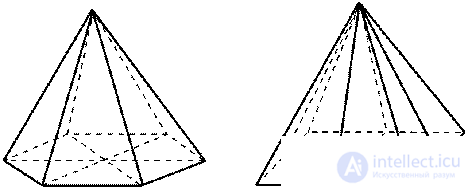
1. Planes of symmetry: for an even number of base sides — the planes passing through opposite lateral edges; and the planes passing through the medians drawn to the base of opposite lateral faces (Fig. 15).
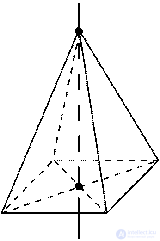
2. Axis of symmetry: for an even number of base sides — the axis of symmetry passing through the apex of the regular pyramid and the center of the base .

Comments