
Lecture
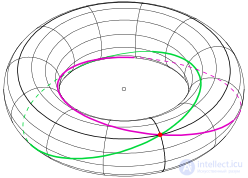
Villarceau circles are a pair of circles obtained by cutting a torus obliquely through its center at a certain angle. For an arbitrary point on the torus, four circles can be drawn through it. One lies in a plane parallel to the equatorial plane of the torus, and another is perpendicular to that plane (they are analogous to lines of latitude and longitude on Earth). The other two are the Villarceau circles. They are named after the French astronomer and mathematician Yvon Villarceau (1813–1883). Mannheim (1903) showed that the Villarceau circles intersect all parallel circular cross-sections of the torus at the same angle — a result that, as he said, Colonel Schölcher had presented to a congress in 1891.
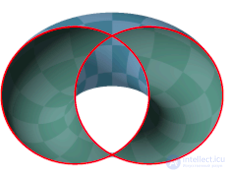
Villarceau circles as the intersection of a torus and a plane
For example, suppose that the major radius of the torus is 5 and the minor radius is 3. This means that the torus is the union of circles of radius three whose centers lie on a circle of radius five in the xy plane. Points on this torus satisfy this equation:

Slicing with the plane z = 0 gives two concentric circles, x 2 + y 2 = 2 2 and x 2 + y 2 = 8 2 . Slicing with the plane x = 0 gives two side-by-side circles: ( y - 5) 2 + z 2 = 3 2 and ( y + 5) 2 + z 2 = 3 2 .
Two examples of Villarceau circles can be obtained by slicing with the plane 3 x = 4 z . One is centered at (0, +3, 0), and the other at (0, -3, 0); both have radius five. They can be written in parametric form as

and also

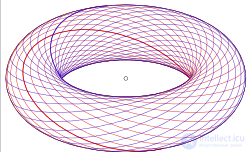
The cutting plane is chosen tangent to the torus at two points, passing through its center. This is the tangent at the points ( 16 ⁄ 5 , 0, 12 ⁄ 5 ) and at ( -16 ⁄ 5 , 0, -12 ⁄ 5 ). The cutting angle is uniquely determined by the dimensions of the chosen torus. Rotating any such plane about the z axis gives all the Villarceau circles for that torus.
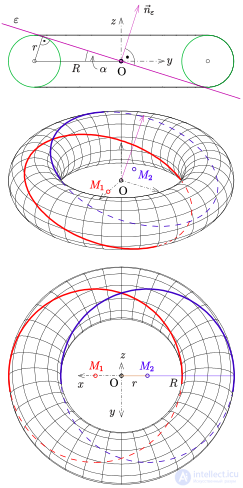
A proof of the existence of the circles can be built on the fact that the cutting plane is tangent to the torus at two points. One characteristic of a torus is that it is a surface of revolution . Without loss of generality , choose a coordinate system so that the axis of rotation is the z axis. Start with a circle of radius r in the xz plane centered at the point ( R , 0, 0).

Sweeping replaces x with ( x 2 + y 2 ) 1/2 , and clearing the square root gives a quartic equation .

The cross-section of the swept surface in the xz plane now includes a second circle.

This pair of circles has two common internal tangents, with a slope at the origin obtained from a right triangle with hypotenuse R and opposite side r (which has a right angle at the point of tangency). Thus, z / x equals ± r / ( R 2 - r 2 ) 1/2 , and choosing the plus sign gives the equation of the plane tangent to the torus.

By symmetry, rotating this plane about the z axis gives all the tangent planes through the center. (There are also horizontal planes tangent to the top and bottom of the torus, each of which gives a «double circle», but not Villarceau circles.)

We can compute the intersection of the plane(s) with the torus analytically and thereby show that the result is a symmetric pair of circles, one of which is a circle of radius R centered at

A similar treatment can be found in Coxeter (1969).
A more abstract — and more flexible — approach was described by Hirsch (2002) using algebraic geometry in a projective context. In the homogeneous quartic equation for the torus

setting w equal to zero gives the intersection with the «plane at infinity» and reduces the equation to

This intersection is a double point, and in fact the double point counts twice. Moreover, it lies on every tangent plane. The two points of tangency are also double points. Thus the curve of intersection, which by theory should be a quartic, contains four double points. But we also know that a quartic with more than three double points must factor (it cannot be irreducible), and by symmetry the factors must be two congruent conics. Hirsch extends this argument to any surface of revolution generated by a conic, and shows that the intersection with a plane tangent to the tube must yield two conics of the same type as the generator, when the curve of intersection is real.
The torus plays a central role in the Hopf fibration of the 3-sphere S 3 over the ordinary sphere S 2 , whose fibers are circles S 1 . When the three-dimensional sphere is mapped into three-dimensional Euclidean space by stereographic projection, the preimage of a circle of latitude on S 2 under the fiber map is a torus, and the fibers themselves are Villarceau circles. Banchoff (1990) studied such a torus using computer graphics images. One of the unusual facts about the circles is that each is linked through all the others, not only within its own torus but also collectively, filling all of space; Berger (1987) discusses and illustrates this.

Comments